
Pittsburgh, PA and Washington, DC
Energy and Natural Resources Alert
(by Sean McGovern and Jordan Brown)
The Pennsylvania Department of Environmental Protection has issued two new Standard Operating Procedures (SOPs) for civil penalty assessments related to unconventional and conventional oil and gas wells and a new SOP for identifying, tracking, and resolving oil and gas violations:
- Standard Operating Procedure for Calculating Civil Penalty Assessments for Conventional Oil and Gas Operations (February 2026)
- Standard Operating Procedure for Calculating Civil Penalty Assessments for Unconventional Oil and Gas Operations (February 2026)
- Standard Operating Procedure for Identifying, Tracking, and Resolving Oil and Gas Violations (February 2026)
These SOPs supersede the Civil Penalty Assessments in the Oil and Gas Management Program (Doc. ID No. 550-4180-001, issued January 12, 2002) and the Standards and Guidelines for Identifying, Tracking, and Resolving Oil and Gas Violations (Doc ID. No. 820-4000-001, issued January 17, 2015) Technical Guidance Documents (TGDs), respectively.
The Department’s transition from TGDs to SOPs represents a significant procedural shift. TGDs undergo public comment periods and structured review processes with opportunity for the regulated community to participate, whereas SOPs are internal agency documents that the Department can revise at its discretion without public input. This transition provides the Department with greater administrative flexibility but reduces opportunities for stakeholder engagement.
Conventional and Unconventional Civil Penalty SOPs
Changes common to both civil penalty SOPs (Conventional and Unconventional) include, but are not limited to the following:
-
- Statutorily Based Penalty Ranges
The SOPs now clarify the full civil penalty ranges authorized under the 2012 Oil and Gas Act. While these statutory maximums have existed since 2012, the new SOPs provide detailed guidance on how the Department will calculate penalties within these ranges. - Environmental Justice Areas
Both SOPs now explicitly incorporate environmental justice (EJ) considerations into penalty assessments. Penalties may be increased where violations impact or have the potential to negatively impact residents in Environmental Justice Areas. - Stronger Unilateral Enforcement Posture
While the 2002 TGD permitted the Department to deviate from guidelines in appropriate circumstances, the new SOPs contain more explicit and emphatic language stating that if an operator refuses to settle, the Department may impose a larger civil penalty in unilateral enforcement actions. This represents a more aggressive enforcement stance than previously articulated by the Department. - Expanded Water Supply Impact Categories
The “Impact of Violations” section in both SOPs now includes:-
- Both public and private water supplies (previously only public supplies were explicitly addressed in the prior technical guidance document);
- Broader range of impacts beyond combustible gas migration, including impacts to both public and private water supplies, as well as other types of contamination and supply loss scenarios affecting any source of water used for human consumption, agriculture, or industrial purposes;
- A Separate “Moderate” category with detailed criteria (previously combined “Moderate to Low”); and
- Updated terminology from “explosive nature of gas contamination” to “migration of combustible gas”.
-
- Statutorily Based Penalty Ranges
-
- Escalating Penalties for Continuing and Uncorrected Violations
The Department can elevate the willfulness category for violations that remain outstanding after receiving Notice(s) of Violation (uncorrected violations). Uncorrected violations are singular incidents that have not been remedied after the Department has issued notice to the operator, but do not involve ongoing discharges, damage, or conditions. In contrast, continuing violations involve ongoing discharges, damage, or conditions that persist over time and are observed continually, and such violations are subject to daily penalties for each day the violation continues. For example, a negligent violation may be reclassified as “reckless” after prior warning via NOV by the Department or “deliberate” when the operator has prior knowledge that the action or inaction constitutes a violation. - Enhanced Confidentiality Protections in Documentation
The “Documentation” section of the SOPs now explicitly states that some records and evidence collected during penalty assessments will be treated as confidential information. SOP civil penalty worksheets completed by the Department to support proposed civil penalty offered to operators in the context of settlement discussions. - Changes to Penalty Amounts
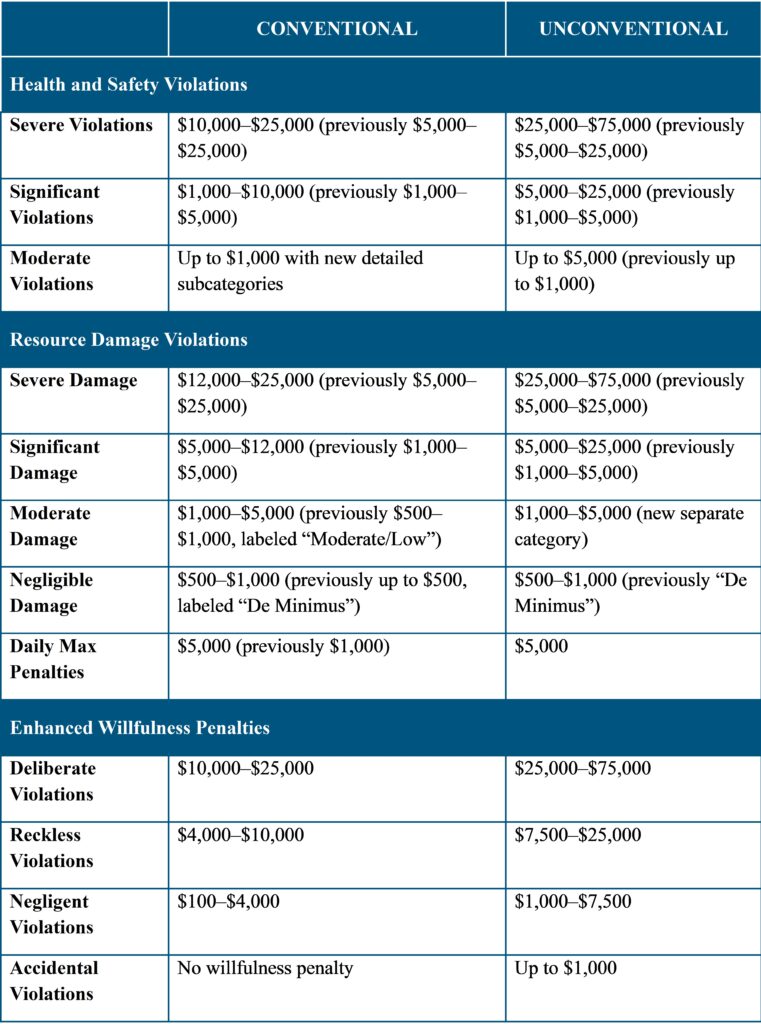
- Doubled Repeat Violator Enhancement for Unconventional Operators
A key difference between the conventional and unconventional civil penalty SOPs is the violator’s history multiplier applied when operators have a record of recent similar violations. For conventional operations, the maximum penalty enhancement remains at 10% of the penalty subtotal (unchanged from the 2002 TGD), while for unconventional operations, the maximum enhancement has doubled from 10% to 20% of the penalty subtotal.
- Escalating Penalties for Continuing and Uncorrected Violations
SOP for Identifying, Tracking, and Resolving Oil and Gas Violations
The SOP for Identifying, Tracking, and Resolving Oil and Gas Violations introduces several important procedural updates. Environmental justice considerations are now integrated into inspections, enforcement priorities, and penalty evaluations, with new enforcement priorities for violations impacting Environmental Justice Areas and the involvement of Regional EJ Coordinators. The Department’s inspection program has been updated to include a 15-year baseline inspection cycle for all operational wells, reduced inspection frequency for gas storage wells, enhanced plugging oversight, and new inspection types such as compliance schedule evaluations. Certain inspection types, such as road spreading inspections, have been eliminated. Permitting and reporting requirements have also changed, with the removal of some notification requirements and the addition of new ones, including notifications for horizontal directional drilling, modular storage structure installations, well communication incidents, and specific gas storage well activities. Water supply investigation procedures have been significantly updated, introducing new tracking and reporting systems, a streamlined notice process, and a two-tier notification approach based on the findings of the Water Quality Specialist.
These SOPs represent substantive changes from the prior TGDs and formalize the Department’s practices moving forward regarding oil and gas compliance and enforcement matters. All oil and gas operators should review their compliance programs in light of these enhanced penalty provisions and enforcement procedures, as these SOPs are immediately effective and are already being implemented by the Department.
If you have any questions about the applicability of the new civil penalty SOPs to your operations, please contact Sean M. McGovern at (412) 394-5439 or smcgovern@babstcalland.com or Jordan N. Brown at (202) 853-3459 or jbrown@babstcalland.com.