PIOGA Press
(by Sean McGovern and Jordan Brown)
The Pennsylvania Department of Environmental Protection has issued two new Standard Operating Procedures (SOPs) for civil penalty assessments related to unconventional and conventional oil and gas wells and a new SOP for identifying, tracking, and resolving oil and gas violations:
These SOPs supersede the Civil Penalty Assessments in the Oil and Gas Management Program (Doc. ID No. 550-4180-001, issued January 12, 2002) and the Standards and Guidelines for Identifying, Tracking, and Resolving Oil and Gas Violations (Doc ID. No. 820-4000-001, issued January 17, 2015) Technical Guidance Documents (TGDs), respectively.
The Department’s transition from TGDs to SOPs represents a significant procedural shift. TGDs undergo public comment periods and structured review processes with opportunity for the regulated community to participate, whereas SOPs are internal agency documents that the Department can revise at its discretion without public input. This transition provides the Department with greater administrative flexibility but reduces opportunities for stakeholder engagement.
Conventional and Unconventional Civil Penalty SOPs
Changes common to both civil penalty SOPs (Conventional and Unconventional) include, but are not limited to the following:
-
- Statutorily Based Penalty Ranges
The SOPs now clarify the full civil penalty ranges authorized under the 2012 Oil and Gas Act. While these statutory maximums have existed since 2012, the new SOPs provide detailed guidance on how the Department will calculate penalties within these ranges.
- Environmental Justice Areas
Both SOPs now explicitly incorporate environmental justice (EJ) considerations into penalty assessments. Penalties may be increased where violations impact or have the potential to negatively impact residents in Environmental Justice Areas.
- Stronger Unilateral Enforcement Posture
While the 2002 TGD permitted the Department to deviate from guidelines in appropriate circumstances, the new SOPs contain more explicit and emphatic language stating that if an operator refuses to settle, the Department may impose a larger civil penalty in unilateral enforcement actions. This represents a more aggressive enforcement stance than previously articulated by the Department.
- Expanded Water Supply Impact Categories
The “Impact of Violations” section in both SOPs now includes:
-
- Both public and private water supplies (previously only public supplies were explicitly addressed in the prior technical guidance document);
- Broader range of impacts beyond combustible gas migration, including impacts to both public and private water supplies, as well as other types of contamination and supply loss scenarios affecting any source of water used for human consumption, agriculture, or industrial purposes;
- A Separate “Moderate” category with detailed criteria (previously combined “Moderate to Low”); and
- Updated terminology from “explosive nature of gas contamination” to “migration of combustible gas”.
-
- Escalating Penalties for Continuing and Uncorrected Violations
The Department can elevate the willfulness category for violations that remain outstanding after receiving Notice(s) of Violation (uncorrected violations). Uncorrected violations are singular incidents that have not been remedied after the Department has issued notice to the operator, but do not involve ongoing discharges, damage, or conditions. In contrast, continuing violations involve ongoing discharges, damage, or conditions that persist over time and are observed continually, and such violations are subject to daily penalties for each day the violation continues. For example, a negligent violation may be reclassified as “reckless” after prior warning via NOV by the Department or “deliberate” when the operator has prior knowledge that the action or inaction constitutes a violation.
- Enhanced Confidentiality Protections in Documentation
The “Documentation” section of the SOPs now explicitly states that some records and evidence collected during penalty assessments will be treated as confidential information. SOP civil penalty worksheets completed by the Department to support proposed civil penalty offered to operators in the context of settlement discussions.
- Changes to Penalty Amounts
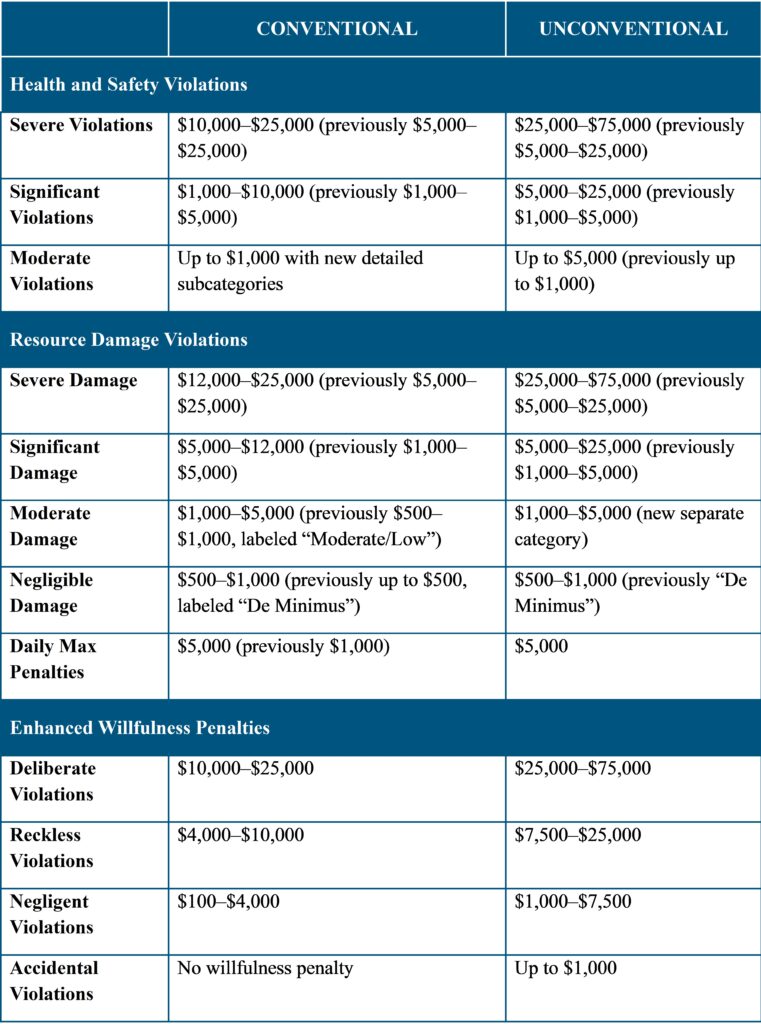
- Doubled Repeat Violator Enhancement for Unconventional Operators
A key difference between the conventional and unconventional civil penalty SOPs is the violator’s history multiplier applied when operators have a record of recent similar violations. For conventional operations, the maximum penalty enhancement remains at 10% of the penalty subtotal (unchanged from the 2002 TGD), while for unconventional operations, the maximum enhancement has doubled from 10% to 20% of the penalty subtotal.
SOP for Identifying, Tracking, and Resolving Oil and Gas Violations
The SOP for Identifying, Tracking, and Resolving Oil and Gas Violations introduces several important procedural updates. Environmental justice considerations are now integrated into inspections, enforcement priorities, and penalty evaluations, with new enforcement priorities for violations impacting Environmental Justice Areas and the involvement of Regional EJ Coordinators. The Department’s inspection program has been updated to include a 15-year baseline inspection cycle for all operational wells, reduced inspection frequency for gas storage wells, enhanced plugging oversight, and new inspection types such as compliance schedule evaluations. Certain inspection types, such as road spreading inspections, have been eliminated. Permitting and reporting requirements have also changed, with the removal of some notification requirements and the addition of new ones, including notifications for horizontal directional drilling, modular storage structure installations, well communication incidents, and specific gas storage well activities. Water supply investigation procedures have been significantly updated, introducing new tracking and reporting systems, a streamlined notice process, and a two-tier notification approach based on the findings of the Water Quality Specialist.
These SOPs represent substantive changes from the prior TGDs and formalize the Department’s practices moving forward regarding oil and gas compliance and enforcement matters. All oil and gas operators should review their compliance programs in light of these enhanced penalty provisions and enforcement procedures, as these SOPs are immediately effective and are already being implemented by the Department.
If you have any questions about the applicability of the new civil penalty SOPs to your operations, please contact Sean M. McGovern at (412) 394-5439 or smcgovern@babstcalland.com or Jordan N. Brown at (202) 853-3459 or jbrown@babstcalland.com.
To view the full article, click here.
Reprinted with permission from the May 2026 issue of The PIOGA Press. All rights reserved.
BTI Consulting Group’s Associate Satisfaction A‑Listers report recognizes law firms that outperform peers based on direct associate feedback across factors tied to retention, engagement and long‑term career satisfaction. This first and only report of its kind, BTI Associate Satisfaction A-Listers 2026: BTI Survey of Law Firms Where Associates are Happiest is based on a large-scale independent survey with more than 5,000 responses of associates at Am Law 200, global, mid-size, and smaller law firms. The report shows exactly what drives associate satisfaction – and which firms deliver on it best.
According to the report, the surveyed associates identified Babst Calland as an Associate Satisfaction Leader across the activities and factors that drive associate job satisfaction. Women associates ranked the Firm as Distinguished in those same areas, an important distinction, as BTI found that women associates report job satisfaction levels that are 17% lower than those of their male counterparts across the legal industry.
Recognized among only 189 law firms in the country, Babst Calland ranked in the two top levels, Associate Satisfaction Leader and Distinguished Law Firm, where associates reported the highest levels of career development support, mentoring, training, growth opportunities, and overall job satisfaction. Babst Calland also ranked among the top 138 firms with the most satisfaction among women associates.
Among the seven factors most valued by associates, these are the BTI Associate Satisfaction A-Listers 2026 survey categories in which Babst Calland was ranked:
Associate Satisfaction Leader
- top 5% of firms Best at Helping Women Associates in Their Careers
- top 6% of firms With Partners Invested in Individual Women Associates’ Success
- top 10% of firms Best at Helping Associates in their Careers
- top 12% of firms With Partners Invested in Individual Associates’ Success
Distinguished Law Firm
- top 14% of firms With Highest Number of Extremely Satisfied Women Associates
- top 15% of firms Best at Mentoring Women Associates
- top 15% of firms Best Opportunity for Women Associates to Grow Within Their Firm
- top 16% of firms Best at Access to Training for Women Associates
- top 20% of firms With Highest Number of Extremely Satisfied Associates
- top 22% of firms Best at Mentoring Associates
- top 22% of firms Best Opportunity to Grow Within Their Firm
- top 23% of firms Offering the Best Access to Training
“We’re extremely proud of our associates at Babst Calland and value their contributions,” said Managing Shareholder Donald C. Bluedorn II. “Ensuring a satisfying work environment is a priority for us, and our associates have been integral in achieving that. For example, through their involvement in our Associates Committee and our Women’s Initiative, our associates have provided invaluable insights in improving our ability to support them professionally and personally. I am so grateful for them and for our shareholders who make such an impact as mentors and are committed to ensuring our associates realize their full potential.”
For more information about the report, visit BTI Associate Satisfaction A-Listers 2026 – The BTI Consulting Group.
The Legal Intelligencer
(by Joseph Schaeffer)
Earlier this term, a unanimous Supreme Court held that Chevron could invoke federal officer removal under 28 U.S.C. § 1442(a)(1) to remove environmental litigation that certain Louisiana parishes had filed in Louisiana state court. Chevron USA Inc. v. Plaquemines Parish, No. 24-813, at 2 (U.S. Apr. 17, 2026). The decision is significant primarily because it expands the circumstances under which persons acting under federal officers can remove cases to federal court. But it is also notable for how it lays bare a clear distinction in how certain members of the Court approach the task of statutory interpretation.
Start with the merits. In 2013, Plaquemines Parish and other parishes filed 42 state-court suits against oil and gas companies for allegedly violating Louisiana’s State and Coastal Resources Management Act, La. Rev. Stat. Ann. § 49:214.21 et seq. Id. at 5. Enacted in 1978, the Act requires persons using Louisiana’s coastal zone to obtain a permit unless the use was lawfully commenced or established prior to the permitting program taking effect in 1980. Id. The parishes alleged that the oil and gas companies had failed to obtain required permits, including because certain pre-1980 uses had been illegally commenced and not eligible for the permitting exemption. Id. Among other things, the parishes argued that the oil and gas companies’ operations during the 1940s were conducted in “bad faith” and failed to protect the “marshland from contamination and excessive land losses” by using earthen pits instead of steel tanks; using vertical-drilling methods instead of allegedly less harmful alternatives; and primarily using canals instead of roads for transportation. Id.
Several defendants, including Chevron, invoked federal officer removal under 28 U.S.C. § 1442(a)(1) to remove cases against them to federal court. Id. at 5-6. They argued that their operations in Louisiana’s coastal zone during the 1940s supported the production of crude oil for refining into high-octane aviation gasoline under wartime contracts with the United States. Id. at 6. The Petroleum Administration for War (P.A.W.) oversaw the entire oil industry from 1941 to 1945 and, pursuant to a directive to increase avgas production, contracted with dozens of avgas refineries, including one of Chevron’s predecessors, to meet military requirements. Id. at 3-4. The P.A.W. knew that refineries needed crude oil to produce avgas and adjusted the price of avgas based on the cost of obtaining crude oil. Id. at 4. The P.A.W. also allocated crude oil to specific refineries to maximize output and required production methods, such as vertical drilling, that resulted in higher crude oil production. Id. at 4. Chevron accordingly contended that the parishes’ suits targeted acts related to its performance of federal duties.
Before 2011, the federal officer removal statute authorized removal of state-court suits against federal officers or their agents “for any act under color of such office.” 28 U.S.C. § 1442(a)(1) (2006 ed.). The Supreme Court had interpreted that language as requiring a causal nexus between the conduct at issue and the alleged federal authority. Id. at 8 n.3. In 2011, however, Congress amended the federal officer removal statute to allow removal of state-court suits against federal officers or their agents “for or relating to any act under color of such office.” 28 U.S.C. § 1442(a)(1) (emphasis added). The federal district court and Fifth Circuit nevertheless both rejected Chevron’s arguments for removal. The Fifth Circuit acknowledged that the parishes were targeting wartime crude oil production, but it held that the claims did not relate to the performance of the avgas refining contracts because those contracts did not specify how crude oil was to be acquired. Id. at 6.
The Supreme Court unanimously reversed. Writing for the Court, Justice Clarence Thomas looked to the ordinary meaning of the phrase “relating to” as encompassing even an indirect connection, albeit one that is more than “tenuous, remote, or peripheral.” Id. at 7-8. Justice Thomas considered the crude oil production challenged by the parishes to fit comfortably within the concept of a suit “relating to” Chevron’s performance of federal contracts for avgas refining. Id. at 9. Crude oil was an essential feedstock for avgas, and much of the crude oil that Chevron produced in the Louisiana coastal zone was used for avgas refining. Id. Moreover, the actions that the parishes alleged gave rise to liability were in service of wartime directives. Vertical-drilling methods maximized production, transportation by canal saved the time, materials, and manpower that would have been needed to build roads, and earthen pits satisfied P.A.W.’s directive to preserve steel. Id. at 9-10. Justice Thomas, contra to the Fifth Circuit, found it of no moment that the wartime contracts did not specify how Chevron was to obtain crude oil. He wrote that conduct can relate to federal duties even without the federal duties “specifically invit[ing]” that conduct. Id. at 10-11. He likewise rejected the Fifth Circuit’s conclusion that P.A.W.’s allocation of crude oil severed any relationship between production and refining, holding that acts can relate to their consequences despite the involvement of an intermediary in the chain of causation. Id. at 11.
Now to the doctrinal distinction. Justice Thomas took a clear textualist approach. He referenced the Court’s prior interpretation of the federal officer removal statute only in a footnote, implying that Congress’s subsequent amendment to the statute had made that interpretation irrelevant. Id. at 8 n.3. His analysis omits any discussion of Congressional intent and focuses solely on the ordinary meaning of the phrase “relating to” that Congress added to the federal officer removal statute in 2011.
Justice Ketanji Brown Jackson, by contrast, took an unapologetically holistic approach in concurrence. Starting from the premise that the Court should determine Congressional intent, she concluded that Congress did not intend for its 2011 amendment to change the causal-nexus requirement for federal officer removal. Id. at 2 (Jackson, J., concurring). Looking at legislative history, she determined that Congress was concerned with circumstances where federal officers were subjected to pre-suit discovery proceedings under state law. Id. at 3 (Jackson, J., concurring). The then-operative statutory language did not clearly allow removal in those circumstances because the pre-suit discovery proceedings were not targeting the federal officer “for” any act under color of office. Congress addressed that ambiguity in its 2011 amendments by providing that federal officers could remove “any proceeding” in which “a judicial order, including a subpoena for testimony or documents, is sought or issued.” The addition of the phrase “relating to” was simply a conforming amendment to make the rest of the statute consistent with the substantive changes. Id. at 4-5 (Jackson, J., concurring). In Justice Jackson’s view, this legislative history answered the interpretative question: rather than effecting a substantive change in the law, as Justice Thomas impliedly found, it was a minor change that left the causal-nexus requirement unaltered. Id. at 5 (Jackson, J., concurring).
Justice Jackson, of course, reached the same result as her colleagues: Chevron can remove the litigation to federal court. But she did so by applying the causal-nexus requirement, holding that the United States’ wartime demand for avgas was a but-for cause of Chevron’s production of crude oil from the Louisiana coastal zone. Id. at 6-7 (Jackson, J., concurring). Her different analytical approach thus had a material interpretive effect.
Lastly consider the significance. The Court’s decision opens more cases to removal under the federal officer statute by relaxing the causation requirement. At the same time, however, Justice Thomas notably identified climate litigation proceeding on false-advertising theories as lacking even the indirect connection permitted under the Court’s new test. Id. at 9. The true consequences of the Court’s decision will be determined in future proceedings in the lower court.
Joseph Schaeffer is a shareholder in the Litigation Group and Co-Chair of the Appellate Practice Group at Babst, Calland, Clements and Zomnir, P.C. He focuses his practice on environmental, energy, and complex commercial litigation. Joseph has an active appellate practice and has served as co-counsel or lead counsel in appellate matters before Pennsylvania and West Virginia State Courts, the United States Courts of Appeals for the Third and Fourth Circuit, and the Supreme Court of the United States. Contact him at 412-394-5499 or jschaeffer@babstcalland.com.
To view the full article, click here.
Reprinted with permission from the May 7, 2026 edition of The Legal Intelligencer© 2026 ALM Media Properties, LLC. All rights reserved.
The Legal Intelligencer
(by Steve Korbel, Anna Hosack and Alex Giorgetti)
The use of street opening ordinances to regulate and maintain public rights-of-way has increased in popularity over the past few years, with many of the local municipalities having adopted some form of a model ordinance. These ordinances commonly include references to fees for permitting and inspection, and in many cases provide for the use of a variable fee based on the linear footage of the proposed opening into the public right-of-way. The goal of this variable fee is to provide for flexibility, as a street opening can be minor, requiring very little review, or involve significant linear footage, requiring longer inspections and/or additional engineer review. The Commonwealth Court’s recent decision in Columbia Gas of Pennsylvania, Inc. v. Menallen Township, 351 A.3d 326 (Pa. Cmwlth. 2026), impacts the interpretation of those street opening ordinances and their variable fees when applied to public utilities, such as water, gas, and electric companies.
From 2016 to 2022, Columbia Gas of Pennsylvania, Inc. (“Columbia Gas”), a public utility regulated by the Pennsylvania Public Utility Code, 66 Pa.C.S. § 101 et seq., (“PUC”), performed three infrastructure expansion projects in Menallen Township (“Township”), including the installation of approximately 1,700 linear feet of pipe in public rights-of-way. Columbia Gas paid $14,259 in fees to the Township for that infrastructure work, and in order to begin construction on a new project within the Township in 2023, requiring the addition/replacement of approximately 7,000 linear feet of pipe, Columbia Gas paid, under protest, $42,542.08 in fees to the Township. The Township charged these fees via its street opening ordinance (“Ordinance”), which imposes fees on anyone seeking to excavate or open a public roadway. The ordinance included a flat application fee of $150 for all applications. It also imposed variable inspection fees calculated on a per hour and per square foot basis, intended to fund the Township’s inspection of the utility’s pipe installation work and its monitoring of road conditions following the restoration.
Columbia Gas filed a petition for review in the Commonwealth Court’s original jurisdiction challenging the Township’s Ordinance Sections 13-16 which limit the locations where excavation can occur, such as by limiting removal of trees or shrubs, prohibiting excavation of recent paving, and regulating the depth of facilities (“Location Provisions”), Section 20 which set the following fees: a permit fee of $150 (“Application Fee”); inspection and supervision fees of $18-25 per hour for the Township’s engineer to supervise the work, plus $3.67 per square foot of opening/excavation (“Inspection Fees”) and a bond amount of $25 per linear foot, and Section 21 which imposes a civil penalty of $600 per day on any entity that violates the provisions of the Township’s street opening ordinance (“Violation Provision”). Columbia Gas also challenged the Township’s fee resolution, which raised the per-hour Inspection Fee to a minimum of $75 per hour, arguing that the Inspection Fee is preempted under the field preemption doctrine established by the Pennsylvania Supreme Court in PPL Electric Utilities Corp. v. City of Lancaster, 214 A.3d 639 (Pa. 2019).
Before further analysis, the Commonwealth Court dismissed Columbia Gas’s challenges to the Location Provisions and the Violation Provisions as unripe for review since the Township had not enforced those provisions of the Ordinance against Columbia Gas.
Upon further analysis, the Commonwealth Court upheld the $150 flat Application Fee but found that the variable Inspection Fees crossed the line from permissible management of rights-of-way into impermissible regulation of utility facilities and operations. The court’s reasoning followed the analytical framework set out in Waterford Township v. PUC, 276 A.3d 301 (Pa. Cmwlth. 2022), which distinguished between two categories of municipal fees. On one side of the line are fees that regulate access to the right-of-way — permit fees, application fees, and similar charges that control when and how an applicant may open a street. Those remain permissible, even as applied to public utilities. The $150 flat Application Fee in this instance regulated access to public rights-of-way rather than regulating utility operations and did not infringe on preempted utility regulation.
However, fees that regulate the quality of the utility’s work — charges tied to the scope of inspection, the duration of monitoring, or the method of installation — fall within the PUC’s exclusive regulatory field and are preempted. The Commonwealth Court found that the Township’s per hour and per square foot Inspection Fees were designed to fund the Township’s own heightened inspection of the utility’s construction methods and to monitor the utility’s restoration work over time. That purpose, the Court concluded, placed the fees squarely within the preempted field. The Court noted that the dollar amount of the fees alone was not dispositive. The regulatory purpose the fees were designed to serve was the critical determination.
The key takeaways from the Commonwealth Court’s holding in Columbia Gas for municipalities are as follows:
-
- Flat permit or application fees remain on solid ground.
Municipalities own their roads and retain authority over their streets and rights-of-way. A municipality may charge a reasonable flat fee to process an application, issue a permit, and manage access to the right-of-way. The fee must relate to the administrative cost of regulating right-of-way access, not to the scope or duration of the utility’s construction activity. This distinction is necessary to avoid allegations of preempted regulations.
-
- Variable fees related to the size of the excavation, the number of inspection hours, or the length of a monitoring period are vulnerable to preemption challenge when applied to PUC regulated utilities.
A municipality that calculates its fee based on the square footage of the cut or the hours its inspector spends watching and monitoring the utility’s crew is, in the Commonwealth Court’s view, regulating the utility’s work — not managing access to the roadway. Such regulation impermissibly treads on the PUC’s preemptive regulation of public utilities.Despite this decision, municipalities still retain their authority as road owners. The right to define the condition in which a road must be returned after an opening — through restoration standards set as conditions of right-of-way access — is grounded in the municipality’s property interest in its own infrastructure, not in the regulation of utility operations. Assessing street opening fees in the wake of Columbia Gas requires careful structuring, but a municipality that works with its solicitor to think creatively about its ordinance and fee structure is not without recourse.
-
- Municipalities may still impose the full range of their existing fee structures on non-utility applicants — private contractors, developers, cable providers that are not certificated public utilities, and others.
The preemption doctrine applies only where the fee functions as a regulation of a PUC jurisdictional utility. The Commonwealth Court’s decision does not apply to non-utility applicants, as the Code and its preemption do not apply to them. A two-tiered fee structure that distinguishes between utility and non-utility applicants is one way to preserve existing revenue from non-utility work while complying with the court’s holding.
Municipalities that currently impose variable inspection or restoration monitoring fees on public utilities should review their street opening ordinances and fee resolutions promptly. In particular, a governing body should work with its solicitor to determine whether its fee structure, as applied to utilities, can withstand scrutiny under the Columbia Gas framework. Where variable fees are assessed against utilities, the municipality should consider whether an amendment to its fee resolution, its street opening ordinance, or both would better align with current law while still protecting the municipality’s infrastructure investment. A municipality that has already reviewed its ordinance and, if necessary, adopted a compliant approach, will be better positioned to respond to inquiries and challenges from a position of strength.
Stephen L. Korbel is a shareholder at the firm, focusing his practice primarily on municipal and employment and labor law. Contact him at 412-394-5627 skorbel@babstcalland.com.
Anna R. Hosack is an associate at the firm, focusing her practice primarily on real estate, municipal, and land use law. Contact her at 412-394-5406 or ahosack@babstcalland.com.
Alexander O. Giorgetti is an associate at the firm, focusing his practice primarily on municipal and land use law. Contact him at 412-773-8718 or agiorgetti@babstcalland.com.
To view the full article, click here.
Reprinted with permission from the April 23, 2026 edition of The Legal Intelligencer© 2026 ALM Media Properties, LLC. All rights reserved.
Pittsburgh Post-Gazette
(by Justine Kasznica)
For more than half a century, space exploration has been defined by brief human visits to space and to the moon. The NASA Apollo missions proved humanity could reach the Moon, while the International Space Station demonstrated that humans could live in space for extended periods. But these efforts, remarkable as they were, remained temporary by design.
A week before the launch of NASA’s Artemis II crewed lunar orbit mission, NASA unveiled plans to establish a permanent lunar base near the Moon’s south pole. The effort includes at least two crewed missions per year, a 30-lander robotic campaign, and major investments in habitats, mobility systems, and — most notably — an interoperable lunar power grid and communications network. NASA will invest $30 billion over the next decade.
NASA also announced Space Reactor-1 Freedom, a nuclear-powered interplanetary spacecraft targeting a Mars launch by 2028 and a new plan for the International Space Station that expands the current platform with government and commercial modules rather than retiring it. Funding will come from repurposed programs and more efficient use of existing resources.
While public attention for this new effort will naturally gravitate toward launch sites in places like Florida and mission control centers in Texas, the deeper economic opportunity lies in the industrial backbone needed to sustain this vision. In particular, Pittsburgh and the broader Keystone Region including Ohio and West Virginia.
Building in space
NASA is signaling something far more ambitious than exploration. It is laying the groundwork for permanence, building in space with commercial industry at the helm.
The agency is moving away from symbolic milestones toward sustained infrastructure, assembling the foundation for a permanent human presence beyond Earth. It is creating a space-based industrial economy, one that will depend on supply chains spanning manufacturing, energy, robotics, materials science, and logistics. NASA is becoming an anchor customer catalyzing entire industries.
This region brings a unique combination of strengths aligned with a lunar economy. Its legacy in energy, robotics, and advanced manufacturing positions it to produce critical components for space infrastructure. The same expertise that once powered America’s industrial rise can now be redirected toward building systems for the lunar surface.
Importantly, the region is not starting from scratch. Companies like Astrobotic Technology in Pittsburgh are already contributing to NASA’s lunar ambitions through landers, delivery systems, and lunar power technologies. Other Pennsylvania-based firms, including Westinghouse, Ansys, and Advanced Cooling Technologies, are leaders in space nuclear technologies, computing and simulation, and thermal technologies respectively.
Building here for space
This growing base of activity provides a nucleus for a broader network of manufacturers, robotics firms, materials companies across Pennsylvania, Ohio, and West Virginia.
The region is further strengthened by research institutions, space-oriented institutes and centers, and strong community colleges and technical schools. southwestern Pennsylvania’s leadership in robotics and AI — particularly in the Pittsburgh area — positions it to develop technologies for autonomous construction, maintenance, and operations on the Moon.
NASA assets such as the Glenn Research Center in Ohio and the Independent Verification and Validation Facility in West Virginia offer critical capabilities directly tied to propulsion, power, communications, materials development and mission assurance.
Energy is another of the region’s advantages. Decades of expertise in reactor and grid technologies translate directly to the challenge of powering off-world systems.
Finally, the region can play a catalytic role in NASA’s Ignition plans and implementation, by developing the innovations needed to sustain human health, enable closed-loop life support, and support long-duration survival in extreme extraterrestrial environments.
As NASA deepens its reliance on commercial partnerships, a wide network of companies will be needed to deliver the systems required for sustained lunar operations. The Keystone Region is well positioned to compete in the specialized manufacturing and engineering layers of this supply chain.
Building the 21st century
What is unfolding is not just another phase of space exploration. It is the early stage of a new industrial revolution.
The Keystone Region helped build the infrastructure that powered the 20th century. It will help build the infrastructure that could define the 21st and beyond.
But this opportunity will not materialize on its own. Capturing it will require state-level action and investment as well as coordinated action across states and sectors. Pennsylvania, Ohio, and West Virginia must position themselves as a unified industrial space corridor, aligning workforce development, strengthening university-industry partnerships, and engaging proactively with federal agencies.
The question is no longer whether humanity will establish a lasting presence in space. NASA’s plans make clear that it will. The question is which regions on Earth will help make it possible and who will benefit when they do.
Justine Kasznica is a shareholder and chair of the Emerging Technologies Group at the Pittsburgh law firm Babst Calland and is a co-founder and board chair of the Keystone Space Collaborative, a nonprofit organization supporting the Tri-State Region’s space industry.
To view the article, click here.
Copyright © 1997-2026 PG Publishing Co. All rights reserved
The Wildcatter
(by Nik Tysiak)
There have been interesting developments surrounding Renewable Energy Zoning, Estate Administration, Real Estate Tax Sales, and all also regarding the West Virginia Unknown Heirs Act.
Renewable Energy Development and Zoning
Renewable energy development faced significant zoning challenges during this period. The Pennsylvania Commonwealth Court’s decision in West Lampeter Solar 1, LLC v. West Lampeter Township Zoning Hearing Board, 2026 WL 110932, — A.3d —-(2026) established important precedent for solar development, holding that a proposed 25-acre agrivoltaics project combining solar energy production with sheep grazing was not agricultural use under zoning ordinances. The court determined that agriculture, as an undefined term given its plain and ordinary meaning, does not include solar energy production, even when combined with traditional agricultural activities like sheep grazing. This ruling significantly impacts solar developers seeking to utilize agricultural zoning classifications for renewable energy projects.
Ohio courts addressed wind energy development in One Energy Enterprises Inc. Board of Allen Township Trustees of Hancock County One Energy Enterprises Inc v. Board of Allen Township Trustees of Hancock County, 2026 WL 357969 (2026), involving disputes over wind turbine expansion and local zoning authority. The case arose when Allen Township, historically without zoning laws, began considering zoning regulations in response to proposed wind turbine expansion, demonstrating ongoing tension between renewable energy development and local control over land use.
Estate Administration and Real Property Transfers
Estate-related property disputes also appeared across multiple jurisdictions. Pennsylvania’s Superior Court in Imbrenda v. Imbrenda, 2026 WL 81887, — A.3d —- (2026) addressed a quiet title action involving allegations of forged deeds transferring property from family members to a deceased father. The case largely involved the acceptability of evidence from interested parties regarding the allegedly forged deed. The court examined the application of Pennsylvania’s Dead Man’s Act, a statute designed to facilitate testimony about pre-death transactions, pursuant to an allegedly forged 1978 deed. The Court ultimately held that a statutory exception to the Dead Man’s Act, for parties claiming property interests under the deceased, applied because the controversy involved ownership interests following the father’s death rather than estate claims, and found the testimony of such interested parties appropriate.
Ohio courts addressed estate administration complexities in Estate of Guito Alibrando v. Minor, 2026-Ohio-133, (5th Cir. 2026), involving disputes over real property sales by a holder of power of attorney and the distinction between probate and non-probate assets in joint survivorship accounts. The court clarified that funds in joint and survivorship accounts are non-probate assets that pass to the surviving joint owner outside of estate administration procedures.
In re Estate of Forte, 2026 WL 249802, — A.3d —- (2026), a case where Pennsylvania’s Superior Court addressed spousal election rights and property settlement agreements in contested estate proceedings. The Superior Court examined the Orphans’ Court’s mandatory jurisdiction over estate administration and distribution, noting the court’s authority over both decedent estates and testamentary trusts.
Tax Title and Property Redemption Issues
Tax title procedures generated significant litigation during this period. Pennsylvania’s Supreme Court in In re Upset Sale, Tax Claim Bureau of Tioga County, Control No. 012488, 349 A.3d 933 (2026) established that, absent irregularity or illegality in upset tax sale proceedings tied to allegedly inadequate sale prices, the Real Estate Tax Sale Law does not permit landowners to seek equitable relief based solely on sale price, regardless of the ratio between sale price and fair market value.
West Virginia’s Intermediate Court of Appeals addressed tax redemption rights in Roper v. Mattera, 2026 WL 290363, Not Reported in S.E. Rptr. (February 3, 2026), holding that property owners retain redemption rights until a tax deed is actually issued. The court emphasized that under W.Va. Code § 11A-3-56, “the owner of a tax delinquent property may redeem that property at any time before a tax deed is issued,” protecting property owners’ rights even when purchasers at tax sales have pending requests for deed issuance.
Winged Foot Minerals, LLC v. SWN Production Company, 2026 WL 685161 (not reported in S.E. Rptr.) (March 3, 2026) was a West Virginia Intermediate Court of Appeals decision addressing the validity of a 1993 tax deed purporting to convey a three-fourths interest in oil and gas rights underlying approximately 227 acres in Marshall County, West Virginia. The case centers on whether severed mineral interests can be properly conveyed through tax deed procedures when the severed minerals may not have been correctly assessed for taxation, and when the severed minerals also appear to have remained assessed with the surface.
The dispute involves a three-fourths oil and gas interest that was originally devised to James Prendergast’s predecessors. Petitioners, led by Winged Foot Minerals, LLC and various members of the Prendergast family, claimed ownership of this 75% mineral interest based on James Prendergast’s purchase at a 1991 tax sale and the resulting 1993 tax deed. The remaining one-fourth interest in the oil and gas was initially devised to Joseph Nolte, Jr., and remained unsevered from the surface estate. The case reveals a complex title history where the one-fourth interest owned by Joseph Nolte, Jr. was never separately severed from the surface and continued to be taxed as part of the overall surface tract assessment. The remaining ¾ interest, while severed in title, appears to have remain assessed with the surface following such severance, and also subject to a later, separate assessment that may have been created improperly. The separate assessment apparently covered interests in “royalty” only and were entered in the name of parties with no interest in such ¾ minerals. The central legal issue involves the validity of a tax deed for the severed 3/4 mineral interest and the requirements for proper tax assessment of such interests. The court focused on the fact that the “royalty” assessment was not proper for various reasons, and also that the ¾ oil and gas rights remained assessed with the surface, ultimately finding that the tax deed for the “royalty” rights was void.
WEST VIRGINIA UNKNOWN HEIRS PROCEEDING
Heritage Resources -Marcellus Minerals, LLC v. JB Exploration I, LLC, 2026 WL 688270 (not reported in S.E. Rptr.) (February 18, 2026) was a West Virginia Intermediate Court of Appeals decision addressing the seven-year statute of limitations for reopening unknown heir proceedings under West Virginia’s Unknown Heir Statute. The case demonstrates the strict temporal limitations that apply to parties seeking to establish their identity and claim mineral interests after unknown heir proceedings have concluded.
JB Exploration I, LLC had apparently initiated unknown heir proceedings as to a tract of 28.25 acres in McElroy District, Tyler County, to obtain leasing authority over mineral interests owned by unknown or missing owners. Heritage Resources-Marcellus Minerals, LLC subsequently sought to intervene and establish its claim to these mineral interests but filed its motion to reopen after the statutory deadline had expired. The Appeals Court agreed but also stated that the trial court likely erred regarding its declaration that Heritage was, in fact, an unknown owner without appropriate factual findings or development of Heritage’s claims. The decision was partially reversed and sent back to the trial court for further development on the factual issues.
To view the full article, click here.
To view the PDF, click here.
Reprinted with permission from the MLBC April 2026 issue of The Wildcatter. All rights reserved.
Law360 Pulse
(by James Boyle)
An attorney with nearly 10 years of experience representing clients in commercial real estate development and transactions has moved her practice to Babst Calland Clements and Zomnir PC’s Harrisburg, Pennsylvania, office after more than four years with McNees Wallace & Nurick LLC.
 Kate W. Millikan has been welcomed to Babst Calland as senior counsel in the corporate and commercial practice group in the Harrisburg office, the firm announced Thursday. Millikan told Law360 Pulse she has been with the firm for about a month and is “happy and pleased” about her addition to the firm.
Millikan said her decision to move to Babst Calland sprouted from a business trip to Pittsburgh. She was in town closing a transaction for a client and stayed with a friend from law school who practices at Babst Calland. They talked about the firm, and those conversations turned into an opportunity for Millikan to join a team of attorneys she held in high regard.
“There are a lot of attorneys at Babst Calland I know personally and professionally, through our overlapping years of practice,” Millikan said. “The quality of their personalities as individuals and as legal practitioners played a huge part in my decision to move. It is hard to find people to work with whom you like and are good at their jobs.”
Babst Calland’s strong reputation for its commercial real estate practice also played a key role in Millikan’s decision to join the firm, she said. Her work largely focuses on managing the legal requirements for the development of condominiums and mixed-use communities, and Babst Calland has the resources she needs to expand her practice, Millikan said. “Babst Calland’s clientele are front-runners in commercial development, including data center projects,” Millikan said. “This is a win-win situation for both of us, where I can help their clients and they can help my practice.”
Millikan’s practice represents clients from all sides of commercial real estate transactions and development, including builders, investors, and lenders and guides projects through financing, land use and zoning permits and regulatory approvals. She has been involved in development projects throughout Pennsylvania and in New Jersey and North and South Carolina, Millikan said.
“I am heavily focused on commercial real estate, with a special emphasis in commercial condominiums and mixed-use planned community development,” Millikan said. “I draft the declarations forming and the ancillary documents governing commercial condominiums and large-scale planned communities, such as shopping centers, 55 and older communities, developments featuring retail and residential uses, office complexes, and industrial sites.”
Millikan said she enjoys the tangible aspects of her practice, where she can get involved with a development project on the ground floor and see her efforts result in physical buildings and neighborhoods in a matter of years.
“I get to see concept plans and help build the strategy to make them happen,” Millikan said. “In three to four years, I can see what I pictured come to life. I also enjoy the challenge of helping the project adapt to changes as they evolve.”
Donald C. Bluedorn II, managing shareholder of Babst Calland, said in a statement to Law360 Pulse on Friday that the firm is “very pleased” to add Millikan to the Harrisburg office.
“Kate is a well-respected real estate lawyer with experience in managing complex commercial transactions and property development matters,” Bluedorn said. “She will be a tremendous asset to our firm and clientele, especially in serving the needs in the development or redevelopment of multi-unit residential, commercial, industrial, and mixed-use projects.”
Millikan earned her law degree from Penn State Dickinson Law in 2015 and started her legal career as an associate with Martson Law Offices. She moved to McNees Wallace & Nurick in February 2018, then left the firm to practice at Troutman Pepper Locke in December 2019. In April 2022, Millikan returned to McNees Wallace’s Harrisburg office.
–Editing by Linda Voorhis.
For the full article, click here.
Reproduced with permission. All Content © 2003-2026, Portfolio Media, Inc.
TEQ Magazine
(featuring Justine Kasznica)
Guiding hyperscale and modular projects across Pennsylvania and West Virginia, Babst Calland is helping shape the power-secure future of this mission-critical infrastructure.
The rapid growth of data centers – driven by cloud computing, artificial intelligence, and the need for low-latency digital infrastructure – has transformed what were once primarily real estate projects into some of the most complex developments in the energy and infrastructure sectors in our region.
At the core of modern data center development is power. Securing sufficient, reliable, and resilient electricity has become one of the defining challenges for developers, particularly as grid congestion, interconnection delays, and regulatory scrutiny increase. Many projects now require sophisticated power purchase agreements (PPAs), power generation agreements (PGAs), and on-site or co-located generation solutions to meet capacity and uptime requirements.
Today’s data center projects sit at the intersection of power generation, environmental regulation, land use, construction, and technology governance, requiring coordinated legal strategies across multiple disciplines. Babst Calland’s legal team has become increasingly involved from the earliest stages of development on projects – advising on site acquisition and control, evaluating water and energy access, and assessing regulatory and permitting risks across state and federal jurisdictions, and land use and zoning approvals, including variances and conditional use permits, often require public hearings and coordination with local governments, which often add another layer of complexity and potential delay.
Behind-the-Meter Power and Islanded Systems Gain Momentum
Grounded in active, large-scale work, Babst Calland is currently guiding the development of well over 3,000 megawatts of new power generation capacity tied to data center projects across Pennsylvania and West Virginia. These projects range from hyperscale campuses to smaller modular facilities encompassing the design, permitting, interconnection, and financing of both behind-the-meter generation assets, such as natural gas turbines and solar paired with battery storage, as well as fully islanded power systems.
These islanded systems are designed to provide baseload power, redundancy, and resiliency, supporting mission-critical workloads that cannot tolerate downtime. By considering both conventional and emerging energy solutions, companies are now navigating the technical and legal complexities of meeting power demand while maintaining operational flexibility.
Attorney Justine Kasznica, team leader of Babst Calland’s data center development practice, outlined the various near-term challenges and opportunities facing the industry.
Site Selection & Development
Data Center companies look for large-scale sites with an emphasis on water and energy access, infrastructure alignment, regulatory compliance, and risk analysis on co-located energy infrastructure, including gas pipelines, electric transmission, solar generation, and battery energy storage systems (BESS). Companies also need to be concerned about land use and zoning matters, variances, conditional use approvals, and public hearings when developing new or expanded facilities.
Contracts Drive Risk Allocation and Performance
Contracting has become a central risk-management tool in data center development. Engineering, Procurement and Construction (EPC), design-build, and modular construction contracts must address accelerated schedules, supply-chain constraints, and performance guarantees tied to uptime and efficiency. On the operational side, agreements governing power supply, cooling systems, and maintenance increasingly focus on redundancy, preventative maintenance, and vendor accountability.
Leasing and colocation agreements must also address power allocation, connectivity, shared infrastructure, and scalability. For operators and tenants alike, service-level agreements (SLAs) and enterprise technology contracts—covering SaaS, IaaS, and software licensing—are critical to ensuring performance standards are met as infrastructure becomes more virtualized and cloud-based.
Energy-related contracting continues to evolve as well. Solar PPAs, BESS service agreements, and SREC contracts now routinely include detailed provisions governing pricing mechanisms, dispatch rights, performance guarantees, and risk allocation among developers, operators, utilities, and investors.
Permitting, Regulatory Compliance, and Workforce Considerations
Beyond construction and power, data center development raises broader compliance issues. Environmental permitting at the federal, state, and local levels remains a key consideration, particularly for projects involving on-site generation or significant land disturbance. At the same time, operators must navigate data privacy, cybersecurity, and cross-border compliance requirements – especially when structuring public, private, or hybrid cloud environments.
Workforce issues are also gaining attention. Skilled labor shortages, safety compliance, and employment regulations affect both construction and long-term operations, making workforce planning an increasingly important component of development strategy.
When disputes arise, they often span multiple areas of law, including commercial contracts, zoning and environmental compliance, and cybersecurity or data-privacy incidents – underscoring the interconnected nature of today’s data center projects.
A Rapidly Evolving Sector
As data centers grow in scale and strategic importance, development has become less about standalone facilities and more about integrated infrastructure ecosystems. Power generation, land use, technology, and regulatory compliance are no longer parallel tracks – they are deeply interdependent.
The result is a shift toward multidisciplinary legal and advisory models that mirror the complexity of the projects themselves. For developers, investors, and operators, success increasingly depends on addressing these issues holistically, from site selection and power strategy through long-term operation and eventual decommissioning.
To view the article, click here.
The Legal Intelligencer
(by Steve Silverman and Katerina Vassil)
Employers wanting to protect their trade secrets and goodwill often ask counsel to include restrictive covenants in their employment agreements to limit departing employees from harming them in future employment. Two of the most common include non-competition (non-compete) and non-solicitation (non-solicit) provisions, which are often thought to be equally enforceable. In practice, these restrictive covenants are not interchangeable and not equally enforceable, which is why familiarity with the client’s business interests and precise drafting are both essential. A recent Pennsylvania Superior Court decision serves as a primer on restrictive covenants and provides valuable insight into Pennsylvania courts’ historical handling of non-compete and non-solicit agreements, with one noteworthy deviation from years of established case law.
On February 18, 2026, in First Nat. Trust Co. v. English et al., No. 1109 WDA 2025 (Pa. Super. Feb. 18, 2026), the Pennsylvania Superior Court issued a non-precedential opinion that serves as a one-stop shop for all things Pennsylvania restrictive covenant law. The Court breaks down the requirements for enforceable non-competes and non-solicits, what constitutes adequate consideration to support employment agreements, and the standards for obtaining injunctive relief, as well as more nuanced issues like the meaning of the term “solicit” and the use of non-acceptance provisions.
The primary focus of the opinion, however, is on non-competes and non-solicits and their limitations. Non-competes restrict a former employee’s ability to work for a competitor or start a competing business within a specific time frame and geographic area. Courts are hesitant to uphold non-compete agreements that overly restrict an employee’s ability to engage in work opportunities within their profession. But non-compete agreements will be upheld so long as they are of reasonable duration, geographic scope, and necessary to protect legitimate business interests. If a non-compete agreement is overly broad and fails to address legitimate protectible business interests, courts will often refuse to enforce them. Similarly, if the geographic scope is overinclusive, courts will likely strike, or in some instances, rewrite the non-compete as an unfair restriction on the former employee.
Conversely, non-solicit agreements allow ex-employees to work for competitors but restrict them from soliciting customers and clients of the former employer for a specified time period. Non-solicits do not typically include explicit geographic limitations, because these implicitly exist based on where the specific customers or clients are located. If customers and clients are scattered in various locations, an explicit geographic limitation could make the non-solicit agreement overly restrictive and provide insufficient protection for the former employer. Instead, because a non-solicit provision identifies a definitive and finite set of business contacts that the former employee is prohibited from contacting or soliciting, such a provision is already limited in geographic scope to exclusively where those specific business contacts are.
As a matter of public policy, courts are reluctant to limit employees’ future employment as an unfair restraint on trade. For that reason, courts often closely examine an employer’s right to enforce a restrictive covenant before doing so. Generally, courts have been more likely to enforce non-solicit clauses than non-competes because non-solicit agreements, by definition, pose less restrictions on the employee’s ability to work in their chosen profession. Theoretically, an employee could begin working right next door to their former employer without violating the non-solicit agreement so long as they don’t bring the employer’s customers or confidential business information along with them. It is simply easier to convince a judge that an ex-employee can still earn a living and yet honor his or her non-solicit obligations than it is with a non-compete that may force that employee to move across the country to continue working in their field.
Historically, it has been easier for employers to meet the legal requirements of a non-solicit than a non-compete because non-solicits have typically involved less stringent requirements. For example, an employer enforcing a non-compete must show that the geographic restriction is reasonable, justified, and not overly broad, but an employer enforcing a non-solicit need not prove any of those elements since no geographic restriction was required. Instead, that employer must be able to specifically identify which clients and customers his ex-employee can no longer solicit business from and then justify that restriction. But enforcing a non-solicit provision can also have its own challenges, such as clearly defining and proving what is and is not considered a “solicitation.”
In First Nat. Trust Co. v. English et al., the Superior Court threw in another twist – a new requirement that non-solicits must include reasonable geographic limitations to be enforceable. The Court reviewed the trial court’s determination that the non-solicit provision in the employment agreement at issue lacked geographic confines, ultimately agreeing that the provision unduly restricted movement in long-term relationships. If relied on by other courts, this would make non-solicit agreements far more complicated to draft to ensure their enforceability. Employers would be forced to make difficult decisions: either include a broad geographic scope in their non-solicits to guarantee capturing an entire customer base that could not be solicited or self-edit to limit those customers by limiting the geographic scope of the provision to avoid overreaching that would render the provision unenforceable. Even more significant, this requirement could invalidate countless employment agreements containing non-solicits without geographic restrictions.
Notably, the Superior Court relies on Pittsburgh Logistics Systems, Inc. v. Beemac Trucking, LLC, a case decided by the Pennsylvania Supreme Court in 2021 concluding that restrictive covenants are only enforceable if the restrictions are reasonably limited geographically. This reliance is misplaced, as Beemac exclusively addresses the geographic scope of non-compete agreements and is silent on geographic limitations for non-solicits. Thus, the Superior Court’s conclusion that the non-solicit clause is unenforceable as written due to the lack of geographic limitation appears to be in error. A geographic restriction requirement in non-solicits could force attorneys to identify the location of every customer the employer-client seeks to prohibit the employee from soliciting. This could also require these agreements to be regularly updated, raising issues of additional consideration and enforceability. Besides impracticability, this could significantly increase the employer’s legal expenses and potentially throw judicial review of these provisions into disarray. For those reasons, hopefully other courts will see that in this particular instance, the Superior Court simply misspoke when noting that a non-solicit must also have a geographic restriction to be enforceable.
When enforcing restrictive covenants, courts seek to strike a balance between protecting an employer’s legitimate business interests and limiting unfair restrictions on an employee. Requiring geographic limitations in non-solicits guarantees an imbalance that contradicts this exact objective – whether it be overinclusive or underinclusive, non-solicit agreements cannot include explicit geographic limitations while maintaining adequate protections for both employer and employee. Ultimately, employers must seek to strike a balance by utilizing narrowly tailored restrictive covenants that ensure enforceability to protect their legitimate protectible business interests.
In First Nat. Trust Co., the Superior Court also addressed the use of “non-acceptance” provisions, which restrict an employee’s ability to accept business from customers or potential customers that the employee had contact or involvement with during their employment. Non-acceptance provisions restrict a former employee from accepting business even if the former employee does not initiate contact or affirmatively solicit the customer or client or if the customer seeks out the employee directly to continue the business relationship. For example, a non-acceptance provision in a non-solicit agreement would prohibit an employee from accepting business from a customer or client that contacts or seeks out the employee directly to continue their business relationship. The use of non-acceptance provisions has increased over the last few years, as they provide protection for employers. In First Nat. Trust Co., however, the Superior Court determined that the trial court properly concluded that the non-acceptance provision was overly broad because it restricted pre-existing customers, family, and friends of former. The lesson is clear: non-acceptance provisions should be drafted carefully to avoid overbreadth that may render them unenforceable, keeping in mind that business relationships that predate the employment at issue may be exempt from such provisions.
_________________________
Steve Silverman is a shareholder in the Litigation and Employment and Labor groups of Babst Calland. Mr. Silverman devotes a significant amount of his practice to the defense and prosecution of theft of trade secrets and non-compete suits. Contact him at 412-253-8818 or ssilverman@babstcalland.com.
Katerina Vassil is an associate in the Litigation Group of Babst Calland. Ms. Vassil represents clients in a variety of litigation practice areas, including commercial, energy and natural resources, environmental, and employment and labor. Contact her at 412-394-6428 or kvassil@babstcalland.com.
To view the full article, click here.
Reprinted with permission from the March 26, 2026 edition of The Legal Intelligencer© 2026 ALM Media Properties, LLC. All rights reserved.
TEQ Hub
(featuring Justine Kasznica)
The rapid growth of data centers – driven by cloud computing, artificial intelligence, and the need for low-latency digital infrastructure – has transformed what were once primarily real estate projects into some of the most complex developments in the energy and infrastructure sectors in our region.
At the core of modern data center development is power. Securing sufficient, reliable, and resilient electricity has become one of the defining challenges for developers, particularly as grid congestion, interconnection delays, and regulatory scrutiny increase. Many projects now require sophisticated power purchase agreements (PPAs), power generation agreements (PGAs), and on-site or co-located generation solutions to meet capacity and uptime requirements.
Today’s data center projects sit at the intersection of power generation, environmental regulation, land use, construction, and technology governance, requiring coordinated legal strategies across multiple disciplines. Babst Calland’s legal team has become increasingly involved from the earliest stages of development on projects – advising on site acquisition and control, evaluating water and energy access, and assessing regulatory and permitting risks across state and federal jurisdictions, and land use and zoning approvals, including variances and conditional use permits, often require public hearings and coordination with local governments, which often add another layer of complexity and potential delay.
Behind-the-Meter Power and Islanded Systems Gain Momentum
Grounded in active, large-scale work, Babst Calland is currently guiding the development of well over 3,000 megawatts of new power generation capacity tied to data center projects across Pennsylvania and West Virginia. These projects range from hyperscale campuses to smaller modular facilities encompassing the design, permitting, interconnection, and financing of both behind-the-meter generation assets, such as natural gas turbines and solar paired with battery storage, as well as fully islanded power systems.
These islanded systems are designed to provide baseload power, redundancy, and resiliency, supporting mission-critical workloads that cannot tolerate downtime. By considering both conventional and emerging energy solutions, companies are now navigating the technical and legal complexities of meeting power demand while maintaining operational flexibility.
Attorney Justine Kasznica, team leader of Babst Calland’s data center development practice, outlined the various near-term challenges and opportunities facing the industry.
Site Selection & Development
Data Center companies look for large-scale sites with an emphasis on water and energy access, infrastructure alignment, regulatory compliance, and risk analysis on co-located energy infrastructure, including gas pipelines, electric transmission, solar generation, and battery energy storage systems (BESS). Companies also need to be concerned about land use and zoning matters, variances, conditional use approvals, and public hearings when developing new or expanded facilities.
Contracts Drive Risk Allocation and Performance
Contracting has become a central risk-management tool in data center development. Engineering, Procurement and Construction (EPC), design-build, and modular construction contracts must address accelerated schedules, supply-chain constraints, and performance guarantees tied to uptime and efficiency. On the operational side, agreements governing power supply, cooling systems, and maintenance increasingly focus on redundancy, preventative maintenance, and vendor accountability.
Leasing and colocation agreements must also address power allocation, connectivity, shared infrastructure, and scalability. For operators and tenants alike, service-level agreements (SLAs) and enterprise technology contracts—covering SaaS, IaaS, and software licensing—are critical to ensuring performance standards are met as infrastructure becomes more virtualized and cloud-based.
Energy-related contracting continues to evolve as well. Solar PPAs, BESS service agreements, and SREC contracts now routinely include detailed provisions governing pricing mechanisms, dispatch rights, performance guarantees, and risk allocation among developers, operators, utilities, and investors.
Permitting, Regulatory Compliance, and Workforce Considerations
Beyond construction and power, data center development raises broader compliance issues. Environmental permitting at the federal, state, and local levels remains a key consideration, particularly for projects involving on-site generation or significant land disturbance. At the same time, operators must navigate data privacy, cybersecurity, and cross-border compliance requirements – especially when structuring public, private, or hybrid cloud environments.
Workforce issues are also gaining attention. Skilled labor shortages, safety compliance, and employment regulations affect both construction and long-term operations, making workforce planning an increasingly important component of development strategy.
When disputes arise, they often span multiple areas of law, including commercial contracts, zoning and environmental compliance, and cybersecurity or data-privacy incidents – underscoring the interconnected nature of today’s data center projects.
A Rapidly Evolving Sector
As data centers grow in scale and strategic importance, development has become less about standalone facilities and more about integrated infrastructure ecosystems. Power generation, land use, technology, and regulatory compliance are no longer parallel tracks – they are deeply interdependent.
The result is a shift toward multidisciplinary legal and advisory models that mirror the complexity of the projects themselves. For developers, investors, and operators, success increasingly depends on addressing these issues holistically, from site selection and power strategy through long-term operation and eventual decommissioning.
Pittsburgh Business Times
(featuring Justine Kasznica and Anna Jewart)
Energy-rich and workforce-strong, Pennsylvania is the focus of an increased national demand to develop and power data centers – centralized technology hardware facilities that support digital services such as AI, streaming and more. “By 2030, $1 trillion of new invested private capital will be devoted to data center projects,” said Justine Kasznica, chair of the Emerging Technologies Group and team lead of the data center development practice for the law firm Babst Calland.
To fuel the global demand signal, approximately 100 gigawatts of new power generation will need to come online, fueling the 1000 terawatt-hours of new electricity projected to be consumed on an annual basis by 2030. Forty-five percent of that is expected to be driven by the United States.
Domestically, the Commonwealth of Pennsylvania ranks among the top states for growth in data center development. In 2025 alone, more than 90 billion dollars’ worth of new data center, energy, and AI infrastructure commitments were announced across Pennsylvania.
But despite tremendous demand and potential for significant regional economic opportunities, communities in which these centers are proposed are faced with a number of issues, and developers need to be prepared to address them.
“They have to go somewhere and the somewhere is in someone’s community no matter where it is; whether it’s rural, urban or suburban, it’s somebody’s home,” said Anna Jewart, an attorney who focuses her practice in real estate, land use and zoning, in the Energy and Natural Resources, and Public Sector groups at Babst Calland.
Babst Calland’s multidisciplinary data center development team includes specialists in land use and zoning, real estate, environmental and regulatory, energy, construction, emerging technologies, and corporate law. On the land use side, Babst Calland works closely with developers to navigate Pennsylvania’s highly localized land use process in its more than 2,500 municipalities. To position themselves for success, the best developers seek legal counsel early in the siting process. Early consideration of local, as well as state and federal regulations, in addition to potential local community concerns, is key to selecting the most appropriate site for development.
“The right data center in the right location can be very good for a community,” Jewart said. “If you properly develop a site and address concerns early on, you can really provide a relatively low impact use for a community, especially compared to some of the other industrial uses that they are replacing in a community that really needs reinvestment.”
As people learn more about data centers, community involvement and attention to development increases. Pennsylvania’s land use approval processes often require public hearings and public meetings. These processes offer a forum for developers to welcome community concerns and often shape neighbors’ expectations of how the facility is going to impact day-to-day life in their community. A successful developer will treat these hearings as an opportunity, not a burden. Long-time residents often have information about a property or community that may be valuable to developers. Concerns raised during these meetings and hearings are also, mostly, reasonable and capable of being addressed through design or operational practices.
“If you have a good project, you’ve not only anticipated those concerns, but you also are able to adapt throughout the process to be able to impose additional conditions, change your design or respond to what people are telling you,” Jewart said.
The 70-20-10 rule
In Pennsylvania, land use approval processes, governed by the Pennsylvania Municipalities Planning Code, and implemented through local ordinances, are designed to ensure people have the opportunity to have their voices heard.
At a typical public meeting or hearing, Jewart said that in her experience, about 70 percent of citizens attending will have reasonable concerns that typically stem from how the proposed data center will impact their livelihoods, home values, and their children’s futures. They typically want answers or commitments on addressable issues such as potential sound, air quality, traffic, aesthetics, water consumption and electricity rates.
Another approximately 20 percent of citizens will raise fears or assumptions that are grounded in reasonable concerns but based on false assumptions, misinformation or disinformation. They might have absorbed information that is false or uncorroborated, applicable to past iterations of the technology, or informed by the bad reputation of a differently designed center in another community. This is a group whose concerns can often be addressed through education, both through the public hearing process and through active community engagement.
Unfortunately, oftentimes, the remaining 10 percent are going to be unhappy with the project, regardless of the information provided. Still, developers need to listen and respect their concerns, even if they might not ever come around on the project.
“Your main audience is those 70 percent of people who have true concerns about how they are going to live their lives with this technology located next to them,” Jewart said. “When you do that, you have a successful project. When you address that extra 20 percent then you have a really successful project.”
But in some instances, there can be true community support, as well. “Seeing the potential for new revenue and low impact on school districts and public safety with a current data center project, residents of one community are ‘waiting with open arms’ for its completion,” Kasznica said.
Proposed regulations
Earlier this month, Governor Shapiro, in his budget address, proposed that data centers be required to fully fund their own power infrastructure – a call to BYOP, or bring your own power, as part of a responsible infrastructure development grid strategy.
“The Governor’s proposal is a direct response to the single greatest community concern voiced about data centers – that data centers drive rising electrical costs that will be borne by the average ratepayer. The idea is to encourage data center projects to bring their own power generation sources rather than to rely on an already strained grid for electricity,” Kasznica said.
Babst Calland is working on several projects that have either a power plant or equipment on site to generate the necessary electrical power. Not only does this fuel the data center, but it addresses the demand to generate more power by 2030.
In addition, the Governor’s data center strategy emphasizes the need for community engagement and transparency, setting high environmental and water consumption standards as well as the development of AI education and workforce training programs.
In a similar vein, at the federal level, the White House has introduced a federal compact for hyperscalers (massive-scale data processing and storage providers like Microsoft Azure and Google Cloud) to meet certain requirements, notably that projects cannot increase the ratepayer experience. One hundred percent of all infrastructure costs associated with creating a data center project must be met by the hyperscaler looking to build that data center project. The compact also sets out a “water-positive” approach. Hyperscalers cannot tax local water supplies but rather are required to find ways to recycle or produce water necessary for cooling data center facilities. Finally, the compact calls on hyperscalers to mitigate community impacts like traffic, noise, and environmental effects, and to support AI education and workforce programs in local areas where facilities are built.
At the local level, many residents have a misconception about what a municipality can do versus what might be in the regulatory jurisdiction of the county, state, federal government, or one of the agencies (such as the Department of Environmental Protection).
“For the most part, the most control that municipalities have is if they choose to enact zoning regulations,” Jewart said.
Zoning powers allow municipalities to identify and restrict where data centers can be located within their boundaries. Municipalities cannot prohibit or exclude data centers entirely, but they can limit where they are located. For example, many municipalities may choose to only allow data centers in industrial districts, where you might find an industrial park, or to areas burdened by old brownfields. Next, the municipality has the authority, through zoning, to regulate issues such as setbacks, height and noise limits, and landscaping restrictions. But zoning can only regulate where data centers operate, not how they operate.
Many other issues that are of concern to a local community, for example, air quality or utility rates, are not regulated by the municipality and cannot legally be addressed through a zoning or other local ordinance. However, when it comes to concerns that involve other agencies, a developer can still work with the community, perhaps by making voluntary concessions that work toward the best solutions. For example, if there are concerns over water consumption, they can propose an alternative system design during the zoning process.
Currently, Babst Calland is guiding the development of data center projects that account for nearly 4 gigawatts of power. Some, potentially robust projects in western Pennsylvania, are “bring your own power” centers, measuring 1 gigawatt each. Others, measuring from 500 to 600 megawatts, are in the central and eastern part of the state. Many of the newer projects will be grid-connected, meaning they are setting “digital reality structures” that can support data center development. Other projects include hybrid facilities.
“When developers come to us, they are looking for local support,” Kasznica said.
When Babst Calland’s land use team gets the call early in the process to assist with the site selection process and help educate the community, well before any applications are submitted, it can greatly increase the likelihood of success of a data center project.
Babst Calland also provides project management support across every other facet of data center development, including supply chain issues.
“There’s a real race to get these projects up and going, but there are all sorts of issues,” Kasznica said, adding, for example, that current development has some necessary power equipment on hold with suppliers for three years.
A new project should be built in roughly three to four years based on hyperscaler and investor demand. But ideally, these projects should take two years if supply chain and permitting processes run smoothly.
Advice to developers – look at local regulations “yesterday”
“If there is one piece of advice to developers across the board, it’s to find a local partner in your regulatory compliance team to walk with you hand-in-hand as you go through that two- to three-year process,” Jewart said.
Developers with a potential property under contract – or even close to it – should immediately start looking at local regulations because they can change relatively quickly, and, in many instances, are the biggest barrier to development.
“Make communities know that you’re understanding their concerns and you’re going to address them as best you can; the process will be quicker, and you’ll meet that 2030 date,” Jewart said.
Reprinted with permission from the Pittsburgh Business Times.
To view the PDF, click here.
To view the full article and video, click here.
FNREL Water Law Newsletter
(by Lisa Bruderly and Ethan Johnson)
On January 3, 2026, the Pennsylvania Department of Environmental Protection (DEP) announced the publishing of the Final Environmental Justice Permit Review and Public Participation Policy (EJ Policy) and the Final PennEnviroScreen EJ Tool and Methodology Document. See 56 Pa. Bull. 81 (Jan. 3, 2026). Both documents were updated from September 16, 2023, interim final versions.
In the 2026 final versions of both documents, DEP’s revisions largely focus on expanding, clarifying, and refining policies and key terms in response to public comments. The core substantive policies remain the same as the 2023 interim versions. For example, in the 2026 final EJ Policy, DEP added to the definition of “environmental justice” that it involves “the centering of environmentally burdened community voices in addressing environmental justice concerns.” DEP also broadened the definition of “community-based organizations” by including any organizations, not just those that are private or public. DEP also clarified that community-based organizations are not officially selected or appointed by DEP. Additionally, DEP expanded EJ area coverage by redefining which census block groups are considered EJ areas. More specifically, DEP revised the criteria so that census block groups that lacked overall scores due to data gaps but were in the top 5% of PennEnviroScreen Pollution Burden Scores qualified as EJ areas. National Pollutant Discharge Elimination System (NPDES) permits for industrial wastewater facilities remained on the list of enhanced public participation trigger projects in the 2026 final version. In a substantive change, DEP reclassified concentrated animal feeding operations as public participation opt-in projects instead of public participation trigger projects.
In the 2026 final EJ Tool and Methodology Document, DEP added violence, political engagement/political disenfranchisement/political powerlessness, gentrification, climate change, industrial developments, and drinking water as additional future considerations, as well as offering strategies on integrating this new data in the future. In considering drinking water, DEP stated that it may be beneficial to include more data on the quality of drinking water systems in the future. The 2026 version recognized the constraints of only using statewide data and discussed the potential development of regional screening tools that could incorporate “hyperlocal” data. Additionally, DEP included a new “Model Updates” section that explained DEP’s intention to update the PennEnviroScreen data “on a periodic basis.” DEP also stated there are “substantial improvements” that could be made to the PennEnviroScreen model that may warrant additional public comment periods.
DEP published a Comment Response Document that includes more detail on these 2026 revisions as well as summaries of the agency’s responses to public comments.
Copyright © 2026, The Foundation for Natural Resources and Energy Law, Westminster, Colorado
FNREL Mineral and Energy Law Newsletter
Pennsylvania – Oil & Gas
(By Joseph Reinhart, Sean McGovern, Matthew Wood and Christina Puhnaty)
On January 24, 2026, the Pennsylvania Public Utilities Commission (PAPUC) published notice of an increase in the Act 13 unconventional gas well impact fees for calendar year 2025. 56 Pa. Bull. 580 (Jan. 24, 2026). Act 13 of 2012 allows counties or municipalities to impose fees on unconventional gas wells within their borders based on a 15-year fee schedule, provided the county or municipality passed an impact fee ordinance. Act 13 requires a significant portion of the funds received from the impact fees to go to the affected local governments, with remaining fees being divided between various state agencies and funds, including the Marcellus Legacy Fund. The impact fees are intended to offset the local impacts of unconventional gas well drilling and are based on the average annual price of natural gas. They are adjusted on an annual basis as appropriate to reflect upward changes in consumer price index if the total number of unconventional wells spud in a given year exceeds the prior year.
PAPUC reported 444 wells spud in 2025 as compared to 309 in 2024. Some categories of PAPUC’s impact fees for 2025 increased significantly as compared to 2024 fees (as much as 116%), while others barely increased. Impact fees for calendar year 2025 for horizontal unconventional gas wells are $59,700 for Year 1, $47,800 for Year 2, $35,800 for Year 3, $23,900 for Years 4–10, and $12,100 for Years 11–15. Horizontal unconventional gas wells pay the yearly fee upon spudding plus two subsequent years. Fees after the first three years are based on production levels. Impact fees for calendar year 2025 for vertical (producing) unconventional gas wells are $11,900 for Year 1, $9,600 for Year 2, $7,200 for Year 3, and $4,800 for Years 4–10. Vertical wells producing gas levels above a 90,000 cubic feet average in any one given month during the current reporting year are subject to 20% of the applicable horizontal well fee rounded to the nearest $100. Active vertical wells are assessed a fee for 10 years.
Impact fees for calendar year 2024 for horizontal unconventional gas wells were $51,800 for Year 1, $40,200 for Year 2, $34,500 for Year 3, $17,200 for Years 4–10, and $5,600 for Years 11–15. Impact fees for calendar year 2024 for vertical (producing) unconventional gas wells were $10,400 for Year 1, $8,000 for Year 2, $6,900 for Year 3, and $3,400 for Years 4–10.
Copyright © 2026, The Foundation for Natural Resources and Energy Law, Westminster, Colorado
FNREL Mineral and Energy Law Newsletter
Pennsylvania – Oil & Gas
(By Joseph Reinhart, Sean McGovern, Matthew Wood and Christina Puhnaty)
At its December 9, 2025, meeting, the Pennsylvania Environmental Quality Board (EQB) voted to accept three oil and gas-related rulemaking petitions for further study. A rulemaking petition by the Clean Air Council (CAC) and Environmental Integrity Project (EIP) seeks to amend 25 Pa. Code ch. 78a to increase unconventional gas well setback distances (CAC and EIP Petition). The CAC and EIP Petition proposes to increase the minimum setback distances for any new unconventional oil and gas well to 3,281 feet from any building (currently 500 feet) and drinking water well (currently 1,000 feet for water supply extraction points, water wells, surface water intakes, and reservoirs), 5,280 feet from the property boundary of any building serving vulnerable populations (not currently addressed), and 750 feet from any surface water of the commonwealth (currently 300 feet from a wetland greater than one acre and 750 feet from certain other waters). As reported in Vol. 42, No. 2 (2025) of this Newsletter, the EQB voted to table the CAC and EIP Petition at its April 8, 2025, meeting, and did not address it for three months, causing the petition to expire, after which CAC and EIP resubmitted it to the EQB on September 18, 2025. The EQB’s acceptance of this rulemaking petition was published in the Pennsylvania Bulletin on December 27, 2025. See 55 Pa. Bull. 8758 (Dec. 27, 2025).
The EQB also voted to accept a petition submitted by Marcellus Shale Coalition (MSC), the Pennsylvania Coal Alliance (PCA), and the Pennsylvania Independent Oil and Gas Association (PIOGA), which requests a rulemaking to clarify how attainable bottom is determined during well plugging and how plugging of oil and gas wells should proceed from that point (MSC, PCA, and PIOGA Petition). This petition seeks clarifications concerning well plugging requirements, given the Pennsylvania Department of Environmental Protection’s (PADEP) priority to plug orphan wells and to receive federal funding for that purpose. The proposed amendments to 25 Pa. Code chs. 78 and 78a would state that an operator is presumed to have made a reasonable effort to achieve the attainable bottom if the well has been cleaned out to at least 200 feet below the coal protective casing (or to the coal seam if no coal protective casing is present) or surface casing, whichever is deeper, and an additional 100 feet of well bore cannot be cleaned out within one eight-hour work shift. The EQB’s acceptance of this rulemaking petition was also published in the Pennsylvania Bulletin on December 27, 2025. See 55 Pa. Bull. 8758 (Dec. 27, 2025).
The EQB also accepted a separate rulemaking petition from MSC that seeks to amend 25 Pa. Code § 78a.58(a) to allow fluids from various oil and gas operations to be processed and stored at the site at which they are produced, at the well site where they are used, or at a well site where they are distributed to other well sites for use in stimulating those wells (MSC Petition). This petition requests these changes to encourage efficient storage, handling, and reuse of fluids from oil and gas operations, arguing the current regulatory language limits PADEP’s ability to authorize certain fluid processing activities. The EQB’s acceptance of this rulemaking petition was also published in the Pennsylvania Bulletin on December 27, 2025. See 55 Pa. Bull. 8759 (Dec. 27, 2025). The CAC and EIP Petition, MSC, PCA, and PIOGA Petition, and MSC Petition are each available on the EQB website here under the December 9, 2025, meeting summary.
For each of these rulemaking petitions, next steps include PADEP’s preparation of a report evaluating the petition that includes a recommendation whether the EQB should approve the actions requested in the petition, with the anticipated date EQB will consider the proposed rulemaking. Petitioners are sent a copy of PADEP’s report and are permitted to submit a written response. PADEP prepares a recommendation to the EQB based on the report and comments received from the petitioner.
Copyright © 2026, The Foundation for Natural Resources and Energy Law, Westminster, Colorado
FNREL Mineral and Energy Law Newsletter
Pennsylvania – Oil & Gas
(By Joseph Reinhart, Sean McGovern, Matthew Wood and Christina Puhnaty)
On December 6, 2025, the Pennsylvania Department of Environmental Protection (PADEP) published for public comment a draft revised policy for erosion and sediment (E&S) control and stormwater management for earth disturbance associated with oil and gas exploration, production, processing, or treatment operations or transmission facilities (Draft Guidance). 55 Pa. Bull. 8318 (Dec, 6, 2025). The Draft Guidance applies to both unconventional and conventional operators.
The draft policy would replace the existing 2012 version and includes permitting process requirements for general and individual erosion and sediment control permits. It also outlines regulatory requirements for erosion and sediment control, post construction stormwater management, stabilization, and restoration, co-permittees, and pre-construction meetings.
Regarding revisions to the existing policy, PADEP said at the September 2025 Oil and Gas Technical Advisory Board meeting it is not a “radical departure” from the way the program is currently being administered; that many of the changes are organizational. Oil and Gas TAB Meeting (Sept. 11, 2025). Specific substantive changes include increasing the distance by which support facilities, e.g., impoundments, staging areas, tank farms, auxiliary roads, parking lots, or borrow areas, are considered substantially connected and part of a project from 900 feet to 1,320 feet.
PADEP also adds details concerning filing deed instruments for stormwater control measures after a project is completed. For projects that do not require a well permit under the 2012 Oil and Gas Act, for any property containing a post-construction stormwater management plan with stormwater control measures (PCSM SCM), the E&S permittee or co-permittee must record an instrument with the County Recorder of Deeds Office. The purpose of the instrument is to
identify the PCSM SCM, provide for necessary access related to long-term operation and maintenance for PCSM SCMs and provide notice that the responsibility for long term operation and maintenance of the PCSM SCM is a covenant that runs with the land that is binding upon and enforceable by subsequent grantees and provide proof of filing with the [Notice of Termination] under 25 Pa. Code § 102.7(b)(5).
Draft Guidance at 5. For projects that require a well permit, “the permittee must certify that they are responsible for long-term operation and maintenance of PCSM SCMs remaining on the well site after post drilling restoration in accordance with the PCSM/[site restoration] Plan included in the [PADEP]-approved E&S permit,” in addition to other requirements after post-plugging restoration if any PCSM SCMs remain on site. Id.
PADEP incorporated references to 25 Pa. Code ch. 78a, the regulations that govern unconventional wells that had not been promulgated in 2012 when the current policy was published. PADEP also added language stating that if an operator restores the well site within the nine-month statutory period, it is not required to comply with the requirements to restore the site to approximate original conditions, even though it still must stabilize the site to permanent stabilization requirements in 25 Pa. Code ch. 102. PADEP accepted comments on the Draft Guidance through January 20, 2026, and the Draft Guidance will become final when it is published in the Pennsylvania Bulletin. The Draft Guidance and current 2012 guidance are available on PADEP’s eLibrary website here (in the Technical Guidance Draft Documents and Technical Guidance Final Documents folders, respectively).
Copyright © 2026, The Foundation for Natural Resources and Energy Law, Westminster, Colorado