The Legal Intelligencer
(by John McCreary)
The February 2017, issue of Pennsylvania Law Weekly published this author’s comments on the employment law issues created by the then-recently enacted Medical Marijuana Act (MMA). I identified some of the practical and legal problems presented by the continued illegality of marijuana under federal law, the conflict between statutory employment protections for medical marijuana patients and common employer policies prohibiting illegal drug use. I predicted that the “imprecision of the MMA’s statutory language” would “inject needless uncertainty into the employer-employee relationship” that “likely would not be resolved absent litigation.” Although to date there have been no cases reported under Pennsylvania’s MMA, several courts in other jurisdictions have considered employment issues arising under similar medical marijuana statutes. The uncertainty is lessening; the smoke is beginning to clear.
The 2017 article conjectured that the federal Drug Free Workplace Act (DFWA), which requires recipients of federal funds to maintain a drug-free workplace as described, see 41 U.S.C. Section 8102, might serve as a defense to a claim brought by a medical marijuana patient. Noffsinger v. SSC Niantic, 338 F.Supp.3d 78 (D.Ct. 2018), a case arising under Connecticut’s Palliative Use of Marijuana Act (PUMA), Conn. Gen. Stat. Sec. 21a-408 et seq.says otherwise. There, medical marijuana patient Noffsinger accepted a position as activities manager at the defendant’s health and rehabilitation facility. The plaintiff informed her prospective employer about her medical marijuana prescription. PUMA Section 21a-408p(b)(3) provides that “no employer may refuse to hire a person or may discharge, penalize or threaten an employee solely on the basis of such person’s or employee’s status as a qualifying patient” under PUMA. When Noffsinger’s pre-employment drug screen returned positive for marijuana the job offer was rescinded. A representative of the defendant articulated company policy: “medical marijuana is not an approved prescription, … we use federal law, which indicates that marijuana is still illegal.” The court rejected the defendant’s reliance on the DFWA as a defense to Noffisinger’s claim, stating that: “The DFWA does not require drug testing. Nor does the DFWA prohibit federal contractors from employing someone who uses illegal drugs outside the workplace, much less an employee who uses medical marijuana outside of the workplace in accordance with a program approved by state law. That defendant has chosen to utilize a zero tolerance drug testing policy in order to maintain a drug free work environment does not mean that the policy was actually ‘required by federal law in order to obtain federal funding.’”
Thus, the judge revealed the DFWA to be merely aspirational and not a source of positive duty or affirmative defense.
Much like Connecticut’s PUMA, Pennsylvania’s MMA prohibits discrimination against employees and applicants “solely on the basis of such employee’s status as an individual who is certified to use medical marijuana.” In the 2017 piece, I parsed this language and wrote:
“Although subparagraph (b)(1) protects employees from employment actions based “solely” on their “status as an individual who is certified to use medical marijuana,” it says nothing about employment actions based on actual use pursuant to such certification. It would have been a simple matter for the legislature to have protected use pursuant to certification—“No employer may discharge, etc., an employee solely on the basis of such employee’s use of medical marijuana in accordance with a valid certification …,” but it did not do so. The failure to provide protection for actual use of prescribed marijuana suggests that no such protection was intended by the legislature, but that is not the only possible reading of the act.
My suggestion was, however, unfounded, at least in Connecticut under PUMA:
“The defendant next argues that PUMA prohibits discrimination only on the basis of one’s status as an approved medical marijuana patient but not on account of one’s use of medical marijuana in accordance with a PUMA program. For this argument, defendant relies on the language of the statute that forbids an employer from refusing to hire someone ‘solely on the basis of such person’s or employee’s status as a qualifying patient.’ But the language and purpose of the statute make clear that it protects employees from discrimination based on their use of medical marijuana pursuant to their qualifying status under PUMA. Under defendant’s restrictive interpretation of the statute, employers would be free to fire status-qualifying patients based on their actual use of medical marijuana—the very purpose for which a patient has sought and obtained a qualifying status. That makes no sense and would render the statute’s protection against PUMA-based discrimination a nullity, because there would be no reason for a patient to seek PUMA status if not to use medical marijuana as permitted under PUMA.”
Despite the learned judge’s characterization of the argument as making “no sense,” this author maintains that it is not nonsensical. Both the Pennsylvania and Connecticut statutes are ambiguous about whether employment protections extend to actual use, or only to status as a patient. The ambiguity may be attributable to the recognition by these legislatures that they were regulating in an area arguably preempted by federal law.
The 2017 comment noted that the conditions for which medical marijuana may be prescribed are explicitly designated as “serious health conditions” that would constitute “disabilities” under the Pennsylvania Human Relations Act. The Massachusetts Supreme Judicial Court held recently that employers in Massachusetts have a duty to reasonably accommodate the use of medical marijuana by their employees, as in Barbuto v. Advantage Sales & Marketing, 477 Mass. 456, 78 N.E.3d 37 (2017). Massachusetts’ medical marijuana law provides that “Any person meeting the requirements under this law shall not be penalized under Massachusetts law in any manner, or denied any right or privilege, for such actions.” Barbuto accepted an entry-level position with defendant Advantage Sales and Marketing (ASM), and informed ASM that she was certified to use medical marijuana for treatment of Crohn’s disease. Her pre-employment drug screen confirmed the presence of marijuana metabolites. Barbuto began work before being told by an ASM human resources representative that she was being terminated as a result of the positive drug test. According to Barbuto, she was told “that ASM did not care if Barbuto used marijuana to treat her medical condition because ‘we follow federal law, not state law.’”
Barbuto sued claiming, inter alia, disability discrimination under Massachusetts law. The trial court dismissed her claims, but the Supreme Judicial Court reversed. That court first noted that under Massachusetts law employers have a duty to accommodate the use of prescribed medication to treat and alleviate serious health conditions, and where the use of medication might interfere with job performance or violate policy, employers “would have a duty to engage in an interactive process with the employee to determine whether there were equally effective medical alternatives to the prescribed medication whose use would not be in violation of its policy.” The Massachusetts Court then held that:
“Where no equally effective alternative exists, the employer bears the burden of proving that the employee’s use of the medication would cause an undue hardship to the employer’s business in order to justify the employer’s refusal to make an exception to the drug policy reasonably to accommodate the medical needs of the handicapped employee.”
Rejecting ASM’s defense that it was per se unreasonable to accommodate the use of drug still illegal under federal law, the court ruled that under Massachusetts law, as a result of the act, the use and possession of medically prescribed marijuana by a qualifying patient is as lawful as the use and possession of any other prescribed medication. Where, in the opinion of the employee’s physician, medical marijuana is the most effective medication for the employee’s debilitating medical condition, and where any alternative medication whose use would be permitted by the employer’s drug policy would be less effective, an exception to an employer’s drug policy to permit its use is a facially reasonable accommodation. A qualified handicapped employee has a right under [Massachusetts law] not to be fired because of her handicap, and that right includes the right to require an employer to make a reasonable accommodation for her handicap to enable her to perform the essential functions of her job.
The court remanded the case for trial to permit ASM to prove that accommodating the plaintiff’s medical marijuana use would pose an undue hardship.
Pennsylvania antidiscrimination law requires a similar duty of reasonable accommodation for disabled employees, e.g., 16 Pa.Code Section 44.14(a) (“An employer shall make reasonable accommodations by modifying a job, including, but not limited to, modification of duties, scheduling, amount or nature of training, assistance provided, and the like, provided that the modification does not impose an undue hardship”). It is therefore quite likely, especially in light of the more robust employment protection provisions of the MMA, e.g., 35 Pa.C.S.A. Section 10231.2103(b), that the Pennsylvania Human Relations Commission and the courts will apply an analysis similar to that adopted in Massachusetts to claims challenging the refusal of employers to accommodate medical marijuana use by employees.
John A. McCreary Jr. is a shareholder in the employment and labor and public sector groups of the Pittsburgh law firm Babst Calland Clements & Zomnir. His practice spans the full range of issues encountered in the employment setting, including labor contract negotiation and administration, grievance arbitration, benefit plan issues, disputes over discriminatory hiring practices, wrongful termination claims, as well as litigation over pension and benefit entitlement. Contact him at jmccreary@babstcalland.com.
Employment Alert
(by John McCreary and Stephen Antonelli)
|
| Under the current law, for an employee to be exempt from the FLSA’s overtime provisions, he or she must earn at least $23,660 per year ($455 per week) on a “salary basis” and perform the job duties described in the executive, administrative, professional and other exemption categories recognized by DOL. If enacted, that salary threshold would rise to $35,308 ($679 per week) under the new rule, which could become effective in January 2020.
The job duties tests will not change. This salary increase would mark the first increase in the salary threshold since 2004. The new rule would enable approximately one million more employees to earn overtime pay. A more drastic increase to the threshold was approved by the Obama administration and blocked by a federal judge in Texas shortly before it was to become effective. That increase would have doubled the salary threshold and enabled over four million additional employees to be eligible to earn overtime.
In addition to increasing the overtime salary threshold, the final rule would also:
- increase the total annual compensation requirement for highly compensated employees (HCE) from $100,000 to $147,414;
- maintain overtime protections for police officers, fire fighters, paramedics, nurses, and laborers including, non-management production-line employees and non-management employees in maintenance, construction and similar occupations such as carpenters, electricians, mechanics, plumbers, iron workers, craftsmen, operating engineers, longshoremen, and construction workers; and
- make a commitment to periodically review the salary threshold, although any update would not be automatic and would continue to require notice-and-comment rulemaking.
More information about the proposed rule is available at www.dol.gov/whd/overtime2019. Babst Calland’s Employment and Labor Group will continue to keep employers apprised of further developments related to this and other employment and labor topics. If you have any questions or need assistance in addressing the above-mentioned area of concern, please contact John A. McCreary, Jr. at (412) 394-6695 or jmccreary@babstcalland.com, or Stephen A. Antonelli (412) 394-5668 or santonelli@babstcalland.com.
Click here for PDF. |
The PIOGA Press
(by Lisa M. Bruderly and Gary E. Steinbauer)
On February 14, the U.S. Environmental Protection Agency and the U.S. Army Corps of Engineers opened a 60-day public comment period on the proposed rule to revise the definition of “waters of the United States” (WOTUS) under the Clean Water Act (CWA) by publishing the proposed rule in the Federal Register. The comment period is scheduled to end April 15, although this date may be extended. The publication comes more than two months after the agencies released the proposed revised definition of WOTUS to the public on December 11.
Comments provided on the proposed new WOTUS definition must be considered by the two agencies prior to promulgation of the new definition. Oil and gas companies as well as other regulated parties are encouraged to provide their input during the public comment process.
Less WOTUS would reduce federal permitting and compliance requirements
The agencies proposed the revised WOTUS definition to provide more predictability and certainty in identifying federally regulated waters.[2] Overall, the proposed WOTUS definition is generally regarded as being less stringent than previously proposed definitions. For the oil and gas industry, the new proposed definition of WOTUS could reduce the federal CWA permitting and compliance obligations associated with the construction and maintenance of well sites and pipelines. Under the proposed new definition of WOTUS, only those waters or features with a “continuous surface connection” to an otherwise traditionally navigable water (i.e., river, lake, or other waterbody that supports or has supported navigation) would be subject to federal jurisdiction. The proposed definition of “tributary” would be limited to streams with perennial or intermittent flow during a “typical year,” and would exclude ephemeral streams and features that flow only in direct response to precipitation. In addition, wetlands would be federally jurisdictional only if they touch or have a direct hydrological surface connection to another federally jurisdictional water in a typical year. Finally, ditches would not be considered WOTUS unless they function as a traditionally navigable water (e.g., the Erie Canal), are constructed within and meet the newly proposed definition of “tributary,” or are constructed in a newly defined “adjacent wetland” and also meet the definition of “tributary.”
The approach taken with the newly proposed definition of WOTUS stands in stark contrast to that taken when WOTUS was last defined in 2015. The 2015 definition identified WOTUS as including waterbodies with a “significant nexus” to a downstream water, and defined tributaries as including channelized waterbodies with defined beds and banks and ordinary high-water marks, even if their flow only was in direct response to precipitation. Under the 2015 WOTUS definition, certain wetlands are subject to federal jurisdiction even though they may not directly abut an otherwise federally jurisdictional water.
The more expansive 2015 WOTUS definition is in effect in Pennsylvania and 21 other states, as a result of various ongoing lawsuits challenging the 2015 definition and the Trump administration’s initial unsuccessful efforts to temporarily suspend the 2015 definition. Unless and until the 2015 definition is enjoined in Pennsylvania or otherwise suspended, Pennsylvania’s oil and gas industry will remain subject to broader CWA permitting and compliance obligations and requirements.
Comments being accepted on all aspects of proposed new WOTUS definition
The agencies are seeking comments on all aspects of their proposal, including the six categories of waters that categorically would be considered to be WOTUS, the 11 categories of waters or features that would not be considered to be WOTUS, and the newly proposed definitions of the terminology referenced in the proposal, such as “tributary” and “adjacent wetland.” Each of these terms will define the CWA permitting and compliance obligations and requirements for well sites, pipelines, and other construction activities by the oil and gas sector. Comments in the form of support for the proposed definitions, questions about their meaning and application, or first-hand, on-the-ground observations or experiences can all be submitted to the agencies.
Some of the issues on which the agencies request comment deal with policy choices underlying the proposed narrower scope of federal jurisdiction under the CWA. For example, the agencies request comment on whether the “significant nexus” test must be a component of the proposed WOTUS definition. The agencies also seek input on whether the definition of “tributary” should include waters contributing either perennial or intermittent flow to a traditionally navigable water, or whether the definition should be limited to perennial waters.
In addition to the more fundamental and policy-based aspects of the rule, the agencies have specifically requested comments on a slew of issues related to implementation of the proposed new WOTUS definition. As an example, the proposed rule requests comment on tools that can be used to identify and distinguish perennial and intermittent flow regimes from ephemeral flow regimes. These tools include, in addition to visual field observations, desktop tools such as hydrologic modeling and other publicly available resources. Similarly, the agencies request comment on how they can establish an approach whereby states, tribes and federal agencies could establish a geospatial data set of WOTUS that would be readily accessible to regulated parties for use in identifying jurisdictional waters under the CWA. The use of these tools and other means of identifying and distinguishing between jurisdictional and non-jurisdictional waters will be critical if and when the proposed new WOTUS definition becomes final.
Public comment period another step in the long road to revising definition of WOTUS
As previously noted, the proposed new definition of WOTUS does not bring any immediate changes to the CWA regulatory landscape and instead is the next step in what could be a long road to redefine WOTUS. The public comment period affords oil and gas companies the opportunity to shape what ultimately could be included in the WOTUS definition.
Babst Calland is actively monitoring this rulemaking and evaluating its potential effect on oil and gas activities in Pennsylvania. The proposed new definition and issues on which the agencies request feedback are included in 66 pages of the Federal Register. The notice covers a wide array of topics, only some of which are set forth above and in our prior articles in The PIOGA Press.
If you have questions about the proposed rule and how it may impact your operators or public comment process, please contact Lisa M. Bruderly at 412-394-6495 or lbruderly@babstcalland.com or Gary E. Stein bauer at 412-394- 6590 or mailto:gsteinbauer@babstcalland.com.
Click here for PDF.
PA Law Weekly
(by Jean M. Mosites and Varun Shekhar)
On Feb. 28, Clean Air Council and Widener Commonwealth Law School Environmental Law and Sustainability Center, among others, resubmitted a petition to the Pennsylvania Environmental Quality Board, asking it to promulgate a regulation that would create a multi-sector cap-and-trade system in Pennsylvania to reduce greenhouse gas (GHG) emissions to achieve carbon neutrality by 2052.
The Petition
The petition includes a fully drafted regulation that establishes a cap on all reported GHG emissions, based on a 2016 base year. The cap would decline by 3 percent each year.
The petitioners acknowledge: “The proposed regulation will have an impact on all sectors of Pennsylvania’s economy, although the impact will vary among businesses and individuals, with some benefiting and some suffering adverse impacts.”
Capping GHG emissions means that the covered entities meeting certain thresholds—including producers of cement, glass, steel, lead and paper, any facility producing or importing electricity, and fossil fuel producers—all must obtain allowances, by auction or allocation, for each metric ton of reportable GHG emissions per year attributable to their operations in Pennsylvania. According to the EPA’s envirofacts database, close to 400 facilities in Pennsylvania report GHG emissions to the EPA.
The petition proposes that emissions from covered sources would be capped, with the cap declining each year by an amount equal to 3 percent of 2016 emissions. If the regulation becomes effective for 2020, the cap would be equal to 91 percent of 2016 emissions. Limited by the ever-declining cap and availability of allowances, each covered entity must reduce its GHG emissions over time to achieve carbon neutrality by 2052. Allowances under the proposed trading system would be priced at a minimum of $10 each in 2020, with the price increasing by 10 percent plus the rate of inflation each year. Any person may buy allowances regardless of whether that person emits GHG or not. If a covered entity cannot obtain sufficient allowances by auction or allocation, it may participate in the trading system and purchase needed allowances if they are available. Allowances may be freely traded or banked for future use.
The proposed regulation would allow manufacturers of certain products (but not fossil fuel suppliers or electricity generation) facing international and interstate competition to apply for some allowances to be distributed to them without cost. This mechanism is intended to prevent “leakage,” which refers to the relocation of production or emissions of GHGs to another jurisdiction in which GHG emissions are not commoditized. The number of free allowances directly awarded to such entities would be based initially on the company’s 2018 GHG emissions and be reduced by 5percent each year after.
The petition envisions potential future linkage with other trading systems. The Regional Greenhouse Gas Initiative currently has nine state participants, all from the northeast. RGGI, however, is limited to regulating GHGs emitted from electricity generation units, as is a similar system proposed in Virginia. The petition is based largely on the California cap-and-trade regulation, which is a multi-sector regulator of GHG emissions in a trading program that includes Ontario and Quebec. The California regulation, however, does not require a reduction of all GHG emissions to zero.
The Environmental Rights Amendment and the Petition
The petitioners cite the Pennsylvania Air Pollution Control Act and Article I, Section 27 of the Pennsylvania Constitution, commonly known as the Environmental Rights Amendment (ERA), as legal authority for their petition. The ERA states the “people have a right to clean air, pure water, and to the preservation of the natural, scenic, historic and esthetic values of the environment.” The commonwealth must conserve and maintain public natural resources for the benefit of all the people. The Pennsylvania Supreme Court in PEDF v. Commonwealth, 161 A.3d 911, 933 (Pa. 2017), stated the commonwealth “must act affirmatively via legislative action to protect the environment.”
The petitioners assert the ERA requires the commonwealth to control GHG emissions. They contend that because “a stable climate” should be understood to be a public natural resource, the ERA affords a right to a “natural climate unaffected by climate disruption,” although this right is not expressly included in the Pennsylvania constitution. The petition bypasses legislative consideration of this issue by asking EQB as an administrative body to promulgate a climate change regulation.
Petitioners also contend the allowances to be sold by the Department of Environmental Protection “may be considered to be represent ecosystem services” to be sold, “similar to revenue from timber sales from sustainable management of state forest land.” Without selling these allowances, petitioners warn that the commonwealth “will be unable to address the structural budget deficit or restore the corpus of the trust” created by the ERA.
Climate Change Law
Currently in Pennsylvania, the only express legislative direction related to climate change and greenhouse gases is the Pennsylvania Climate Change Act, Act 70 of 2008. It provides for a report on potential climate change impacts, duties of the DEP, establishment of a Climate Change Advisory Committee, and a voluntary registry of greenhouse gas emissions. Neither the Air Pollution Control Act nor the Climate Change Act provides express authority to regulate GHG emissions or establish a cap and trade system.
This is the second climate change-related petition submitted to the EQB in recent years. The first was initially submitted in 2012 by a group of individuals including several minors alleging the commonwealth violated the ERA by not developing a plan to regulate GHGs to address climate change. The DEP determined that the petition did not meet requirements for submission to the EQB, and the EQB denied it. The Commonwealth Court denied the petitioners’ petition for review for failure to exhaust administrative remedies, as in Funk v. Wolf, 71 A.3d 1097 (Pa. Commw. 2013). The petitioners then resubmitted a petition in 2013 and filed a mandamus petition with the Commonwealth Court, alleging that by failing to develop a comprehensive plan to regulate GHG “in light of the present and projected deleterious effects of global climate change,” the respondents (which included the DEP, DCNR, and PennDOT) have not met their obligations under the ERA. The court dismissed the petition, concluding the petitioners lacked a clear right to relief for purposes of a mandamus action, see Funk v. Wolf, 144 A.3d 228 (Pa. Commw. 2016), aff’d 158 A.3d 642 (Pa. 2017). On the question of the scope of the ERA for GHG regulation, the court stated “the ERA does not authorize respondents to disturb the legislative scheme” established by the Air Pollution Control Act. Id. at 250.
Status and Next Steps
The petition was originally submitted on Nov. 28, 2018, and resubmitted after House Environmental Resources and Energy Committee Chairman Daryl Metcalfe raised concerns that the DEP did not follow applicable notification requirements under EQB’s rulemaking petition policy, see 25 Pa. Code Chapter 23 (Environmental Quality Board Policy for Processing Petitions—Statement of Policy). Under that policy, the DEP initially reviews a rulemaking petition to determine whether the petition contains the background and related information required under 25 Pa. Code Section 23.1, EQB may lawfully take the requested action, and the proposal would not conflict with federal law. In December 2018, the DEP informed the petitioners that the petition satisfied these requirements. Following resubmission of the petition on Feb. 28, the DEP informed the petitioners on March 1, that the petition would be reviewed to ensure it still meets the eligibility criteria of EQB’s policy.
If the DEP determines it meets the criteria, the petition may be presented to the EQB at its April 16 meeting. The petitioners may make a short oral presentation on why the EQB should accept the petition and the DEP will make a recommendation on whether EQB should accept it. If EQB accepts the petition, the department must prepare a report and recommendation within 60 days (or longer if the report cannot be completed within 60 days) on whether EQB should approve the action requested in the petition. EQB may deny a petition if it has previously considered the same issue for which there is no new or different information, if the request concerns a matter in litigation, or if the requested action is inappropriate for EQB rulemaking due to policy or regulatory considerations. If regulatory amendments are recommended, the DEP will prepare a proposed rulemaking for EQB consideration within six months after mailing its report to the petitioners.
Among other things, the petition raises the legal issue whether the ERA confers extra-statutory authority on EQB and the DEP to act through administrative rulemaking in the absence of a clear statutory directive. Further developments on the petition for GHG rulemaking are expected later in 2019.
Jean M. Mosites is a shareholder in the environmental, energy and natural resources, and public sector groups of the Pittsburgh law firm Babst Calland Clements & Zomnir. Her practice includes client counseling on environmental compliance in the energy sector, resolving liabilities under federal and state remediation programs, as well as administrative appeals and environmental litigation in state and federal courts. Contact her at jmosites@babstcalland.com.
Varun Shekhar is an associate in the environmental group of the firm. His practice encompasses a variety of environmental programs, with emphasis on federal, state and local regulatory matters arising under the Clean Air Act (CAA). Contact him at vshekhar@babstcalland.com.
Smart Business
(by Jayne Gest with Christian Farmakis and Justine Kasznica)
Convertible debt is a common investment vehicle by which early-stage companies raise capital, where an investor grants to a company a short-term, often interest-bearing loan that converts into equity of the company at a future date. The convertible debt investors agree to push the question of what the company is worth — the valuation — down the road until the company’s next priced funding round. In return, the investors receive certain advantageous terms at the time that the debt converts to equity.
Smart Business spoke with Christian A. Farmakis, shareholder and chairman of the board, and Justine M. Kasznica, shareholder, at Babst Calland, about this investment vehicle.
What are the benefits for these investors?
As with any loan, the convertible debt note accrues interest until a defined maturity date. Unlike a standard promissory note, the convertible note often includes a conversion discount, valuation cap and other terms designed to mitigate the investor’s risk.
With the conversion discount, these investors receive a discount on the price per share at which their note converts to equity at a future priced round. Although discounts vary, it’s commonly set around 20 percent. Thus, if the price per share is set at $1, an investor’s convertible debt note would convert at a price of 80 cents per share.
With a valuation cap, (a) a maximum value of the company is established, solely for the purpose of calculating conversion of debt to equity; and (b) the investor’s price per share will be capped at the agreed upon number.
How can convertible debt negatively impact the startup?
Convertible notes are intended to be short-term investments. But when a company doesn’t get to its priced round quickly — or may require more notes to generate sufficient capital to keep the company in business — the founders can run into trouble.
By the time the company gets to a priced round, the accrual of interest, conversion discounts and valuation caps can result in a disproportionate percentage of the company being owned by the convertible debt investors, leaving the founders and employees as well as future investors with little future upside. Such a scenario can scare away new investors and render a company uninvestable.
How can founders get out of this scenario?
In many cases, this situation can be remedied through a renegotiation of the notes. For example, the valuation cap can be renegotiated or waived by the existing noteholders. Also, noteholders may agree to waive interest payments to reduce the impact of the conversion and the dilution effect on the founders. Still other times, noteholders may be interested in a buyout to get some or all of their money back.
A company’s negotiation and bargaining power is greatly enhanced if it can point to new investors who have conditioned their investment on a cap table adjustment. Noteholders can often be persuaded to give up or alter their contractual rights, if such a decision will help the company get the critical investment it needs to succeed.
What can be done to avoid this problem?
Although startups are often forced to accept bad financing deals just to get enough operating capital to survive, a few best practices can help mitigate some of these issues.
- Fully understand the impact convertible debt financing rounds will have on shareholder equity positions by working through a variety of conversion and post-financing scenarios with advisers.
- Where possible, try to treat multiple investments as if they were a single round, with a super-majority vote of the holders needed to amend the notes, making it easier to effectuate future note amendments.
- When possible, ask for protective provisions such as prepayment rights, voluntary conversion prior to the maturity date and time-based conversion discounts (where the discount is smaller if the company can get to a priced round sooner).
For the PDF, click here.
For the full article, click here.
The Legal Intelligencer
(by Krista-Ann M. Staley and Jenn L. Malik)
In 2016, Pennsylvania joined several other states in enacting legislation legalizing the use or possession of medical marijuana within its borders. Inherent in adopting this legislation is the regulation of the various retailers and manufacturers charged with supplying legal green to licensed users of medical marijuana. Now that the commonwealth has legislated the “how” of medical marijuana use, local governing bodies are taxed with legislating the “where.” The following addresses state and local regulation concerning the zoning of the medical marijuana industry.
State Regulation of Medical Marijuana Organizations
The Medical Marijuana Act (the act), 35 P.S. Section 10231.101 et seq., authorizes the Pennsylvania Department of Health (the department) to issue permits to “medical marijuana organizations” (MMOs), bifurcated by the act into two categories—namely dispensaries and grower/processors. As the terms suggest, dispensaries are authorized by the department to dispense medical marijuana and grower/processors are permitted by the department to grow and process medical marijuana. The act required the department to divide the commonwealth into regions and to regulate the number of permits issued per region. As a result, the department essentially regulates the amount of medical marijuana grown, manufactured and sold in each region. (The act required the department to establish at least three regions and the department actually established six regions). The department is initially only permitted to issue 25 permits to growers/processors and 50 permits to dispensaries statewide. In addition to the limited number of permits available, stringent state-mandated application requirements and hefty fees (i.e, an initial application fee of $10,000 for grower/processors and $5,000 for dispensaries; a first-year permitting fee of $200,000 for grower/processors and $30,000 for dispensaries; and additional renewal permitting fees) further limit MMO locations in the commonwealth.
Under the act, grower/processors may only conduct their operations within an indoor, enclosed, secure facility equipped with an electronic locking system and electronic surveillance. Dispensaries are also only permitted to operate in an indoor, enclosed, secure facility and may not operate at the same site of a grower/processor. The act requires each MMO to implement an electronic tracking system to monitor inventory and to surveil the premises.
The act requires that grower/processors meet the same municipal zoning and land use requirements as other manufacturing, processing, and production facilities that are located in the same zoning district. Dispensaries must meet the same municipal zoning and land use requirements as other commercial facilities that are located in the same zoning district. In addition, a dispensary is not permitted to be located within 1,000 feet of the property line of a public, private or parochial school or day care center.
Regulation of MMOs at the Local Level
After passage of the act, local governments across the commonwealth amended their zoning ordinances to mandate additional requirements governing MMO operations above and beyond those required at the state level. A survey of various local zoning ordinances regulating MMOs revealed the following typical regulations: conditional-use approvals required for operations occurring in certain zoning districts, minimum lot-size requirements for grower/processors, setback requirements from the nearest property line, additional setback requirements from schools, daycare facilities, and gambling facilities, buffer zones, fencing requirements, regulations concerning emissions from grower/processors, lighting restrictions, parking requirements, prohibitions against outdoor seating, singular entrances for dispensaries, permitted hours of operations, landscaping requirements, square footage limitations and prohibiting consumption of medical marijuana on the premises. Another common local regulation prohibits MMOs from operating in a trailer, cargo container, mobile or modular unit, mobile home, recreational vehicle or other motor vehicle—representing local governments’ recognition of the possible risks involved with a mobile MMO. Additionally, several ordinances prohibit drive-through and exterior sales of medical marijuana.
One Toke Over the Line
Zoning requires local governments to walk a narrow line—balancing the rights of a private property owner to use his or her own land lawfully while considering the general health, safety and welfare of the community. Naturally, the medical marijuana industry moving into the neighborhood will spark the attention of many constituents, given the industry’s very recent legality and the historical and cultural associations with marijuana. Some constituents may feel that an MMO in their area may attract crime and that the legalization of medical marijuana may be the catalyst to the legalization of recreational marijuana. With these considerations in mind, the following are some general considerations to take into account when considering zoning regulations applicable to MMOs.
An outright ban on MMOs is likely illegal. The Municipalities Planning Code (MPC), the local zoning enabling legislation, authorizes a challenge to the validity of a zoning ordinance when its provisions prohibit or unduly restrict a legitimate use, 53 P.S. Section 10916.1. Additionally, Pennsylvania courts have held that an ordinance that prohibits a lawful use throughout the municipality or is duly restrictive is unconstitutional, see Hock v. Board of Supervisors of Mount Pleasant Township, 622 A.2d 431, 433 (Pa. Cmwlth 1993). Consequently, banning MMOs is not permissible no matter the level of disapproval of the use in the community.
Additionally, even zoning regulations that fall short of an outright ban on MMOs should be executed with caution. The act itself explicitly provides that grower/processors meet the same municipal zoning and land use requirements as other manufacturing, processing and production facilities in the area. Likewise, dispensaries must meet the same municipal zoning and land use requirements as other commercial facilities within the area. While not yet addressed by the courts, there is an argument that the act would preempt any local ordinance from requiring grower/processors to comply with stricter requirements than other manufacturing/processing uses or dispensaries to comply with stricter requirements than other commercial uses. See generally, Mars Emergency Medical Services v. Township of Adams, 740 A.2d 193, 196 (Pa. 1999) (a municipal ordinance cannot be sustained to the extent that it is contradictory to, or inconsistent with, a state statute). Further, the act contains a provision stating that an MMO shall not be “subject to arrest, prosecution or penalty in any manner, or denied any right or privilege, including civil penalty or disciplinary action by a commonwealth licensing board or commission, solely for lawful use of medical marijuana or manufacture or sale or dispensing of medical marijuana.” While there have been no cases to date, it is possible that an overzealous zoning ordinance could amount to a violation of the act.
Another consideration to keep in mind is whether the act is pre-empted by federal law, i.e., the Controlled Substance Act (CSA), 21 U.S.C. Section 801, et seq., the Americans with Disabilities Act (ADA), 42 U.S.C. Section 12101 et seq., and the Food Drug and Cosmetic Act (FDCA), 21 U.S.C. Section 301, et seq.. Other jurisdictions that have considered the issue have found that their state medical marijuana statutes are not preempted by the CSA, ADA, or FDCA; however, Pennsylvania has not yet had occasion to decide this issue. See generally,Noffsinger v. SSC Niantic Operating ,273 F.Supp.3d 326 (D. Conn. 2017); Chance v. Kraft Heinz Foods, 2018 WL 6655670, No. K18C-01-056NEP (Del. Super. Ct. 2018); Callaghan v. Darlington Fabrics, 2017 WL 2321181, No. PC-2014-5680 (R.I. Super. 2017).
The most prudent course for local governing bodies would be to mirror the act whenever possible when enacting zoning ordinances affecting MMOs. Wherever possible, similar zoning rules and standards should be applied to grower/processors as other manufacturing, processing and production facilities in the municipality. Likewise, the same zoning rules should be applied to dispensaries as other commercial uses in the district. One-thousand foot setbacks from schools are specifically delineated in the act, consequently, attempts to increase those setbacks will likely be pre-empted.
For the full article, click here.
Environmental Alert
(by Lindsay P. Howard, Alana E. Fortna and Matthew C. Wood)
On February 14, 2019, the U.S. Environmental Protection Agency (EPA) released its Action Plan for regulating and addressing risks concerning per- and polyfluoroalkyl substances (PFAS), comprising a group of synthetic chemicals with widespread consumer, commercial, and industrial applications. PFAS refers to a large collection of man-made chemicals that includes PFOA and PFOS (both specifically targeted in the Action Plan), as well as PFBS, perfluorononanoic acid (PFNA), and others referred to as GenX chemicals, and thousands of other compounds. Although there have been only limited widespread studies, evidence suggests that exposure to some PFAS chemicals can lead to adverse health effects. PFAS have been widely-used since as early as the 1940s, but public and governmental interest has grown, especially in the last decade, as concerns regarding the potential effects of exposure to PFAS have increased.
Although the Action Plan generally tends to focus on drinking water, EPA notes that exposure may occur through, among other things, consumption of plants and meat in which PFAS have bioaccumulated, consumption of food exposed to PFAS, exposure to commercial and consumer products such as non-stick cookware, stain-resistant carpet and clothing, and pizza boxes. According to EPA, the ubiquitous nature of PFAS means that most people have been exposed to PFAS chemicals. In the environment, PFAS have been found in dozens of states, as well as on military bases and tribal land.
EPA developed the Action Plan in response to more than 120,000 comments in the public docket and feedback from federal, state, and local stakeholders who attended the Agency’s two-day National Leadership Summit on PFAS in Washington, D.C. EPA also gathered input by visiting and engaging with members of PFAS-affected communities in several states. In a press conference to announce the Action Plan, EPA Acting Administrator Andrew Wheeler said, “The PFAS Action Plan is the most comprehensive cross-agency plan to address an emerging chemical of concern ever undertaken by EPA.” With that said, several states and other stakeholders believe that EPA’s efforts are too slow and are therefore moving ahead with their own regulatory and other responses to PFAS.
Painted in broad strokes, the Action Plan focuses on: (1) developing a better understanding of PFAS; (2) addressing current PFAS contamination; (3) preventing future PFAS contamination; (4) and keeping the public informed about PFAS. To accomplish these objectives, the Agency has set priority goals, short-term goals (those that can be accomplished in less than two years), and long-term goals (those that will take longer than two years to accomplish).
One of EPA’s immediate priorities is to evaluate whether maximum contaminant levels (MCLs) for two of the more common PFAS – PFOA and PFOS – should be established under the Safe Drinking Water Act (SDWA). While acknowledging that the regulatory process for establishing MCLs can be lengthy and uncertain, Administrator Wheeler anticipated that the first step in the process could be completed by the end of 2019. It should be noted that this first step is only a threshold determination under the SDWA and will not necessarily result in the establishment of enforceable MCLs in the future.
The Agency is also evaluating methods for classifying PFAS as “hazardous substances” under the Comprehensive Environmental Response, Compensation, and Liability Act (CERCLA), also known as Superfund. Doing so would allow EPA and other federal agencies to hold responsible parties accountable and more fully utilize cleanup and cost recovery authority under CERCLA. With that said, EPA is already using available enforcement tools to address PFAS as circumstances dictate.
Another EPA goal is to develop interim cleanup recommendations for groundwater contaminated with PFOA and PFOS that will provide guidance at sites being investigated and/or cleaned up under CERCLA or the Resource Conservation and Recovery Act, while also serving as helpful guidance for other agencies, states, tribes, and other entities. At this time, EPA routinely uses a Health Advisory Level (HAL) of 70 parts per trillion (ppt) as a target cleanup level for PFAS.
Longer term, EPA plans on gathering and/or relying on data and information to determine whether regulation of PFAS is appropriate under various other regulatory schemes, including listing PFAS to the Toxics Release Inventory or developing ambient water quality criteria for human health under Clean Water Act Section 304(a). For curating and sharing data, EPA proposes creating data standards best practices for PFAS monitoring data and researching, identifying, and understanding other ecological impacts of PFAS in the environment.
As noted above, in the wake of perceived inaction by EPA, several states have pushed forward with their own response to PFAS compounds. For example, New Jersey is currently developing the nation’s first MCLs and groundwater quality standards for PFOA and PFOS, at proposed levels that are far more stringent than EPA’s current HAL of 70 ppt (proposed at 14 ppt and 13 ppt, respectively). Similarly, Pennsylvania recently established its PFAS Action Team, a multidisciplinary group that is charged with comprehensively evaluating and addressing the perceived risks presented by PFAS compounds. Several Pennsylvania sites have already been targeted by the Team for additional investigation and potential response. Many other states are initiating their own studies and regulatory response to this growing problem as well. As a result, it is likely that the regulatory community will be facing inconsistent approaches to PFAS across the country even as EPA initiates its Action Plan.
These recent regulatory developments with respect to PFAS and other emerging contaminants (e.g., 1,4 dioxane) are having profound impacts on a number of fronts. For example, many sites that may have already been fully investigated and/or remediated may be subject to new requirements, including further evaluation/characterization of PFAS compounds. At most of these sites, PFAS were not even considered when prior work scopes or remedial alternatives were initially established. As a result, many of our clients have found that some evaluation of PFAS will be required before final regulatory closure is permitted. Routine environmental due diligence in commercial transactions (i.e., ASTM Phase 1 studies) will similarly be complicated by these newly identified compounds and the relative lack of information relating to them.
Despite the bold pronouncements in EPA’s Action Plan, the steps EPA identifies are merely the first of many that will be required to address PFAS across the country. Nonetheless, by the end of 2019, stakeholders should have at least some idea as to the progress EPA is making in implementing its Plan. What is clear, however, is that the states will not be waiting around to see if EPA actually takes the steps it has identified in its Action Plan.
Babst Calland will continue to track EPA’s and the states’ dynamic plans to identify, regulate and respond to PFAS in our communities. If you have any questions regarding the EPA’s Action Plan, specific state responses, or other environmental laws pertaining to PFAS, please contact Lindsay P. Howard at (412) 394-5444 or lhoward@babstcalland.com, Alana E. Fortna at (412) 773-8702 or afortna@babstcalland.com, or Matthew C. Wood at (412) 394-6589 or mwood@babstcalland.com.
Click here for PDF.
Environmental Alert
(by Lisa M. Bruderly and Gary E. Steinbauer)
On February 14, 2019, the U.S. Environmental Protection Agency and Army Corps of Engineers’ proposed rule to revise the definition of “waters of the United States” (WOTUS) under the Clean Water Act (CWA) was published in the Federal Register. The publication begins a 60-day public comment period, which ends on April 15, 2019, and comes more than two months after the Agencies released the proposed revised definition of WOTUS to the public on December 11, 2018. A detailed description of the proposed revised definition of WOTUS was covered in our previous Environmental Alert.
The Agencies are seeking comments on all aspects of their proposal, including the six categories of waters that would categorically be considered to be WOTUS, the 11 categories of waters or features that would not be considered to be WOTUS, and the newly proposed definitions of the terminology referenced in the proposal, such as “tributary” and “adjacent wetland.” In addition, the Agencies have specifically requested comments on the following issues:
- Whether the “significant nexus” test must be a component of the proposed new definition of WOTUS.
- Whether the definition of “tributary” should be limited to perennial waters only and not those with intermittent flows.
- Whether “effluent-dependent streams” should be included in the definition of “tributary.”
- Whether the jurisdictional cut-off for “adjacent wetlands” should be within the wetland or at the wetland’s outer limits.
- Whether a ditch can be both a “point source” and a WOTUS under the CWA.
- Whether the Agencies should work with states to develop, and make publicly available, state-of-the-art geospatial data tools that could be used to identify the locations of WOTUS.
- The appropriate field methodologies for identifying perennial or intermittent flow and navigability.
The proposed new definition of WOTUS would replace the 2015 Clean Water Rule (CWR) definition. As compared with the CWR, the proposed new definition of WOTUS would substantially narrow the scope of the federal government’s jurisdiction under the CWA. The proposed new definition of WOTUS is of particular importance to affected industries and municipalities in Pennsylvania and Ohio and the other 20 states where the CWR’s more expansive definition of WOTUS currently is in effect.
Babst Calland is actively monitoring this rulemaking and evaluating its potential effect across sectors and industries. If you have questions about the proposed rule or comment procedures, please contact Lisa M. Bruderly at (412) 394-6495 or lbruderly@babstcalland.com or Gary E. Steinbauer at (412) 394-6590 or gsteinbauer@babstcalland.com.
Click here for PDF.
The PIOGA Press
(by Jean M. Mosites and Casey J. Snyder)
On January 8, Governor Tom Wolf issued the first executive order (EO) of 2019 entitled: Commonwealth Leadership in Addressing Climate Change and Promoting Energy Conservation and Sustainable Governance. The six-page EO is the current administration’s most recent action to address climate effects from greenhouse gas (GHG) emissions.
The EO consists of the following four components, with the majority of the order applying only to Pennsylvania executive agencies:
- Committing Pennsylvania to a GHG emissions goal
- Setting energy performance goals for Pennsylvania agencies
- Reestablishing the GreenGov council
- Detailing specific responsibilities for Pennsylvania agencies to achieve the energy performance and GHG goals
Statewide climate reduction goals
The EO includes an important, statewide goal within an order that otherwise applies only to state agencies. The EO commits Pennsylvania to a goal to achieve a 26 percent reduction of GHG from 2005 by 2025 and an 80 percent reduction by 2050. The directive places Pennsylvania in a league with 20 other states with specific GHG reduction targets. Pennsylvania’s goal is more stringent in the short term compared to states like Michigan and less stringent in the long term than goals set by California and New York. Of the states with GHG reduction targets, Pennsylvania is the leading net energy producer and the leading natural gas producer, according to the U. S. Energy Information Agency.
The EO comes during a time when the Trump administration has been critical of climate change initiatives. President Trump announced in 2017 that the U.S. would withdraw from the Paris Accord, and the EPA under his administration is considering rolling back regulation of methane emissions from onshore natural gas production. States are free to commit to their own climate plans, but the EO does not specify precisely how the Commonwealth will achieve the GHG reduction commitment.
Executive agencies’ energy performance
Under the EO, executive agencies must reduce energy consumption by 3 percent per year, and 21 percent by 2025 from 2017 levels. They must replace 25 percent of state cars with electric and hybrid vehicles. Agencies must also procure renewable energy to offset 40 percent of Pennsylvania’s energy use through direct purchase of Pennsylvania-sourced renewable energy or Certified Tier I renewable energy credits (solar, wind, low-impact hydropower, geothermal, biologic methane, fuel cells, biomass energy or coal mine methane sources). In addition, new buildings and certain renovations must achieve a 10 percent reduction of energy consumption over the U.S Department of Energy’s ANSI/ASHRAE/IES Standard 90.1-2016.
It is unclear to what extent the renewable energy focus in general and the reduction in the use of oil and gas in agency vehicles and infrastructure in particular will have on the oil and gas industry.
GreenGov Council and specific state requirements
The EO reestablishes the GreenGov Council as the central coordinating body to implement the EO. The council will consist of the secretaries of the departments of General Services, Environmental Protection (DEP), and Conservation and Natural Resources (DCNR) as well as other individuals appointed by Governor Wolf. The EO requires the council to encourage sustainable practices in the government’s policy, planning, operation, procurement and regulatory functions. Addition ally, the Council will be involved in trainings and certification of conservation and efficiency policies, including maintaining a certification checklist of approved measures and strategies that state agencies could implement.
Specific requirements for state agencies include the development and incorporation of policies to meet energy performance and GHG goals. DEP must develop cost-effective conservation, sustainability and efficiency strategies to implement the order, as well as assist in developing long-range conservation plan goals for agency facilities. DCNR is to provide technical assistance on these plans and invest in green projects and buildings.
Tracking agency implementation of these energy saving policies and strategies could be instructive to predict potential regulatory actions on the private sector. The GreenGov Council is required to encourage sustainable practices in executive agency regulatory functions. While ambiguous as to what this will actually require, such energy-saving measures may reappear in policies or proposed regulations going forward.
A continuing trend
Executive orders remain effective until rescinded by a governor, so this EO does not automatically expire when Governor Wolf leaves office in 2023. It signals an ongoing trend under the Wolf administration to regulate GHG and promote climate change initiatives. The EO follows closely the most recent update of Pennsylvania’s Climate Action Plan (CAP), a report required under Pennsylvania’s Climate Change Act of 2008. Pennsylvania’s CAP was most recently updated in November 2018. Under the draft CAP update, one identified climate action strategy is for executive agencies to take a lead-by-example role in implementing energy-saving practices and policies promoting sustainability. Governor Wolf’s EO implements this CAP initiative, and is arguably symbolic of his commitment to continue addressing climate change, as it is the first EO of 2019.
Additional components of the CAP target the energy industry and include: (1) increasing clean electricity generation; (2) creating a diverse portfolio of clean, utilityscale electricity generation; (3) reducing upstream impacts of fossil fuel energy production; and (4) increasing production and use of alternative fuels. Governor Wolf already announced his Methane Reduction Strategy, targeting methane emissions from natural gas well sites, compressor stations and pipelines on January 19, 2016. In June 2018, DEP finalized a new general permit and revised an existing general permit regulating methane emissions for the first time from natural gas compression, transmission, and processing sites and unconventional wells. In addition to the revised general permits, the CAP states that DEP could expand verification processes of methane emissions reported to DEP and expand utilization of remote sensing technologies like vehicle and air-craft mounted detection equipment, as well as hand-held detection technology like FLIR cameras. DEP unveiled a draft rule to regulate methane from existing oil and gas wells in December 2018 (January 2019 PIOGA Press, page 8).
The EO’s effect on the oil and gas industry is unclear. With Pennsylvania agencies now under a mandate to reduce GHG emissions, regulators may continue to scrutinize how this and other industries could provide additional reductions to meet Pennsylvania’s new climate goals. The Wolf administration’s response to the recent cap and trade petition submitted to the Environmental Quality Board will reveal even more in the coming months about the state’s climate change initiatives.
Babst Calland is actively monitoring these and other such initiatives within both state and federal administrations. If you have any questions about the topics discussed in this article or how they may affect your operations, contact Jean M. Mosites at 412-394-6468 or jmosites@babstcalland.com, or Casey J. Snyder at 412-394-5438 or csnyder@babstcalland.com.
Click here for PDF.
The DTCWV Defender
(by Jennifer Hicks)
The Supreme Court of Appeals of West Virginia will hear argument and issue a decision this year in EQT Production Company v. Crowder, et al., Appeal No. 17-0968, a case that could have far-reaching implications for oil and gas operators here.
In 2015, surface owners Beth Crowder and David Wentz filed suit alleging trespass and other claims arising when EQT Production entered the plaintiffs’ surface tract and drilled nine horizontal gas wells that extended into neighboring tracts. The parties’ predecessors had entered into an oil and gas lease in 1901 that was amended in 2011, after the surface and mineral estates were severed, to allow the pooling and unitization of the tract with the oil and gas from neighboring tracts. Plaintiffs argued that neither the lease nor the amendment gave EQT Production the right to use their surface to access and produce gas from neighboring tracts.
They claimed that despite having a valid oil and gas lease that allowed pooling, the producer did not have express permission to utilize the plaintiffs’ surface property to produce natural gas from neighboring mineral tracts. While the plaintiffs acknowledged that the mineral lessee is entitled to “reasonable use” of the surface to extract oil and gas, they argued that such “reasonable use” was limited to extraction from the subject tract only, not neighboring tracts.
Circuit Court Judge Timothy Sweeney agreed. In his summary judgment Order, Judge Sweeney found that because the mineral owners no longer owned the right to use the surface lands for exploration and production from neighboring tracts, they could not have given those rights to EQT Production in the lease amendment. Judge Sweeney found that only the surface owners or their predecessors could have expanded EQT Production’s rights to use the surface. Judge Sweeney concluded that the “reasonable use” doctrine did not even come into play, and he granted summary judgment to the plaintiffs on their trespass and unjust enrichment claims. Following a jury trial on damages, EQT Production appealed.
The Supreme Court declined in 2016 to docket a similar certified question in this very case but now has a fully developed record. If the Court affirms Judge Sweeney’s decision, this will no doubt be a landmark decision that will result in increased litigation over existing operations and create additional hurdles and costs for all future oil and gas operations in the state.
For the PDF, click here.
The Legal Intelligencer
(by Stephen Antonelli)
By the time you are reading this, the federal government will have re-opened, at least temporarily. On Friday, Jan. 25, the president and Congress agreed to end a 35-day partial shutdown of the U.S. government—the longest in history—by passing a continuing resolution that will fund the government through Feb. 15.
Throughout the shutdown, there were numerous news stories concerning the deadlines by which federal courts were expecting to run out of money. As a result, employment litigators and other federal court practitioners questioned whether the shutdown would interfere with their clients’ filing deadlines and how it might affect their practices, generally. Early on, courts were expected to run out of operating funds by Jan. 18. That deadline was later extended to Jan. 25 and then to Feb. 1. Luckily, courts were able to maintain mostly normal operations until the shutdown ended.
Likewise, the shutdown did not affect the National Labor Relations Board (NLRB) or the U.S. Department of Labor (DOL). The same cannot be said for the Equal Employment Opportunity Commission (EEOC), which closed on Dec. 22 and did not reopen until Jan. 28. For the 37 days in between those dates, the EEOC did not process new charges of discrimination and it did not investigate pending charges.
According to the EEOC’s website, during the shutdown, most services were unavailable. Its toll-free phone numbers were unstaffed, its digital portals were inaccessible, and intake interviews were cancelled (unless a charging party was in danger of missing a filing deadline). In other words, unless a deadline was nearing, if parties to a charge of discrimination had questions about the status of a charge, those questions were likely unanswered during the shutdown.
Through a notice posted on its website, the EEOC provided information for potential charging parties as well as to those who had already filed and/or responded to a charge. Once posted, the website was not updated until the shutdown had ended and appropriations were enacted. A summary of the information provided by the EEOC is below.
Information Provided for Potential Charging Parties
The EEOC reminded potential charging parties that, generally, they must file charges of discrimination within 300 days of the incident of alleged discrimination. This deadline is only 180 days in states such as North Carolina, Georgia, Alabama, Mississippi or Arkansas, where there is no state fair employment practice agency. The EEOC clearly noted that the shutdown did not serve to extend these filing deadlines. As a result, it advised charging parties who were within 30 days of an expiring statute of limitations (or those who were unsure of a filing deadline) to immediately begin the process of filing a charge by downloading and submitting a pre-charge inquiry. The EEOC accepted pre-charge inquiries throughout the shutdown, but only via hand delivery, mail or fax because its online portal was not available.
The EEOC also advised potential charging parties who were within 30 days of a filing deadline of how to file a timely charge. Charges must be dated and signed in writing (not typed). They must also include the following:
- The charging party’s name, address and phone number;
- The name, address and phone number of the respondent;
- The adverse action the charging party believes was discriminatory, when it occurred and the reason it was taken; and
- A request for the EEOC to take remedial action.
Information Provided for Parties to a Charge or Litigation
Despite the shutdown, employers were expected to comply with all deadlines for position statements and requests for information. Employers who typically seek extensions of these deadlines were not likely to have their requests granted during the shutdown as the EEOC did not have adequate staff to consider such requests.
The EEOC advised charging parties who have received notice of their right to sue, that the time limits for commencing litigation in federal court were not suspended as a result of the shutdown. As a result, it advised that charging parties who fail to file suit within the applicable time period set forth in the dismissal notice will lose the right to do so.
All mediations—whether for private or public sector matters—that were scheduled to occur during the shutdown, were cancelled until further notice. Now that the EEOC has resumed operations, mediators will contact the parties in each matter to reschedule the mediation.
During the shutdown, the EEOC continued to accept but did not process Freedom of Information Act (FOIA) requests. Now that the EEOC has resumed operations, it will begin to respond to messages left for the FOIA Requester Service Center and the FOIA Public Liaison in the order in which the messages were received. Depending on the volume of messages received, it may take the EEOC as long as 10 business days (until Feb. 8) to respond to your message.
Finally, all litigation involving the EEOC as a party was suspended unless a continuance had not been granted by the court.
In short, the EEOC resumed operations—at least temporarily—on Jan. 28. Its employees will have more than a month’s worth of “catch-up” work to do in addition to their normal responsibilities. Employees, employers and their respective counsel should expect significant delays as the EEOC processes and investigates a presumed backlog of charges of discrimination.
For the full article, click here.
Smart Business
(by Jayne Gest with Christian Farmakis and Sara Antol)
Consider this scenario: A startup in the artificial intelligence (AI) space develops a unique algorithm. A larger AI firm is interested in this algorithm but isn’t sure it’ll work. The larger company doesn’t want to buy the startup, but it wants a foot in the door on the new technology and is willing to invest. The startup needs funds but is concerned about the competitive issues created by giving the larger company a board seat and waiving the corporate opportunity doctrine.
“A smaller company is under pressure — in this scenario or others like it — to waive the corporate opportunity doctrine,” says Sara M. Antol, shareholder at Babst Calland. “Before you do that, stop and think about what this will mean. You need to determine whether there’s room to compromise with tailored language that serves the purposes of both the company and the investor.”
Smart Business spoke with Antol and Christian A. Farmakis, shareholder and chairman of the board at Babst Calland, about the corporate opportunity doctrine.
What is the corporate opportunity doctrine?
The corporate opportunity doctrine is part of the duty of loyalty imposed upon corporate fiduciaries. It’s not uncommon for a business owner or entity to invest in another company. If the investment is significant, the investor may demand a board seat to help influence the policies and operations of the company. If this person finds out about an opportunity as a board member, the corporate opportunity doctrine stops that director or officer from personally benefiting from an opportunity that would belong to the corporation, if it meets a four-pronged test:
- If the corporation is financially able to exploit the opportunity.
- If the opportunity is within the corporation’s line of business.
- If the corporation has an interest or expectation relating to the opportunity.
- If by taking the opportunity, the officer or director is placed in a position adverse or in conflict with the corporation.
How did it become commonplace for this doctrine to be waived?
As private investment increased, investors saw the potential conflict created by the duty of loyalty if they acted to maximize their interests while serving on a board. In 2000, Delaware amended its general corporation law to allow companies to expressly waive that duty in their certificate of incorporation. Since then, other states have adopted similar provisions, such as Pennsylvania’s limited liability company law in 2016.
Today, it’s common for companies to waive the corporate opportunity doctrine. Form investment documents, especially with private equity, often include this language.
Why would a company invest in a competitor and how does it create conflict?
A bigger company looking for the next big thing might invest in startups within its market space. Then, it can leverage the product or technology when the opportunity matures. Frequently, these startups are searching for capital and willing to agree to investment from a larger competitor.
The conflict arises when the larger company wants a waiver of the corporate opportunity doctrine in the investment documents. This allows the larger company to operate in its market space, which is shared by both companies, without restriction. The smaller company, though, may justifiably have concerns about future competition from the larger company.
How can companies find a compromise?
The waiver language can be tailored to address the areas and issues where the two companies might most likely compete. For example, if the larger company ends up competing with the smaller company under the waiver, the investor could lose some investor rights — investor rights that you wouldn’t want a competitor to have, like a board seat, monthly financial information or information about customer opportunities. Instead, perhaps the board seat converts to observer rights and the investor is limited to only receiving annual financial information.
There’s room to negotiate and countless scenarios could be proposed, so founders need to think carefully and assess the situation before agreeing to waive the corporate opportunity doctrine. At the very least they’ll have their eyes open to the risks and know what they’re giving up by agreeing to this waiver.
For the PDF, click here.
For the full article, click here.
The PIOGA Press
(by Lisa M. Bruderly and Gary E. Steinbauer)
On December 11, the U.S. Environmental Protection Agency and Army Corps of Engineers released a much-anticipated proposed rule that would redefine “waters of the United States” (WOTUS) under the Clean Water Act (CWA).1 As compared to the WOTUS definition in the Obama administration’s 2015 “Clean Water Rule” (CWR) (currently applicable in Pennsylvania), the proposed rule would significantly reduce the federal government’s jurisdiction over surface water, including wetlands, nationwide. Should the proposed rule be finalized as writ ten, the oil and gas sector could see significant changes in CWA permitting/compliance obligations associated with well sites and pipeline construction.
Revised definition limits federal government’s CWA jurisdiction
The proposed rule’s WOTUS definition is intended to provide predictability and consistency in identifying federally regulated surface waters. The agencies state the proposed WOTUS definition is “straightforward” and cost-effective while still being protective of the nation’s navigable waters and respectful of state and tribal authority over their land and water resources.
The proposal focuses on surface waters that are “physically and meaningfully connected to traditional navigable waters,” and relies largely on the “relatively permanent water” jurisdictional test established in the late Justice Antonin Scalia’s plurality opinion in United States v. Rapanos, 547 U.S. 715 (2006). The proposed rule includes the following six categories of waters that are WOTUS and also includes 11 categories of waters or features that are not WOTUS:
WOTUS includes
- Traditional navigable waters, including territorial seas (TNWs)
- Tributaries that contribute perennial or intermittent flow to TNWs
- Ditches that (a) are TNWs, (b) are constructed in a tributary, (c) relocate or alter a tributary such that they are a tributary, or (d) are constructed in an adjacent wetland so long as they meet the definition of tributary
- Lakes and ponds that (a) are TNWs, (b) contribute perennial or intermittent flow to a TNW in a typical year directly or indirectly through a jurisdictional water, or (c) are flooded by jurisdictional waters in a typical year
- Impoundments of otherwise jurisdictional waters
- Wetlands adjacent to jurisdictional waters
WOTUS does NOT include
- Any feature not identified in the proposal as jurisdictional
- Groundwater
- Ephemeral features and diffuse stormwater run-off
- Ditches that are not defined as WOTUS
- Prior converted cropland
- Artificially irrigated areas that would revert to upland if irrigation stopped
- Artificial lakes/ponds constructed in upland that are not defined as WOTUS
- Water-filled depressions and pits created in upland incidental to mining or construction activity, and pits excavated in upland to obtain fill, sand or gravel
- Stormwater control features created in upland to convey, treat, infiltrate or store stormwater run-off
- Wastewater recycling structures constructed in upland
- Waste treatment systems
The proposed rule’s definition of WOTUS is significantly different from the definition of WOTUS under the CWR, and, as such, would significantly reduce the extent of federally regulated waters. This is especially true in states, such as Pennsylvania, where the CWR’s WOTUS definition currently applies. Some of the key differences include:
- References to “significant nexus” are eliminated. The proposed rule does not reference the “significant nexus” jurisdictional test, a hallmark of the CWR, that is based on former Justice Anthony Kennedy’s concurring opinion in Rapanos. Rather, the proposed rule focuses on “relatively permanent flowing and standing waterbodies” that are or have a surface connection to TNWs
- “Tributary” is narrowed. Only surface water channels with perennial or intermittent flow to a WOTUS in a “typical year” would be federally defined as tributaries. Ephemeral features are excluded from the definition. Unlike the CWR’s definition of tributary, the proposed rule does not define a tributary based on the presence of defined beds, banks and ordinary high water marks.
- “Adjacent wetlands” are narrowed. “Adjacent wetlands” would not be jurisdictional unless they either physically abut a WOTUS or have a direct hydrologic surface connection to another WOTUS other than a wetland. By contrast, the CWR’s definition of WOTUS extends jurisdiction to wetlands within a certain dis1. For additional background on the events leading up to the release of the proposed rule, please see the authors’ PIOGA Press articles from February and November 2018, and relevant Environmental Alerts on Babst Calland’s Perspectives webpage at www.babstcalland.com/ perspectives. Lisa M. Bruderly, Esq. Gary E. Steinbauer, Esq. Authors: 10 The PIOGA Press | January 2019 tance from an ordinary high water mark or within the 100-year floodplain of a WOTUS, even if they are physically separated from a WOTUS.
- Jurisdiction over ditches clarified. The proposed rule generally would not categorize ditches as WOTUS, unless they function as TNWs, are constructed in or satisfy the definition of a “tributary,” or are constructed in an “adjacent wetland.” Even though certain “ditches” under the proposed rule would not be considered jurisdictional, the agencies note that they could be subject to CWA permitting if they meet the definition of “point source.”
Potential advantages for oil and gas sector and public comment opportunities
The proposed rule’s definition of WOTUS, if finalized as written, would fundamentally alter and substantially narrow the scope of federal CWA authority. For the oil and gas industry, this proposed narrower definition would likely simplify the federal obligations associated with the construction and maintenance of well pads, pipelines and access roads, including the following:
- Section 404 permitting. Because, under the proposed rule, fewer waters would be considered to be WOTUS, the extent of impacts to federally jurisdictional waters from well pad, access road or pipeline construction would be expected to decrease, thereby lessening the likelihood of requiring more expensive, resourceintensive and time-consuming individual Section 404 permits.
- Spill reporting. Under the proposed rule, the likelihood of spilled materials entering a WOTUS and triggering federal spill reporting requirements would be lessened.
- Maintenance of ditches. Under the proposed rule, fewer drainage ditches would be considered to be WOTUS, therefore decreasing the need for Section 404 permits or authorizations to maintain these ditches. We note that, while the proposed rule may reduce certain federal obligations, it does not alter existing state permitting or reporting obligations (e.g., Chapter 102 and Chapter 105 permitting obligations, PPC planning requirements, state spill reporting obligations, etc.).
Oil and gas operators are encouraged to provide their comments on the proposed rule. A 60-day public comment period will open upon publication of the proposal in the Federal Register. The agencies are soliciting public comment on all aspects of the proposed rule, including whether:
- The “significant nexus” test must be a component of the proposed new definition of WOTUS.
- The definition of “tributary” should be limited to perennial waters and not those with intermittent flows.
- “Effluent-dependent streams” should be included in the definition of “tributary.”
- The jurisdictional cut-off for “adjacent wetlands” should be within the wetland or at the wetland’s outer limits.
- A ditch can be both a “point source” and a WOTUS.
- The agencies should work with states to develop, and make publicly available, state-of-the-art geospatial data tools to identify the locations of WOTUS.
Continuing jurisdictional uncertainty and inevitable litigation
While the proposed rule may ultimately be beneficial for the oil and gas sector, it does not bring any immediate changes to the regulatory landscape and is but the first step in what could be a long road to redefine WOTUS. Even if finalized, litigation challenging any final rule adopting all or part of the proposed rule is almost certain. As we have described in previous articles, the litigation challenging the 2015 CWR began almost immediately upon its finalization and still continues. In addition, challenges by states and environmental groups to the Trump administration’s efforts to delay implementation of the CWR have resulted in the current regulatory patchwork where the pre-CWR definition of WOTUS is in effect in 28 states and the arguably more expansive CWR definition of WOTUS is in effect in 22 states, including Pennsylvania.
While efforts to finalize this newly proposed rulemaking continue and the inevitable litigation runs its course, the regulated community must continue to contend with these state-dependent differences in the scope of the federal government’s authority under the CWA.
If you have any questions about the topics discussed in this article or how they may impact your operations and compliance obligations, contact Lisa M. Bruderly at 412-394-6495 or llbruderly@babstcalland.com, or Gary E. Steinbauer at 412-394-6590 or gsteinbauer@ babstcalland.com.
Click here for PDF.
The Legal Intelligencer
(by Kevin K. Douglass)
Many closely-held business owners successfully ignore disagreements with co-owners for years or even decades. Understandably, there is always a more pressing and important business matter that merits immediate attention. Also, particularly in family-owned businesses, contentious issues may be “overlooked” to preserve family harmony. Unfortunately, issues that fester for years can suddenly and dramatically spiral out of control and result in expensive, harmful and sometimes embarrassing litigation. Even after litigation is threatened or commenced, or a controversy between owners otherwise escalates, business owners should remain open to the possibility of resolution through means other than litigation. These options, including mediation, are available for co-owners to address contentious issues quietly, economically and with dignity.
Recognizing There Is a Problem
A common refrain among business owners is that they were “blind-sided” when a co-owner turned aggressive, hired an attorney and began making demands that soon led to litigation. It can sometimes be difficult to pinpoint the underlying reasons for the disagreement and the triggering event that causes the controversy to bubble to the surface. This is especially true when owner animosity or even anger makes it more difficult to fully understand and resolve the underlying problem.
From a legal standpoint, even before a conflict arises, it is important to analyze the rights of each owner, including the terms of applicable agreements and documents (e.g., shareholder, partnership or operating agreements, employment agreements, buy/sell agreements, by-laws, minutes, confidentiality and noncompete provisions), as well as the statutory and common law rights each may have. It is not unusual for disgruntled owners to raise a myriad of complaints and claim damages for alleged injuries suffered directly by the owner or derivatively to the business itself. The possible allegations may include the breach of the terms of the various agreements between the owners, lack of communication and information flow to minority owners, failure to comply with governance requirements (including the failure to hold meetings and votes), the failure to pay dividends or make distributions, unfair salary levels and compensation, buyout issues, mismanagement (including usurpation of company opportunities by a controlling owner), the failure to address succession issues or adopt the right succession plan. In addition, there may be genuine disagreement over the strategic direction of the business, company financial goals and expenditures (including the tension between those favoring distributions and those who want to invest in the business). In short, the list of possible complaints and issues is nearly endless.
Identifying the Issue
When disagreements manifest themselves before litigation, there may be a real opportunity to try to resolve the underlying issues quickly. The odds of a resolution improve if the owners and/or their counsel have a solid understanding of the interplay between the legal, business and personal issues at stake. As to the legal issues, in assessing owner rights and obligations it is important to have an understanding of the company governance structure (ownership percentage, officers, directors, managers, etc.), terms of applicable agreements, as well as some consideration of possible claims and counterclaims. It is also critical to understand the business both operationally and financially and how those conditions may impact the legal analysis and the dynamic between owners. Finally, an often overlooked component is the history of the personal and professional relationship between the owners, or lack thereof.
Considering All Possibilities for Resolution
Many owners may not have fully thought through exactly what they want, what their options are and whether their expectations are realistic. Understanding these options and each owner’s goals and objectives can be invaluable to ensuring that all possibilities for resolution are considered. An owner should be challenged to think critically about the key legal, business and personal aspects of the issue to help expand the options for reaching common agreement. Do the owners want to continue together in business or should they consider separating via a buyout? Do the owners need to redefine the company ownership and governance structure? Do the owners share the same vision for the company’s future? Are new leaders and investors needed? Is a strategic plan or succession plan in place or should one be developed? One or more of these questions may need to be considered, along with a multitude of others depending upon the disagreement and challenges faced by the owners.
Working Toward a Resolution
Under the right circumstances, a proactive and adept owner may be able to objectively analyze competing issues, identify the crux of the conflict and address and resolve the matter directly with the other owner(s) without further drama. However, in most cases, and particularly when complex issues, frayed relationships and lost trust are part of the owner dynamic, it likely makes sense for owners to consult with an attorney to obtain an objective and professional perspective before determining the best course of action. Although the owners may reflexively reach out to the company attorney for help, they should think through whether the advice of a more objective “outsider” makes sense given that the company attorney may have a conflict of interest.
The role of counsel may simply be a “behind the scenes adviser” if it makes sense for the owner to directly address conflicts with their co-owner(s). Alternatively, an attorney may be able to better assist as an active participant in pushing discussions and negotiations forward with the other owner(s) and their counsel. However, there are many circumstances where interplay between the different owners and their counsel results in an escalation of an already tense situation as each side strongly advocates for their position.
The Mediation Option
Mediation is underutilized alternative to resolve disagreements between owners of closely-held and family-owned businesses that arise before litigation. A thoughtful mediator who is familiar with closely-held business issues is often best suited to work with the company owners to achieve a resolution satisfactory to all parties. An adept mediator can assess and adjust their style to adapt to the circumstance by moving between a facilitative and evaluative approach to ensure the best opportunity for success.
Even after litigation is filed, there is always an opportunity for an effective mediator to assist the parties in finding a solution. The filing of a lawsuit obviously raises the stakes considerably, but over time, the experience of protracted and expensive litigation may ultimately serve to nudge entrenched parties to the bargaining table. The intense emotions that exist when litigation is initially filed, often give way to “litigation fatigue.” Mediation presents the possibility of a “win win” scenario for both parties (while avoiding the possibility for both parties of an outright loss in litigation) and may offer an attractive alternative to “all or nothing” litigation.
In short, closely held business owners and their counsel should remain open to the possibility and promise that mediation is a powerful tool that, if successful, can be the key to resolving complex disputes between co-owners, saving the parties money, preserving the business and even restoring harmony to the family or co-owner relationship.
Kevin Douglass is a shareholder in the Babst Calland Clements and Zomnir’s litigation and energy and natural resources groups. He focuses his practice on litigating complex commercial matters in a variety of forums including federal, state and bankruptcy courts.
For the full article, click here.
The Legal Intelligencer
(by Lisa M. Bruderly)
On Dec. 11, the U.S. Environmental Protection Agency and Army Corps of Engineers (collectively, the agencies) released a long-awaited proposed rule that would redefine “waters of the United States” (WOTUS) under the Clean Water Act (CWA) and dramatically alter the federal government’s jurisdiction over surface water, including wetlands, throughout the United States. The Trump administration’s proposed rule is intended to replace the Obama administration’s 2015 rule defining WOTUS, known as the “Clean Water Rule” (CWR). The purpose of the 253-page proposed rule is to provide clarity, predictability and consistency in identifying federally regulated waters. The public comment period on the proposed rule will be open for 60 days after formal publication in the Federal Register.
Earlier WOTUS Actions by the Trump Administration
Since taking office, President Donald Trump has prioritized rolling back the CWR’s definition of WOTUS, which is widely regarded as expanding the scope of federal CWA jurisdiction. In February 2017, the president’s Executive Order 13778 directed the agencies to publish a proposed rule rescinding or revising the CWR and to consider defining WOTUS in a manner consistent with the narrower interpretation of WOTUS adopted in Justice Antonin Scalia’s plurality opinion in Rapanos v. United States, 547 U.S. 715 (2006). Scalia’s opinion limits WOTUS to include only relatively permanent, standing or flowing bodies of water. In contrast, the CWR relied heavily on Justice Anthony Kennedy’s concurring opinion in Rapanos, which adopted a “significant nexus” test for CWA jurisdiction. These actions and others by the Trump administration and related judicial decisions have resulted in the current, unique and confusing situation in which the CWR is enjoined in 28 states but in effect in 22 others, including Pennsylvania.
Proposed WOTUS Rule
The agencies describe the proposed rule as “straightforward” and cost-effective, while still protective of navigable waters and consistent with statutory authority. However, the proposed WOTUS definition is considerably scaled back from the CWR definition and would mean less federally regulated waters.
The proposal focuses on waters that are “physically and meaningfully connected to traditional navigable waters.” Unlike the CWR, which separates waters into those that are jurisdictional either by rule or on a case-by-case basis (i.e., by significant nexus), the proposed rule identifies six categories of waters that are WOTUS and 11 categories of waters/features that are not WOTUS, as summarized below:
The proposed rule materially changes the CWR definition of WOTUS in several ways, including the following
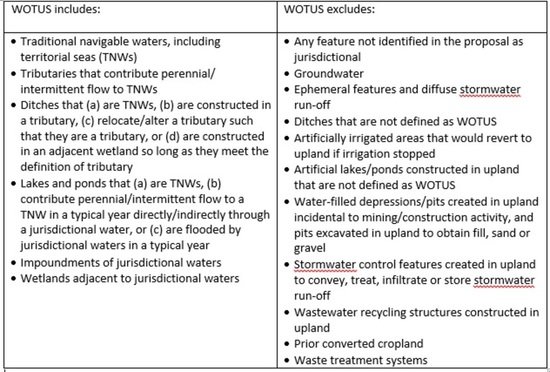
- “Significant nexus” is absent—The proposed rule does not reference waters with a “significant nexus” to TNWs, a hallmark of the CWR. Instead, the proposed WOTUS definition would focus largely on whether the water has a “surface connection” or contributes perennial/intermittent flow to a TNW.
- “Tributary” is narrowed—The proposed definition of a “tributary” is limited to naturally occurring surface water channels with perennial/intermittent flow to a WOTUS in a typical year either directly or indirectly through another WOTUS. Ephemeral streams and references to defined beds/banks are absent from the proposed definition.
- “Adjacent Wetland” is narrowed—“Adjacent wetlands” (as defined in the Proposed Rule) would only be jurisdictional if they either physically abut a WOTUS or have a direct hydrologic surface connection to another WOTUS other than a wetland. In contrast, under the CWR, jurisdiction extended to wetlands that are physically separated from a WOTUS but within a certain distance from an ordinary high water mark or within the 100-year floodplain of a WOTUS.
- “Typical year” defined—Under the Proposed Rule, federal jurisdiction over tributaries, lakes, and adjacent wetlands and the proposed definitions of perennial/intermittent streams would be determined based on the conditions during a “typical year.” “Typical year” is defined as the “normal range of precipitation over a rolling 30-year period for a particular geographic area.”
- New definitions for “waste treatment systems” and “prior converted cropland”—The Proposed Rule includes a new definition of “waste treatment systems” that would exclude from federal jurisdiction all components of such lawfully constructed systems designed to actively or passively treat wastewater. The Proposed Rule also clarifies when “prior converted cropland” would be abandoned and, therefore, no longer subject to the existing CWA exclusion.
Opportunities for Comment
If adopted as proposed, the proposed definition of WOTUS would fundamentally alter, and substantially narrow, the scope of the federal government’s authority under the CWA. Interested parties are encouraged to provide comments to the Agencies during the upcoming 60-day comment period. In addition, the agencies have scheduled a public webcast on Jan. 10, and a public listening session in Kansas City, Kansas on Jan. 23.
The agencies are specifically soliciting comments on several key aspects of their proposal, including whether:
- The significant nexus test must be a component of the proposed new definition of WOTUS.
- The definition of “tributary” should be limited to perennial waters and not those with intermittent flows.
- “Effluent-dependent streams” should be included in the definition of tributary.
- The jurisdictional cut-off for “adjacent wetlands” should be within the wetland or at the wetland’s outer limits.
- A ditch can be both a “point source” and a WOTUS.
- The agencies should work with states to develop, and make publicly available, state-of-the-art geospatial data tools to identify the locations of WOTUS.
Continuing Uncertainty
It is important to highlight that the proposed rule, while significant, is far from a final step in what undoubtedly will be a lengthy process to redefine WOTUS. As with the CWR, litigation challenging any final rule adopting all or part of the proposal is certain. For example, litigation regarding the CWR began almost immediately upon finalization of the CWR in 2015 and continues today. Until this proposal works its way through the rulemaking process and the CWR challenges work their way through the courts, regulated parties must contend with state-dependent differences in the scope of federal authority under the CWA. These nuances can have significant permitting, compliance, and enforcement implications.
Babst Calland is actively monitoring this rulemaking and is analyzing how it could affect industrial, commercial and municipal clients across the country.
For the full article, click here.