GO-WV News
(Keith Coyle, Ashleigh Krick and Chris Kuhman)
On November 15, 2021, the Pipeline and Hazardous Materials Safety Administration (PHMSA) released a final rule for onshore gas gathering lines. The final rule, which represents the culmination of a decade-long rulemaking process, amends 49 C.F.R. Parts 191 and 192 by establishing new safety standards and reporting requirements for previously unregulated onshore gas gathering lines. Building on PHMSA’s existing two-tiered, risk-based regime for regulated on-shore gas gathering lines (Type A and Type B), the final rule creates:
- A new category of onshore gas gathering lines that are only subject to incident and annual reporting requirements (Type R); and
- Another new category of regulated onshore gas gathering lines in rural, Class 1 locations that are subject to certain Part 191 reporting and registration requirements and Part 192 safety standards (Type C).
The final rule largely retains PHMSA’s existing definitions for onshore gas gathering lines but imposes a 10-mile limitation on the use of the incidental gathering provision. The final rule also creates a process for authorizing the use of composite materials in Type C lines and prescribes compliance deadlines for Type R and Type C lines. Additional information about these requirements is provided below.
Type R Lines: The final rule creates a new category of reporting-only regulated gathering lines. These gathering lines, known as Type R lines, include any onshore gas gathering lines in Class 1 or Class 2 locations that do not meet the definition of a Type A, Type B, or Type C line. Operators of Type R lines must comply with the certain incident and annual reporting requirements in Part 191. No other requirements in Part 191 apply to Type R lines.
Type C Lines: The final rule creates a new category of regulated onshore gas gathering lines. These gathering lines, known as Type C lines, include onshore gas gathering lines in rural, Class 1 locations with an outside diameter greater than or equal to 8.625 inches and a maximum allowable operating pressure (MAOP) that produces a hoop stress of 20 percent or more of specified minimum yield strength (SMYS) for metallic lines, or more than 125 psig for non-metallic lines or metallic lines if the stress level is unknown.
Operators of Type C lines are subject to the same Part 191 requirements as Type A and Type B lines and must comply with certain Part 192 requirements for gas transmission lines, subject to the non-retroactivity provision for design, construction, initial inspection, and testing, as well as other exceptions and limitations that vary based on the outside diameter of the pipeline and whether there are any buildings intended for human occupancy or other impacted sites within the potential impact circle or class location unit for a segment. The final rule also provides additional exceptions from certain requirements, including for grandfathered pipelines if a segment 40 feet or shorter in length is replaced, relocated, or otherwise changed. A chart illustrating the applicable requirements is provided below.
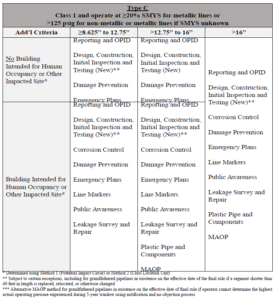
In addition to prescribing these new requirements, the final rule authorizes the use of composite materials in Type C lines if the operator provides PHMSA with a notification containing certain information at least 90 days prior to installation or replacement and receives a no objection letter or no response from PHMSA within 90 days.
Deadlines: The effective date of the final rule is May 16, 2022. Operators of Type R and Type C lines must comply with the applicable requirements in Part 191 starting on May 16, 2022, although the first annual report is not due until March 15, 2023. Operators must also comply with the requirement to document the methodology used in determining the beginning and end-points of onshore gas gathering by November 6, 2022, and operators of Type C lines must comply with the applicable requirements in Part 192 by May 16, 2023. Operators may request an alternative to these 6- and 12-month compliance dead-lines by providing PHMSA with a notification containing certain information at least 90 days in advance and receiving a no-objection letter or no response from PHMSA within 90 days.
Other Considerations: Along with the final rule, PHMSA published its final regulatory impact analysis, which estimated that the final rule will regulate approximately 426,000 miles of gas gathering lines, of which 91,000 miles will be subject to new safety requirements. PHMSA also estimated that the annualized cost to implement the final rule is approximately $13.7 million. PHMSA determined that these costs are outweighed by the benefits of the rule, which include avoided injuries, evacuations, commodity loss, improved reporting processes, and a reduction in the number of pipeline incidents. Notably, PHMSA did not address comments submitted by industry raising concerns regarding the costs of complying with the new regulations, but instead reiterated its findings from the preliminary regulatory impact analysis.
Administrative petitions for reconsideration must be filed with PHMSA within 30 days of the final rule’s publication in the Federal Register. Petitions for judicial review must be filed within 89 days of the final rule’s publication in the Federal Register or, if an administrative petition for reconsideration is filed, within 89 days of PHMSA’s decision on the petition.
Click here to view the article online in the January issue of GO-WV News.
Babst Calland recently named Mary H. Binker, Michael E. Fink, Jennifer L. Malik and Cary M. Snyder shareholders in the Firm.
Mary Binker is a member of the Corporate and Commercial, Energy and Natural Resources, and Real Estate groups. Her practice focuses primarily on corporate and transactional matters, including negotiation of commercial contracts and real estate transactions. Ms. Binker advises businesses of various sizes and complexity, in a broad range of industries including chemical, energy and real estate development, in their corporate contracting needs. She counsels clients on their day-to-day contracting needs such as procurement and service agreements. Ms. Binker also has experience assisting real estate clients in acquisitions, leasing, and management agreements. She is a 2010 graduate of the University of Pittsburgh School of Law.
Michael Fink is a member of the Corporate and Commercial and Emerging Technologies groups. Mr. Fink focuses his practice on assisting high-tech start-up ventures with both fundraising and general corporate or governance matters. He also counsels clients with technology transactions and licensing, and he works on both the buy-side and the sell-side in mergers and acquisitions in the technology, real estate, energy, and healthcare sectors. Entity selection and formation, preparation and programming of capitalization tables and distribution models, and corporate governance counseling are additional services Mr. Fink routinely provides clients. He is a 2011 graduate of the University of Pittsburgh School of Law.
Jenn Malik is a member of the Public Sector and Energy and Natural Resources groups. Ms. Malik’s practice focuses primarily on municipal and land use law, with an emphasis on zoning, subdivision and land development, and municipal ordinance construction and enforcement. She represents the Firm’s municipal clients on a wide array of local government issues, including developing and implementing zoning and land development ordinances, reviewing and overseeing the processing of Pennsylvania Municipalities Planning Code applications, such as applications for conditional uses and special exceptions, analyzing and responding to Pennsylvania Right-to-Know Law record requests, navigating public bidding procedures, assisting to identify and enforce property maintenance and zoning violations, and counseling clients to ensure compliance with both the Pennsylvania Sunshine Act and the Pennsylvania Public Official and Employee Ethics Act. Additionally, Ms. Malik represents corporations, and businesses before local governing bodies, zoning hearing boards, planning commissions and private landowners. In doing so, Ms. Malik assists private-sector clients in analyzing municipal zoning ordinances, obtaining land development approvals, filing Right-to-Know Law requests, defending against Notices of Violation, challenging the procedural and substantive validity of municipal zoning ordinances, and appealing the issuance or denial of local permits. She is a 2011 graduate of the University of Houston Law Center.
Cary Snyder is a member of the Litigation group. He primarily works in the areas of complex commercial litigation and appellate practice. Mr. Snyder has experience in all stages of litigation, from drafting complaints through dispositive motions, discovery, settlement, and trial. He also represents clients in matters before federal and state appellate courts. He is a 2011 graduate of the University of Minnesota Law School.
Babst Calland today announced the lateral move of Harley Stone, who recently joined the Firm’s Pittsburgh office.
A shareholder in Babst Calland’s Public Sector and Energy and Natural Resources groups, Attorney Stone provides senior-level counsel in municipal, land use, environmental and energy law. He represents municipal governments, authorities and private developers in municipal permitting, planning, land use, and zoning. A seasoned trial lawyer, he also has many years of experience as a litigator in the areas of municipal law, employment law, and tax assessment appeals.
Commenting about Harlan’s lateral move to the Firm, Babst Calland Managing Shareholder Donald C. Bluedorn II said, “We are very pleased to welcome Harlan to our Firm. He is a natural fit for us as he shares our values, experience and philosophy in serving clients. Harlan is a highly-regarded attorney and supports our strategy to expand Babst Calland’s legal counseling team and capabilities to serve the needs of existing and new clients in the region.”
With significant experience in municipal, land use and zoning law, Mr. Stone will be joining forces with Babst Calland’s well-established and respected Public Sector team.
“Much deliberation went into my decision to join Babst Calland after practicing with various law firms over my 40+ year career,” said Mr. Stone. “Ultimately, I became convinced that Babst Calland represented the perfect fit for me and my practice.”
Mr. Stone is admitted to practice in Pennsylvania and before the Supreme Court of Pennsylvania, Supreme Court of the United States, United States Court of Appeals for the Third Circuit, and United States District Court for the Western District of Pennsylvania. He is a member of the Allegheny County Bar Association, Allegheny County & Western Pennsylvania Association of Township Commissioners (AC&WPTAC), Association of Municipal and School Solicitors, and the Local Government Academy. Mr. Stone is a past president of the Rodef Shalom Congregation, that oldest and largest reform Jewish congregation in southwest Pennsylvania. He has been rated by Martindale-Hubbell as AV Preeminent, Peer Rated for the Highest Level of Professional Excellence since 2009.
Smart Business
(by Sue Ostrowski featuring Molly Meacham)
Running a business presents a multitude of challenges, but the pandemic has added another layer of complexity as leaders struggle to stay compliant with ever-evolving laws and regulations regarding COVID-19.
“The biggest issues now facing employers are COVID-related — and not just operations and physical safety but complying with a host of local, state and federal laws and regulations,” says Molly Meacham, co-chair, Litigation Group, at Babst Calland. “Strategic planning is more important than ever, and you need to have a good grasp on the issues that may impact your business and be prepared to deal with them.”
Smart Business spoke with Meacham about issues impacting employers and the steps they can take to ensure compliance.
How can employers ensure compliance with local, state and federal regulations?
It can be a significant burden to monitor COVID-related local, state and federal government actions and court decisions. Employers have always had significant regulatory burdens, but they previously had more lead time to plan for compliance and implementation. COVID requires businesses to adapt, act quickly and be flexible. Unfortunately, COVID-related compliance can be expensive, with new laws requiring employers to provide items like additional paid leave, job-protected unpaid leave and regular COVID testing.
Understanding the current legal challenges and evaluating how they impact your business is key. And it’s not just local activity. COVID issues are developing quickly on the national stage. For example, a federal court in Georgia issued a stay effective across the country regarding the executive order requiring federal contractor employees to be vaccinated. Another court stayed the OSHA vaccinate-or-test requirement for companies with more than 100 employees, and yet another stayed the federal requirement for certain health care workers to be vaccinated. If those stays are lifted, impacted employers need to be ready to comply.
What steps should a business take to be prepared as things change?
It is risky to stand by until the court cases are decided, as that could leave you with a very short timeline for implementation of any necessary changes. Put policies and procedures in place in the background, which is typically possible at a reasonable cost, to prepare for the possibility of implementation. If you haven’t gone through that strategic planning and mandates are reinstated, it may be difficult to adjust on an abbreviated timeline, and your operations may be negatively impacted.
Put the building blocks in place so you understand the absolute minimum necessary for compliance. Your workplace policies may need to be adjusted, and you may need to source materials like COVID tests. A “wait-and-see” approach can be more expensive when you have to locate resources in a limited timeframe.
These issues don’t just impact in-person workforces. Many employers that went to a remote workforce during the pandemic are considering when, how and to what extent to resume in-person work. And employers accustomed to a Pittsburgh-based workforce may now have employees physically working in other locations and need to comply with employment laws in multiple states with different requirements.
How can an expert adviser help businesses prepare and stay in compliance?
Regularly check in with your advisers to make sure you understand the current state of COVID-related laws and regulations, how they impact your business and how different potential outcomes may impact your big picture. An attorney current on these issues will generally have a grasp of the overall landscape, so it is a worthwhile investment to have that issue-spotting conversation that will help you to know where your business stands.
These issues have the potential to significantly impact your organization. An informed adviser can help you navigate gray areas, maintain operations and minimize legal risk. You don’t have to implement your strategic plan regarding unresolved legal and regulatory issues, but engaging in the strategic planning process is critical so you are prepared to implement operational changes on short notice in response to future court decisions or government actions.
For the full article, click here.
For the PDF, click here.
The Legal Intelligencer
(By Anna Jewart and Blaine Lucas)
Under the U.S. and Pennsylvania Constitutions, private property may not be taken for public use without payment of just compensation to the owners, see U.S. Const. amend. V; Pa. Const., art. I Section 10. This conversion of private property for a public purpose is interchangeably known as a “condemnation” or a “taking.” In Pennsylvania, the Eminent Domain Code, 26 Pa.C.S. Section 101 et seq., provides “a complete and exclusive procedure and law to govern all condemnations.” This includes de jure condemnations initiated by condemning bodies in compliance with statutory requirements, as well as de facto condemnations, initiated by property owners when entities cloaked with eminent domain powers substantially deprive them of the beneficial use and enjoyment of their properties without initiating and following the procedures set forth under the Eminent Domain Code.
Under the Eminent Domain Code, a property owner asserting that a de facto taking of property has occurred is authorized to bring an “inverse condemnation” action against the condemnor in order to receive adequate compensation for the loss. Generally, courts considering an allegation that a de facto taking occurred place a heavy burden on the property owner to show that:
- The condemnor had the power to condemn the land under eminent domain procedures;
- The property owner was substantially deprived of the use and enjoyment of the property through exceptional circumstances; and
- The damages sustained were an immediate, necessary, and unavoidable consequence of the condemnor’s exercise of its eminent domain power.
Therefore, courts have required evidence that the taking resulted from the actions of an entity “clothed with the power of eminent domain.” Both public, and “quasi-public” entities, such as corporations or public utilities to whom special governmental powers have been delegated, may hold such a power. Recently, following a protracted appellate history, the Pennsylvania Supreme Court, in Hughes v. UGI Storage, No. 49 MAP 2021, No. 50 MAP 2021, (Pa. Nov. 29, 2021), considered whether or not a condemnor must possess the power to condemn the specific land in question, ultimately holding that that a public or quasi-public entity need not possess a property-specific power of eminent domain in order to implicate inverse condemnation principles.
In 2009, UGI Storage Co. (UGI) filed an application with the Federal Energy Regulatory Commission (FERC), seeking a certificate of public convenience and necessity to acquire and operate certain facilities related to the interstate transportation and sale of natural gas owned by UGI Central Penn Gas, Inc. (CPG), a company regulated by the Pennsylvania Public Utility Commission. These facilities included an underground storage field located in Tioga County, consisting of 1,216 acres (storage field), as well as an additional 2,980-acre protective zone around the storage field (buffer zone). UGI was a quasi-public entity invested with the power of eminent domain. FERC granted the application as to the storage field, but denied UGI’s request to certificate the full buffer zone, noting that CPG had not obtained all of the necessary property rights within the buffer zone, and that UGI had failed to contact the owners of the properties in the buffer zone as required by federal regulations.
In 2015, the owners of certain parcels located within the buffer zone (owners) filed petitions seeking appointment of a board of viewers to assess damages for an alleged de facto condemnation of their properties under Section 502(c) of the Eminent Domain Code, which establishes the procedural avenue for securing just compensation in inverse condemnation scenarios. The owners’ claims were based on their allegation that although the buffer zone was not certified in its entirety, UGI was utilizing the properties within the uncertificated segments in the same manner as those within the certificated areas as protection for the integrity and security of the storage field. The owners claimed that UGI had effectively prohibited all hydraulic fracturing activities on the properties within the buffer zone, depriving them of the financial benefits of any natural gas lying beneath their lands, and resulting in a de facto condemnation. For the next several years, the case went up and down on appeal, resulting in multiple trial court decisions, as well as two split Commonwealth Court opinions.
In 2020, the case returned on appeal to the Commonwealth Court, where members of the court disagreed as to whether the owners needed to prove that UGI had property-specific powers of eminent domain in order to prove a de facto condemnation had occurred. See Hughes v. UGI Storage, 243 A.3d 278 (Pa. Cmwlth. 2020) (en banc). The majority invoked the three-part test for de facto condemnation discussed above. While the majority did not require a property-specific inquiry as to the first prong as the trial court had, it found that because UGI was precluded from exercising eminent domain powers over the owners’ properties in the absence of FERC certification, the owners could not establish that any deprivation of their properties was the “immediate, necessary and unavoidable consequence of the exercise of the power to condemn” under the third prong of the test. Judges Leavitt (concurring and dissenting) and McCullough (dissenting) authored separate opinions, agreeing with the owners’ position that the argument asserted by UGI and accepted by the majority “conflated the elements of a de jure condemnation” lawfully initiated by a condemnor “with those of a de facto condemnation, which generally reflects a condemnor’s unlawful interference with property rights.” The Pennsylvania Supreme Court granted the owners’ subsequent petition for allowance of appeal.
As an initial matter, the Supreme Court noted that as a matter of statutory construction it would construe the Eminent Domain Code in a manner most consistent with constitutional norms. It then looked to the text of the Eminent Domain Code, finding that the relevant definitions suggested no requirement of any nexus between the power of eminent domain and a specific property. More specifically, looking at the Eminent Domain Code’s definition of to “condemn,” (to “take, injure or destroy property by authority of law for a public purpose,”) the court found that it closely adhered to the constitutional conception of a taking, defined as “when government action directly interferes with or substantial disturbs the owner’s use and enjoyment of the property.” Although the court noted that the definition of “condemnor,” “interjects the concept of an ‘acquiring agency,” in turn defined as any “entity … vested with the power of eminent domain,” it found the reference to eminent domain solely depicted an attribute of an “acquiring agency,” and did not suggest any requirement of a nexus between that power and a specific property.
The court further noted that Section 502(c)(2) of the Eminent Domain Code, which describes the actionable conduct necessary to support an inverse condemnation claim, said nothing about a power of eminent domain, and that in order to effect an actionable taking it was enough that the condemnor has proceeded by authority of law for a public purpose. Consequently, the court held that the plain terms of the code do not signify a requirement of a property-specific power of eminent domain, an interpretation it found to be most consonant with both federal and state constitutional law. The court therefore held that “a public or quasi-public entity need not possess a property-specific power of eminent domain in order to implicate inverse condemnation principles.” Although the court based its decision on its interpretation of the Eminent Domain Code, it also pointed to the long line of U.S. Supreme Court decisions finding that government actions constituting regulatory takings have not “parsed through whether or not each offending agency has a power of eminent domain. The court cited as an example the Supreme Court’s landmark decision in Nollan v. California Coastal Commission, 483 U.S. 825 (1987) (Finding that conditioning issuance of a permit on the conveyance of an uncompensated easement constituted a taking). The court also quoted from the U.S. Court of Appeals for the Eleventh Circuit in Foundation v. Metropolitan Atlanta Rapid Transit Authority, 678 F. 2d 1038, 1043-44 (11th Cir. 1982) “([W]e disagree with the basic premise … that an inverse condemnation action will not lie against [a government agency] because it does not have the power of eminent domain. A taking occurs when a public entity substantially deprives a private party of the beneficial use of this property for a public purpose.”)
Although the Supreme Court ultimately remanded the case to the Commonwealth Court to address a waiver issue, its holding in UGI Storage underscores the need for state and local regulatory authorities (and private entities possessing eminent domain power) to proceed cautiously when taking actions impacting private property rights, even if the no formal declaration of taking is being filed against a specific property.
For the full article, click here.
Reprinted with permission from the December 23, 2021 edition of The Legal Intelligencer© 2021 ALM Media Properties, LLC. All rights reserved.
The Wildcatter
(By Nikolas Tysiak)
Hello MLBC friends, family and colleagues! This time around, you get a DOUBLE dose of statutes, regulations and cases because your friendly, neighborhood Legislative and Regulatory Committee Chair was too busy to get an article finalized for the last issue of the Wildcatter. Luckily for us, there has not been a lot of activity to report on, so hopefully this article will fill in the gap in your life with fascinating legal and legislative developments.
PENNSYLVANIA
In Pennsylvania Environmental Defense Foundation v. Commonwealth (255 A.3d 289 (Pa. 2021)), the Pennsylvania Supreme Court was asked to determine if allocations of bonuses, yearly rentals and interest penalties for late payments under oil and gas leases on state forest and game lands were improperly allocated to the Commonwealth General Fund under the Environmental Rights Amendment (“ERA”) to the Pennsylvania Constitution (Art. I, Sec. 27). In a prior decision, the Supreme Court had determined that the ERA created a public trust subject to private trust principles, and that royalty revenue streams generated by the sale of gas extracted from Commonwealth lands represented the sale of trust assets that had to be returned to trust fund principal.
In that prior decision, it was determined that not enough information existed in the record to determine whether the bonuses, rentals and interest penalties were also improperly allocated. The issue regarding the non-royalty payments had been remanded to the Commonwealth Court, which decided these non-royalty revenue streams did not constitute the sale of trust assets and were instead “income” and were not required to be returned to the trust fund principal. The Supreme Court relied on contract principles to determine that the non-royalty payments were not compensation for trust assets (oil and gas in the ground), and therefore did not have to be returned to the trust fund principal in kind. Instead, the court designated the non-royalty payments as income streams. However, the court still found that the allocation of income streams to the general fund based on private trust principles and the language of the documents establishing the duty owed by the Commonwealth as fiduciary. In short, the Supreme Court found that the Pennsylvania constitution holds that the ERA effectively establishes a trust for conservation and environmental purposes for the benefit of all Pennsylvanians, whether currently living or not yet born. As such, all principal and income of the trust must be used for the stated purposes (conservation and maintenance of public natural resources), and cannot be allocated to the Commonwealth general fund, stating “to hold otherwise would permit the Commonwealth to use trust income to advance a non-trust purpose, an outcome we previously rejected.” The Supreme Court ordered that the trust income assets (non-royalty payments under the leases) be returned to the trust, accordingly.
On September 14, 2021, the Sierra Club, PennFuture, Clean Air Council, Earthworks and other groups (Petitioners) submitted two parallel rulemaking petitions to Pennsylvania’s Department of Environmental Protection (DEP) asking the Environmental Quality Board (EQB) to require full-cost bonding for conventional and unconventional oil and gas wells, for both new and existing wells. The petitions do not address or consider the permit surcharges and other funding mechanisms for plugging wells, including the federal infrastructure bill that is expected to provide millions of dollars to plug abandoned wells.
The Pennsylvania General Assembly addressed and increased bonding in 2012. Under Act 13, well owners/operators are required to file a bond for each well they operate or a blanket bond for multiple wells. Currently, the bond amount for conventional wells is$2,500 per well, with the option to post a $25,000 blanket bond for multiple wells. 72. P.S. §1606-E. For unconventional wells, the current bond amount required varies by the total well bore length and the number of wells, and is limited under the statute to a maximum of $600,000 for more than 150 wells with a total wellbore length of at least 6,000 feet. 58 Pa.C.S. §3225(a)(1)(ii). EQB has statutory authority to adjust these amounts every two years to reflect the projected costs to the Commonwealth of plugging the well.
Per the EQB Petition Policy, as set forth in the regulations at 25 Pa. Code Chapter 23, DEP has 30 days from receipt of the petitions to determine whether the petitions are complete and if they request an action that can be taken by the EQB that does not conflict with federal law. If the DEP determines the petitions meet the above conditions, the EQB will be informed of the petition for rulemaking and the nature of the request. At the next EQB meeting occurring at least 15 days after the Department’s determination, the Petitioners may make a brief oral presentation and DEP will make a recommendation whether the EQB should accept the petition.
OHIO
A public hearing on HB 152, designed to amend Ohio’s forced pooling statutes and accompanying regulations, was held on June In Estella Roberts v. Roy C. Roberts, 2021-Ohio-3857 (6th Dist. Ct. App. 2021), the Court of Appeals was asked to adjudicate a dispute arising from an 1895 oil and gas lease in Sandusky County, Ohio. The lease had been in continuous operation until approximately 1979, after which production ceased until Roy C. Roberts re-commenced operations and sent royalty checks to Estella Roberts, which were accepted and cashed. In 2015, Estella asserted that the lease had expired and was operating the wells in question without a valid lease, requesting the negotiation of a new lease. At trial, it was determined that the lessee held a fee interest (fee simple determinable) the parties presented arguments on whether the interest created in 1895 constituted a lease that had expired due to lack of production, or whether the interest was saved by the Dormant Mineral Act. The trial court declined to decide on the nature of interest (fee vs. lease) but held that the Dormant Mineral Act applied and the interest held by Roy was saved by actual production. The Court of Appeals agreed with the trial court’s analysis. It appears that Estella also failed to properly argue the Ohio’s lease forfeiture law, ORC 5301.332, applied, as the Court indicated that the record contained insufficient allegations or pleadings that would allow for a decision on that basis. The Court upheld the trial court decision that Dormant Mineral Act preserved the Roy Roberts interest, but overturned on issues regarding payment of attorneys’ fees by Estella.
In 4 Quarters, LLC v. Hunter, 2021-Ohio-3586 (7th Dist. Ct. App. 2021), the Court of Appeals heard (yet another) claim relating to the Ohio Marketable Title Act. In 1922, Hunter conveyed a tract of 78.9 acres in Belmont County to Carpenter, effectively reserving a ½ non-participating royalty interest. In August of 2019, 4 Quarters obtained the surface to the 78.9 acres and immediately filed a complaint under the MTA to extinguish the Hunter reservation. In October of 2019, Ruble, purported to be the sole successor to Hunter, was informed that he may be the sole successor to Hunter. In March of 2020, Ruble received notice from an oil and gas operator selected by 4 Quarters that his interest had been granted to 4 Quarters by default judgment and that royalties had been disbursed to 4 Quarters. In July 2020, Ruble brought an action to vacate the prior judgment in favor of 4 Quarters, which was denied. At issue on appeal was the reasonableness of 4 Quarters attempts to locate heirs or successors of Hunter for notice purposes as required by the MTA. The Court found that the search for Hunter and successors was reasonable under existing Ohio law and guidelines. Although Ruble claims there was ample evidence of his succession from Hunter in Marshall County, WV (adjacent to Belmont County) the Court found no evidence in the Belmont County records that Hunter, or any of his heirs, successors or assigns, may be found in a different locality. Consequently, a search limited to Belmont County was reasonable. Ruble’s contentions were found without merit, and the trial court decision affirmed.
A similar fact pattern arose, also in Belmont County, in Mammone v. Reynolds, 2021-Ohio-3248 (7th Dist. Ct. App. 2021). In 2013, surface owners sought to regain title to severed oil and gas under their land but were unable to locate current owners of the interest (also known as the “Huddleston heirs”). Notice of the proceedings was served on the Huddleston Heirs by publication. Because the Huddleston Heirs never responded to the lawsuit, the trial court granted default judgment in September 2013 to the surface owners. In 2020, the Huddleston Heirs sought to have the 2013 judgment vacated, which was overruled by the trial court. On appeal by the Huddleston Heirs, the Court of Appeals agreed with the trial court and affirmed its judgment.
WEST VIRGINA
The West Virginia Supreme Court of Appeals has accepted four questions certified to it by The United States District Court for the Northern District of West Virginia in Charles Kellam, et al. v. SWN Production Company, LLC, et al., No. 5:20-CV-85. The Court will hear oral argument during the January 2022 term. The Court will address four questions: (1) Is Estate of Tawney v. Columbia Natural Resources, LLC, 219 W.Va. 266, 633 S.E.2d 22 (2006) (Tawney) still good law in West Virginia; (2) What is meant by the “method of calculating” the amount of post-production costs to be deducted; (3) Is a simple listing of the types of costs which may be deducted sufficient to satisfy Tawney; and (4) If post-production costs are to be deducted, are they limited to direct costs or may indirect costs be deducted as well?
At the time of the District Court’s certification in Kellam, defendants’ Motion for Judgment on the Pleadings asserting that the Kellams’ lease complied with Tawney and that the District Court was bound by the decision in Young v. Equinor USA Onshore Properties, Inc., 982 F.3d 201 (4th Cir. 2020) was pending. In Young, the 4th Circuit Court of Appeals reversed Judge Bailey and held the lease clearly and unambiguously allowed the deduction of post-production expenses and noted that “Tawney doesn’t demand that an oil and gas lease set out an Einsteinian proof for calculating post-production costs. By its plain language, the case merely requires that an oil and gas lease that expressly allocates some post-production costs to the lessor identify which costs and how much of those costs will be deducted from the lessor’s royalties.” Young, 982 F.3d at 208. Moreover, the 4th Circuit noted recent criticism of Tawney by the West Virginia Supreme Court of Appeals. See Leggett v. EQT Prod. Co., 239 W. Va. 264, 800 S.E.2d 850 (2017).
Until next time,
MLBC Legislative and Regulatory Committee
Nik Tysiak, Chair
To view the full article, click here.
To view the PDF, click here.
Reprinted with permission from MLBC of the December 2021 issue of The Wildcatter. All rights reserved.
PIOGA Press
(By Keith Coyle, Ashleigh Krick and Chris Kuhman)
On November 15, the Pipeline and Hazardous Materials Safety Administration (PHMSA) released a final rule (tinyurl.com/phmsa-gathering-rule) for onshore gas gathering lines. The final rule, which represents the culmination of a decade-long rule-making process, amends 49 C.F.R. Parts 191 and 192 by establishing new safety standards and reporting requirements for previously unregulated onshore gas gathering lines. Building on PHMSA’s existing two-tiered, risk-based regime for regulated onshore gas gathering lines (Type A and Type B), the final rule creates:
- A new category of onshore gas gathering lines that are only subject to incident and annual reporting requirements (Type R); and
- Another new category of regulated onshore gas gathering lines in rural, Class 1 locations that are subject to certain Part 191 reporting and registration requirements and Part 192 safety standards (Type C).
The final rule largely retains PHMSA’s existing definitions for onshore gas gathering lines but imposes a 10-mile limitation on the use of the incidental gathering provision. The final rule also creates a process for authorizing the use of composite materials in Type C lines and prescribes compliance deadlines for Type R and Type C lines. Additional information about these requirements is provided below.
Type R lines
The final rule creates a new category of reporting-only regulated gathering lines. These gathering lines, known as Type R lines, include any onshore gas gathering lines in Class 1 or Class 2 locations that do not meet the definition of a Type A, Type B, or Type C line. Operators of Type R lines must comply with the certain incident and annual reporting requirements in Part 191. No other requirements in Part 191 apply to Type R lines.
Type C lines
The final rule creates a new category of regulated onshore gas gathering lines. These gathering lines, known as Type C lines, include onshore gas gathering lines in rural, Class 1 locations with an outside diameter greater than or equal to 8.625 inches and a maximum allowable operating pressure (MAOP) that produces a hoop stress of 20 percent or more of specified minimum yield strength (SMYS) for metallic lines, or more than 125 psig for non-metallic lines or metallic lines if the stress level is unknown.
Operators of Type C lines are subject to the same Part 191 requirements as Type A and Type B lines and must comply with certain Part 192 requirements for gas transmission lines, subject to the non-retroactivity provision for design, construction, initial inspection and testing, as well as other exceptions and limitations that vary based on the outside diameter of the pipeline and whether there are any buildings intended for human occupancy or other impacted sites within the potential impact circle or class location unit for a segment. The final rule also provides additional exceptions from certain requirements, including for grandfathered pipelines if a segment 40 feet or shorter in length is replaced, relocated, or otherwise changed.
In addition to prescribing these new requirements, the final rule authorizes the use of composite materials in Type C lines if the operator provides PHMSA with a notification containing certain information at least 90 days prior to installation or replacement and receives a no-objection letter or no response from PHMSA within 90 days.
Deadlines
The effective date of the final rule is May 16, 2022. Operators of Type R and Type C lines must comply with the applicable requirements in Part 191 starting on May 16, 2022, although the first annual report is not due until March 15, 2023. Operators must also comply with the requirement to document the methodology
used in determining the beginning and endpoints of onshore gas gathering by November 6, 2022, and operators of Type C lines must comply with the applicable requirements in Part 192 by May 16, 2023. Operators may request an alternative to these six- and 12-month compliance deadlines by providing PHMSA with a notification containing certain information at least 90 days in advance and receiving a no-objection letter or no
response from PHMSA within 90 days.
Other considerations
Along with the final rule, PHMSA published its final regulatory impact analysis, which estimated that the final rule will regulate approximately 426,000 miles of gas gathering lines, of which 91,000 miles will be subject to new safety requirements. PHMSA also estimated that the annualized cost to implement the final rule is approximately $13.7 million. PHMSA determined that these costs are outweighed by the benefits of the rule, which include avoided injuries, evacuations, commodity loss, improved reporting processes and a reduction in the number of pipeline incidents. Notably, PHMSA did not address comments submitted by industry raising concerns regarding the costs of complying with the new regulations, but instead reiterated its findings from the preliminary regulatory impact analysis.
Administrative petitions for reconsideration must be filed with PHMSA within 30 days of the final rule’s publication in the Federal Register. Petitions for judicial review must be filed within 89 days of the final rule’s publication in the Federal Register or, if an administrative petition for reconsideration is filed, within 89 days of
PHMSA’s decision on the petition.
For the full article PDF, click here.
Reprinted with permission from the December 2021 issue of The PIOGA Press. All rights reserved.

Field Guide
(By Jenn Malik and Robert (Max) Junker)
HIGHLIGHTS
- Covered service providers must disclose, in writing, any and all direct and indirect compensation in excess of $1,000.00 they receive for providing services to the plan.
- Covered service providers include brokers and consultants which provide services ranging from third party administration, pharmacy benefits management, plan design, to recordkeeping services.
- Responsible plan fiduciaries must review Section 202 disclosures for reasonableness.
- Section 202 disclosures are applicable to all contracts, renewals, and/or extensions with covered service providers entered into on or after December 27, 2021.
Introduction
If you sponsor a group health plan, do you know how your broker will be compensated if you follow their recommendation for a new program for your members? Although these types of disclosures are commonplace for pension and retirement plans, these questions were largely unanswerable in the healthcare benefits industry until this year.
The Consolidated Appropriations Act, 2021 (CAA), enacted by Congress in December 2020, defines a compendium of transparency, disclosure, and reporting requirements that group health plans and plan sponsors must navigate to fulfill their fiduciary responsibilities to plan beneficiaries. Prior to the enactment of the CAA, group health plans were often limited by healthcare industry practices preventing the disclosure of claims and pricing data necessary to effectively design and administer health plans. Congress’s enactment of the CAA seeks to improve the market by placing the onus on group health plans and plan sponsors to avoid contracting with entities and health benefits issuers whose business practices prevent plan sponsors from making prudent decisions in the administration of health plans.
This Field Guide addresses one area of these new transparency requirements. Section 202 of the CAA, applicable to group health plans governed under the Employee Retirement Income Security Act of 1974, as amended, (ERISA), prohibits covered plans from entering into a contract, renewal, or extension of services for the plan with “covered service providers” without first requiring the covered service provider to disclose, in writing, any and all direct and indirect compensation in excess of $1,000.00 they receive for providing services to the plan. Section 202’s disclosure requirements apply to all contracts, renewals, or extensions provided by a covered service provider on or after December 27, 2021. A covered plan’s failure to obtain the required disclosures from a covered service provider under Section 202 is considered a prohibited transaction under ERISA and the Department of Labor can assess fees in accordance therewith. The following is a brief overview of the applicability and required disclosures of Section 202.
Who Is a “Covered Service Provider”?
A “covered service provider” is defined by the CAA as a service provider (including affiliates and subcontractors of the service provider) who reasonably expects to receive $1,000.00 or more in direct or indirect compensation to provide brokerage or consulting services to a covered plan. The CAA defines direct compensation as payment for services received directly by the covered plan. Indirect compensation is any compensation received from any source other than the plan, the plan sponsor, the covered service provider, or an affiliate of the covered service provider. Examples of indirect compensation include, but are not limited to, commissions, finder’s fees, and incentive payments, received by a covered service provider by an entity other than the plan, plan sponsor, or an affiliate of the covered service provider. Indirect compensation from a subcontractor of a covered service provider must be disclosed unless it is received in connection with services performed under a contract or arrangement with the subcontractor.
The CAA defines brokerage and consulting services broadly to include the following:
- Selection of insurance products (including dental and vision);
- Development or implementation of plan design;
- Recordkeeping services;
- Medical management vendors;
- Benefits administration (including dental and vision);
- Stop-loss insurance;
- Pharmacy benefit management services;
- Wellness design and management services;
- Transparency tools and vendors;
- Group purchasing organization preferred vendor panels;
- Disease management vendors and products;
- Compliance services;
- Employee assistance programs; and/or
- Third-party administration services.
What Must Be Disclosed and to Whom?
Covered service providers must disclose, in writing, the following, to a responsible plan fiduciary in reasonable advance of the date the contract or agreement is expected to be executed, extended, or renewed:
- A description of the services to be provided;
- A statement that the covered service provider, an affiliate, or a subcontractor will provide the services pursuant to the contract or arrangement directly as a fiduciary under Section 3(2) of ERISA, if applicable;
- A description of all direct compensation either in the aggregate or by service;
- A description of all indirect compensation that the covered service provider, an affiliate, or a subcontractor expects to receive in connection with the services, including compensation from a vendor to a brokerage firm based on a structure of incentives not solely related to the contract with the covered entity;
- A description of the arrangement between the payer and the covered service provider, an affiliate, or a subcontractor, as applicable, pursuant to which the indirect compensation is paid;
- Identification of the services for which indirect compensation is received;
- Identification of the payer of the indirect compensation;
- A description of any compensation paid among the covered service provider, an affiliate, or a subcontractor if such compensation is set on a transaction basis, i.e. commissions; and
- A description of any compensation that the covered service provider, an affiliate, or a subcontractor reasonably expects to receive in connection with termination of a contract or arrangement including calculation of refunds for prepaid amounts.
Repercussions for Failing to Provide Section 202 Disclosures
Generally, ERISA prohibits plans from entering into transactions with parties-in-interest, which include service providers such as brokers and consultants. An exception to this general rule is that a plan may enter into contracts for various services as long as those contracts are reasonable. The disclosures listed above, specifically the disclosures regarding indirect compensation, are designed to aid responsible plan fiduciaries in determining the reasonableness of the agreements with consultants and brokers.
Covered service providers must notify the responsible plan fiduciary in writing of any changes in the disclosures no later than 60 days from the date the covered service provider is informed of the change. Additionally, while covered service providers are required to provide responsible plan fiduciaries with the disclosures on their own accord, the CAA also empowers plan fiduciaries to request Section 202 disclosures from covered service providers. The failure of a covered service provider to make the required disclosures within 90 days of a written request obligates the plan fiduciary to notify the Department of Labor within 30 days of the covered service provider’s failure to respond. Additionally, a responsible plan fiduciary should avoid contracting with brokers or consultants who fail to provide Section 202 disclosures as to do so may subject the plan to penalties.
If you have any questions about Section 202 disclosures or CAA compliance generally, please contact Jenn Malik at 412.525.6755 or jmalik@babstcalland.com or Robert Max Junker at 412.773.8722 or rjunker@babstcalland.com.
Click for PDF.
The Legal Intelligencer and Martindale-Hubbell®, the company that has long set the standard for lawyer ratings, have announced the Pennsylvania Top Rated Lawyers®. To view the list of Babst Calland lawyers who have achieved an AV® Preeminent™ Peer Review Rating, click here.
Smart Business
(by Sue Ostrowski featuring Dane Fennell and Chris Farmakis)
Artificial intelligence is revolutionizing the way attorneys approach due diligence, saving clients money, speeding up the review process and creating budget certainty.
“For a long time, AI was an alternative method to the usual approach of manually reviewing documents during an M&A transaction,” says W. Dane Fennell, an associate in the Corporate & Commercial Group at Babst Calland. “But now, clients expect ever-more efficient, accurate and speedy diligence results. To deliver, AI has become a critical tool in the due diligence process for deals of all sizes.”
Smart Business spoke with Fennell and Christian A. Farmakis, shareholder and chairman of the board at Babst Calland, about how AI is transforming due diligence in the legal marketplace.
What are some benefits of implementing AI in due diligence?
The amount of available data is growing at an exponential rate, creating pressure on those leading the M&A team. Just a few years ago, attorneys had months to work on a due diligence project, combing through what could be thousands of documents to gather and analyze data. The review timeframe has been drastically condensed as buyers and sellers both push to close deals faster.
Several years ago, we assisted with an acquisition that required three months of pre-closing diligence, and 18 months of post-closing confirmatory diligence. With a similar project earlier this year, we did the same work and reviewed the same number of documents in three weeks. Our AI tools allowed us to provide more cost-effective, accurate results in weeks instead of months, and oftentimes at a fraction of the price of a manual review.
Today, buyers need to have a better sense of the ‘game-changing’ issues that will guide their deal-making decisions. With AI, we can isolate ‘high-value’ issues from a large volume of raw data earlier in the diligence process.
As the deal process continues toward completion, we can home in on the relevant operational, legal and financial terms pertinent to the deal structure, eliminating the need to review every letter of every document in the data room.
How can using AI create budget certainty for clients?
By using AI, a law firm has the ability to aggregate metrics regarding previously completed projects that are similar in size, scope and complexity, and have comparable delivery windows. This enables a law firm to make business decisions regarding the size of the team needed for the project, as well as the total number of hours required for completion. All of this factors into providing the client a more accurate estimate of the expected cost of its deal diligence.
Will AI eliminate the role of attorneys in the due diligence process?
With machines doing the work formerly done manually by groups of contract attorneys, the fear is that attorneys will be out of work in the near future. But that is not the case. There is a very important human component to the process that will not be going away anytime soon.
Due diligence still requires human interpretation and gut feelings of experienced attorneys. Legal experience, coupled with deal experience, will continue to be required for all diligence projects to determine the type of AI tool to use and how to implement the AI to best deliver the desired results for a client.
AI helps speed up the process and lower costs, but the human element far outweighs a computer; it takes that human intervention to provide absolute certainty in reporting the diligence results. AI can be a fantastic tool for those who accept it and understand both its virtues and its shortcomings.
For the full article, click here.
For the PDF, click here.
Pretrial Practice & Discovery
American Bar Association Litigation Section by the American Bar Association
(By Jessica L. Altobelli)
A reminder to attorneys to take their discovery obligations seriously and not let things get out of hand.
While I haven’t polled all ABA members, I think it’s safe to assume that obtaining default judgment during discovery isn’t a regular case-winning strategy of most litigators. And while Rule 37 of the Federal Rules of Civil Procedure does include default as a potential remedy for a party’s failure to cooperate during discovery, it is undoubtedly an extreme measure. Where a party is engaged in extreme or egregious discovery misconduct, however, default judgment may be a court’s last-resort remedy.
In spring 2021, for example, a Tennessee court entered a default judgment against the pharmaceutical company Endo after determining that Endo and its counsel engaged in a “coordinated strategy” to interfere with the administration of justice. Staubus v. Purdue Pharma L.P., No. C-41916 (Tenn. Cir. Ct. Apr. 6, 2021). As detailed in the court’s April 6, 2021, order granting the default judgment, counsel for Endo made numerous false statements during court proceedings throughout the pendency of the matter, and improperly withheld thousands of documents during discovery. Documents that were provided by Endo, in some cases, contradicted testimony of Endo’s own executives. Upon entry of the default, the judge acknowledged the harshness of the penalty, but stated that anything less than default in the circumstances at hand “would make a mockery of the attorneys who play by the rules and the legal system.”
A recent opinion out of the Southern District of Alabama reveals that courts may take the dramatic step of entering a default judgment for discovery misconduct in any variety of matters. Hornady, et al., v. Outokumpu, No. 1:18-00317 (S.D. Ala. Nov. 18, 2021). In Hornady, a Fair Labor Standards Act (FLSA) collective action, the plaintiffs sought damages for the defendant’s alleged failure to properly pay regular wages, overtime wages, and bonuses. The defendant, a stainless-steel manufacturer, repeatedly refused to produce complete and accurate time and wage records, and misrepresented material facts in connection with the refusal, making trial in the matter impossible.
Any attorney with a wage-and-hour class action on their roster knows just how cumbersome discovery in these suits can be. The allegations upon which these suits rest are intrinsically tied to employees’ time and wage records, which are often kept and managed by third-party providers. Despite this fact, employers are subject to a statutory duty to maintain proper time and wage records, even if they are not the regular custodians of that data. Needless to say, even with the most professional and ethical attorneys involved, third-party discovery to obtain these records isn’t always smooth sailing.
Wage-and-hour attorneys need not fear that difficulty obtaining third-party records will automatically doom them to default, however. Default judgment can only be imposed after a finding of bad faith. For example, the Hornady court referred to the defendant’s misconduct as a “continuing obstinate refusal to produce its time and pay records.” In fact, prior to entering default judgment, the parties participated in 11 discovery conferences (largely focusing on the defendant’s failure to produce accurate and complete time and wage records), and the defendant was subject to a total of 12 orders requiring production of the subject records. The defendant blamed its deficiencies on the plaintiff’s “unreasonable requests” and/or a lack of cooperation by the relevant third-party payroll processor. Seeing through this excuse, however, the court found that the defendant’s misconduct painted “[a] clear picture of willful and prejudicial discovery abuse, requiring imposition of the strictest of sanctions[.]” All in all, these extreme cases are a reminder to attorneys to take their discovery obligations seriously and not let things get out of hand, or face a default-ending.
Jessica L. Altobelli is an associate at Babst, Calland, Clements & Zomnir P.C. in Pittsburgh, Pennsylvania.
To view the PDF, click here.
© 2021. Extreme Discovery Misconduct May Result in Extreme Consequences, Pretrial Practice & Discovery, American Bar Association Litigation Section, December 22, 2021 by the American Bar Association. Reproduced with permission. All rights reserved. This information or any portion thereof may not be copied or disseminated in any form or by any means or stored in an electronic database or retrieval system without the express written consent of the American Bar Association.
Pittsburgh Business Times
(By Sean M. McGovern)
Babst Calland Shareholder Sean McGovern takes a closer look at Pennsylvania Governor Tom Wolf’s executive order to develop a stronger environmental justice policy and what local business and industry can expect.
Pennsylvania businesses can expect 2022 to become the year of environmental justice, thanks largely to Executive Order 2021-7 issued by Pennsylvania Governor Tom Wolf on October 28.
So said Sean McGovern, a shareholder with Pittsburgh law firm Babst Calland’s environmental practice, who suggested the executive order will, indeed, change Pennsylvania’s approach to environmental justice significantly ahead.
“Certainly, this is a very current development,” McGovern said. “There’s no statute or explicit regulation here in the state. We already have an environmental justice policy, but this new environmental justice order, as well as the Executive Order 14008 from President Biden earlier this year, will further establish the rights and duties under the Environmental Rights Amendment to protect all people in Pennsylvania.”
McGovern shared his insights on environmental justice in Pennsylvania recently with the Pittsburgh Business Times as part of the law firm’s ongoing Business Insights series. Babst Calland is one of the Pittsburgh region’s largest law firms. McGovern is considered one of Babst Calland’s environmental counselors on issues surrounding environmental justice and other matters of environmental law.
Environmental justice defined
So, what is it? The U.S. Environmental Protection Agency defines environmental justice as “the fair treatment and meaningful involvement of all people regardless of race, color, national origin, or income, with respect to the development, implementation, and enforcement of environmental laws, regulations, and policies.”
While the issue has been around for decades, it took center stage earlier this year when President Biden signed an executive order prioritizing for the federal government “environmental justice on a fairly systemic federal level,” McGovern said.
“It set forth a policy that the agencies under the federal government’s purview will make achieving environmental justice as part of their missions,” he continued, “by developing programs, policies, activities to address disproportionately high human health, environmental and climate-related and other cumulative impacts on disadvantaged environmental justice communities.”
Federal and state guidance
A key reason for the order: “To spur economic opportunity for disadvantaged communities,” McGovern said. “We’re seeing quite a bit now in the press regarding [President Biden’s] Build Back Better plan.” Among its provisions: it gives all people the same degree of protection from environmental and health hazards, and it gives all people equal access to the decision-making process to have a healthy environment in which to live, learn, and work.
The Biden administration also has begun to establish the White House Environmental Justice Interagency Council which, McGovern said, not only includes traditional environmental agencies, but also the U.S. Departments of Commerce, Labor, Justice, Health and Human Services, Transportation, and other federal departments and agencies.
President Biden’s actions to prioritize environmental justice includes a directive to set aside 40 percent of federal funding “investments” for the benefit of disadvantaged communities, McGovern said.
Seeking improved environmental justice in Pennsylvania
This is important background information, McGovern said, because Pennsylvania’s governor largely followed the Biden administration in issuing his own executive order for the Commonwealth to foster greater equity for all Pennsylvania citizens when it comes particularly to environmental health and safety.
“A lot of language in the recitals of the executive order almost directly mirror the executive order from President Biden, so clearly, I would say, the support — inspiration — for the executive order was placed here,” he said.
McGovern said the Pennsylvania Department of Environmental Protection is working on a revised environmental justice policy that currently is being reviewed by an environmental justice advisory board, although the “guidance document … is not a statute, law, or regulation, but really a policy for the [Pennsylvania Department of Environmental Protection] to evaluate permit applications.”
He expects a final policy to be completed in 2022.
Expanding disadvantaged populations
Among the proposed policy’s key provisions, he said: an expansion of the definition of what should be considered an “environmental justice area.” That is, 30 percent or greater of a population that is considered minority, or 20 percent or greater of a population living below twice the poverty level as defined by the U.S. Census Bureau, as proposed in the department’s current working draft.
McGovern also said Wolf’s order will include populations where at least 10 percent of the households have limited English language proficiency.
“This is a broadening of the current definition of an environmental justice area,” McGovern said.
An impact on well permits
The executive order also includes what McGovern referred to as an unconventional well permit section that would “require the DEP’s Office of Oil and Gas to collaborate with the Office of Environmental Justice to conduct an annual assessment of anticipated or actual drilling operations.
“This is important,” he continued, “because it effectively moves the environmental justice policy into a retroactive document for permits that have already been issued historically.”
McGovern described the potential impact on the oil and gas industry as significant.
“The working draft is likely going to impact all of the DEP’s permitting operations as it spreads across industries,” McGovern said. “It’s going to require a significant amount of collaboration between the Office of Environmental Justice and these individual bureaus under the DEP, and it will consider, as part of permit applications, in some cases, past permit approvals — further analysis that companies may not have had to consider before.
“Also, there’s going to be a broadening of environmental justice guidelines here in Pennsylvania, to include a variety of new data, including potential health impacts,” he added.
Like its federal counterpart, Wolf’s executive order also creates an Environmental Justice Interagency Council, in addition to an advisory board, McGovern explained. The council will include the Pennsylvania Department of Conservation and Natural Resources, as well as the Commonwealth’s Departments of Education, Agriculture, Health, Transportation, Community and Economic Development, and several cabinet members “at the discretion of the governor to be part of a periodic meeting to discuss environmental justice across agencies.”
In addition to the executive order, McGovern said, other state legislators have proposed bills that would establish as law the Office of Environmental Justice and an Environmental Justice Advisory Board, as well as an Environmental Justice Task Force and regional committees.
“There’s quite a bit going on as of late here in Pennsylvania … that further establishes, along with the environmental justice policy, that there are critical aspects moving forward in Pennsylvania with permitting industrial activities and how those permit applications are going to proceed,” McGovern said.
An environmental counseling role
McGovern said Babst Calland “has a strong, vibrant environmental practice, and we do handle all aspects of permitting, compliance, enforcement litigation, and transactional work. But environmental justice considerations would probably fall in the counseling area, in that prior to applying for a permit for a development or new industrial activity, for example, an applicant should seek knowledgeable counsel regarding impacts of the environmental justice policy, especially if constructing or operating in an environmental justice area.”
Without question, McGovern said, the forthcoming new policy will require businesses to build in extra time to complete the permitting process and, even then, prepare for hurdles, depending on the location of environmental justice areas.
He added: “As the policy proceeds … it becomes more and more critical for businesses and industries in Pennsylvania to be cognizant of the updated policy during the application process.”
More aggressive enforcement anticipated
To support environmental justice policy and principles, local business and industry can expect more aggressive enforcement at both the federal and state levels, including Pennsylvania, where there’s going to be more enforcement that may likely result in more penalties.
Babst Calland will continue to track these developments and their potential impact across various industries. If you have any questions about the environmental justice, please contact Sean McGovern at smcgovern@babstcalland.com.
Business Insights is presented by Babst Calland and the Pittsburgh Business Times. To learn more about Babst Calland and its environmental practice, go to www.babstcalland.com.
PIOGA Press
(By Gary Steinbauer)
On November 2, the U.S. Environmental Protection Agency (EPA) released its highly anticipated proposal to expand existing and create new regulations related to greenhouse gas (in the form of methane) and volatile organic compound (VOC) emissions from the oil and gas sector. The proposed rule is entitled Standards of Performance for New, Reconstructed, and Modified Sources and Emissions Guidelines for Existing Sources: Oil and Natural Gas Sector Climate Review. The proposal, if finalized, will lead to more stringent Clean Air Act (CAA) emission limitations and other work practice requirements related to emissions of methane and VOCs from new and existing sources within the crude oil and natural gas production sector, including producers in Pennsylvania.
Brief overview of the methane proposal
The methane proposal is comprised of three distinct actions proposed under sections 111(b) and (d) of the CAA: (1) proposed amendments to the existing methane and VOC requirements in Subpart OOOOa of the New Source Performance Standards (NSPS) in 40 CFR Part 60; (2) a proposed new NSPS to be included in new Subpart OOOOb, regulating emissions of methane and VOCs from new, modified and reconstructed sources within the oil and gas sector; and (3) nationwide methane emission guidelines (EGs) for existing sources within the oil and gas sector in new Subpart OOOOc.
EPA’s proposed amendments to the current requirements in Subpart OOOOa are primarily in response to Congress’ June 2021 revocation of regulatory amendments made by the EPA during the Trump administration. The new proposed NSPS to be included in Subpart OOOOb would expand the existing requirements in Subpart OOOOa and regulate additional sources of methane and VOC emissions within the oil and gas sector, establishing the “best system of emission reduction” for affected sources that are new, modified, and recon-structed after the effective date. The proposed EGs in new Subpart OOOOc are a set of presumptive methane emission standards that would apply nationwide to various existing sources within the crude oil and natural gas sector. The proposed EGs in new Subpart OOOOc, if finalized, would not apply immediately to affected sources. Rather, the EGs are intended to guide states in the creation of their own plans to implement the EGs, which would be submitted to EPA for review and approval similar to the state implementation plan process created under section 110 of the CAA.
When it released the 577-page methane proposal, EPA did not provide proposed regulatory text for proposed new Subparts OOOOb and OOOOc. Rather, the methane proposal includes EPA’s summary of and justification for the proposed regulations in these new subparts. EPA states that it will issue a supplemental proposal seeking “additional public input” when it releases the proposed regulatory text for Subparts OOOOb and OOOOc.
Key changes in EPA’s methane proposal
The following five key changes in the methane proposal could significantly impact the majority of crude oil and natural gas producers in Pennsylvania.
- Shift from production to overall site-level baseline methane emissions for determining LDAR applicability and monitoring frequency at well sites. In a departure from the existing low-production well site exclusion from LDAR in Subpart OOOOa, 40 CFR § 60.5397a(1), EPA now proposes to abandon using pro-duction volume as a basis for excluding equipment at well sites from LDAR requirements. Instead, EPA proposes to require LDAR for equipment at well sites based on total site-level baseline methane emissions. Well sites with total site-level baseline methane emissions less than 3 tons per year (tpy) would be excluded from LDAR monitoring requirements, provided that these well sites demonstrate that methane emissions do not exceed 3 tpy through an on-site specific survey. Well sites with total site-level baseline methane emissions exceeding 3 tpy would be required to perform quarterly LDAR monitoring, although EPA is co-proposing a semiannual LDAR monitoring frequency for well sites with total site-level baseline methane emissions between 3 and 8 tpy and quarterly LDAR monitoring for well sites with total site-level methane emissions above 8 tpy.
- Significant expansion of storage vessel regulations. As part of the methane proposal, EPA proposes to expand its regulation of oil and gas-related storage vessels under both Subparts OOOOb and OOOOc. Currently, Subpart OOOOa storage vessel regulations are limited to VOC emissions and based on a VOC potential to emit (PTE) of 6 tpy for a single storage vessel. Under Subpart OOOOb, EPA is proposing to include the same 6 tpy PTE applicability threshold, expand it to include methane, and apply it to a single storage vessel or the aggregate potential emissions from a “tank battery,” i.e., a group of storage vessels that are adjacent and receive fluids from the same operation or are manifolded together. As for storage vessels at existing facilities, EPA is proposing to regulate existing tank batteries with potential methane emissions of 20 tpy or more. Combined with EPA’s proposal to narrowly redefine instances where legally and practically enforceable limitations are in place to limit the PTE for a single or group of storage vessels below the 6 tpy applicability threshold, EPA’s proposal is likely to increase the number of regulated storage vessels and require that methane and VOC emissions from newly regulated storage vessels be reduced by 95 percent using a vapor recovery device or combustor.
- First-time requirements for new and existing oil wells with associated gas. For the first time, EPA pro-poses to require that associated gas from oil wells be routed immediately to a sales line. Currently, there are no NSPS requirements that apply to emissions from venting associated gas from oil wells. In situations where gas-producing oil wells do not have access to a sales line, associated gas would need to be used on-site as a fuel source, used for another purpose that a purchased fuel or raw material would service, or be routed to a flare or other control device achieving 95 percent reduction of methane and VOC emissions. Under the methane proposal, any new or existing oil well producing associated gas would be regulated, regardless of production volumes.
- Zeroing out emissions from new and existing pneumatic controllers. Currently, under Subpart OOOOa, affected pneumatic controllers located anywhere except for onshore natural gas processing plants are allowed to have a bleed rate of 6 standard cubic feet per hour. 40 CFR § 60.5390a(c). Furthermore, intermittent vent natural gas-driven pneumatic controllers are not regulated under Subpart OOOOa, regardless of their location. Under Subpart OOOOb, EPA proposes to regulate single natural gas-driven continuous and intermittent bleed pneumatic controllers regardless of location. All these affected pneumatic controllers would be required to meet a new zero emission rate for VOCs and methane. Lastly, EPA proposes to remove an exemption in Subpart OOOOa that applies to affected pneumatic controllers with a bleed rate greater than the applicable standard based on functional needs, including response time, safety and positive actuation, so long as such pneumatic controllers are tagged with the month and year of installation. § 60.5390a(a).
- Zeroing out or controlling emissions from liquids unloading. Described as an “episodic high-emitting source,” EPA proposes to regulate methane and VOC emissions from liquids unloading. More specifically, each liquids unloading event at an existing affected well site would be considered a modification triggering the requirements in proposed Subpart OOOOb, eliminating the need to regulate liquids unloading at existing well sites under proposed Subpart OOOOc. EPA is proposing to require liquids unloading operations be performed with zero methane or VOC emissions. Where it is not safe to perform liquids unloading operations with zero emissions, EPA proposes to require best management practices to minimize methane and VOC emissions.
The methane proposal is expected to be published in the Federal Register on November 15, starting a 60-day public comment period. In addition to the five key changes noted above, EPA is specifically requesting comments on whether to add requirements related to: (1) abandoned and plugged wells, tank trunk loading operations and pipeline “pigging” operations; and (2) improving performance and minimizing malfunctions at flares.
Babst Calland is tracking the methane proposal closely, particularly as it affects Pennsylvania oil and natural gas producers. If you have any questions or would like addi-tional information, please contact Gary Steinbauer at 412-394-6590 or gsteinbauer@babstcalland.com, Gina Falaschi at 202-853-3483 or gfalaschi@babstcalland.com, or Christina Puhnaty at 412-394-6514 or cpuhnaty@babst-calland.com.
For the full article, click here.
Reprinted with permission from the November 2021 issue of The PIOGA Press. All rights reserved.
The Legal Intelligencer
(By Stephen Antonelli)
On September 9, 2021, President Biden announced his administration’s Path out of the Pandemic action plan, a six-pronged national strategy aimed to combat COVID-19 while keeping schools and workplaces open and safe. One prong of the plan involves vaccinating those who are not yet vaccinated. To achieve this goal, the president took actions that have since been on the minds of most employers and human resources professionals: he issued an Executive Order requiring contractors who do business with the federal government to mandate vaccinations for their employees; he directed the Occupational Safety and Health Administration (OSHA) to develop a rule requiring employers with 100 or more employees to ensure that their employees are either fully vaccinated or tested weekly; and he ordered the Centers for Medicare & Medicaid Services (CMS) to require vaccinations for most healthcare workers.
As of this writing in early November, the Safer Federal Workforce Task Force has released detailed guidance related to the federal contractor order, but OSHA has not yet released an Emergency Temporary Standard (ETS) to implement the mandate for large employers, and CMS has not yet issued an interim final rule related to healthcare workers. As a result, employers across the country are waiting for important guidance and details about how vaccine mandates will impact their employees. Complicating matters further, at least 12 states have commenced litigation against the Biden administration in at least three different federal district courts (Arizona, Missouri, and Florida) over the federal contractor rule, and several states (Texas, Florida, Arizona, and Alabama) have issued executive orders of their own opposing vaccine mandates.
In short, employers could use some clarity on the topic of implementing vaccine mandates.
One agency that has continually provided timely and detailed guidance throughout the pandemic is the Equal Employment Opportunity Commission (EEOC). On October 25, 2021, it provided the most recent of many updates to its Technical Assistance document, a practical question-and-answer format resource that is organized by category. The most recent update primarily addressed the topic of employees’ religious objections to vaccine mandates, by guiding employers through hypothetical situations that many employers have actually faced since the announcement of mandatory vaccination programs. A summary of the latest guidance is below.
- Although employees must tell their employer if they are requesting an exception to a COVID-19 vaccination requirement because of a sincerely held religious belief, practice, or observance, they are not required to use any “magic words,” such as “religious accommodation.” Instead, they must only notify their employer that the requirement conflicts with their religious beliefs, practices, or observances.
- While employers have the right to seek additional information concerning a request for an exception based on an employee’s religious beliefs, employers should generally assume that the request is based on sincerely held religious beliefs, absent an objective basis to question either the religious nature or the sincerity of the stated or professed belief.
- Title VII of the Civil Right Act uses an expansive definition of the term “religion” that protects nontraditional religious beliefs that may be unfamiliar to employers. Employers should therefore not assume that an employee’s request is insincere or invalid because it is based on unfamiliar religious beliefs.
- On the other hand, Title VII does not protect social, political, or economic views, or personal preferences. Such objections to vaccine mandates do not qualify as “religious beliefs” under Title VII.
- Courts are likely to resolve disputes over the sincerity of an employee’s stated religious belief in favor of the employee, because these disputes are largely matters of “individual credibility” that are not easily undermined unless the employee has acted in a manner inconsistent with the stated belief, or the timing of the request is suspicious because, for instance, it follows an unsuccessful request for an exception for a secular reason, or the employer has objective evidence demonstrating that the accommodation is not religious in nature.
- Employers should not assume that a stated belief is insincere because it does not align with commonly followed or known tenets of the employee’s religion, or because the employee’s belief, practice, or observance is relatively new. An employee’s religious beliefs do not have to be shared by an organized religion to be sincerely held.
- While employers should consider all potential reasonable accommodations, including telework and reassignment, in some circumstances, it not may be possible to accommodate those seeking reasonable accommodations for their religious beliefs, practices, or observances without imposing an undue hardship on the employer.
- Employers that demonstrate that a requested accommodation will be an “undue hardship” are not required to accommodate an employee’s request for a religious accommodation.
- Courts have held that requiring an employer to bear more than a “de minimis” cost to accommodate an employee’s religious belief can constitute an undue hardship. Employers should consider monetary costs as well as the burden on conducting business, including the risk of spreading COVID-19 to other employees or to the public.
- When assessing whether a request for an accommodation will cause an undue hardship, employers should consider the unique facts of each situation and determine the cost or level of disruption of each potential accommodation.
- If an employer grants a religious accommodation to some employees, it does not automatically have to grant religious accommodations to all employees who request one. Employers should assess the specific factual context of each individual request.
- When assessing whether an accommodation would impair workplace safety, an employer may consider a number of factors including the type of workplace, the nature of the employee’s duties, the number of employees who are fully vaccinated, the number of people who physically enter the workplace, and the number of employees who will in fact need a particular accommodation.
- Employers are not required to provide employees with the religious accommodation of the employee’s choosing. If there is more than one reasonable accommodation that is available, the employer is not obligated to provide the reasonable accommodation preferred by the employee.
- After granting a religious accommodation, an employer may reconsider it as circumstances change. An employer may therefore discontinue a previously granted accommodation if it begins to pose an undue hardship on the employer’s operations. Before discontinuing the accommodation unilaterally, employers should discuss the proposed change or revocation with the impacted employee. The employer should also consider whether there are any other accommodations that would not impose an undue hardship.
At a time when employers and human resources professionals have just as many questions as they have answers, the EEOC’s updated Technical Assistance document has provided much needed clarity, most recently on the topic of religious objections to vaccine mandates.
For the full article, click here.
Reprinted with permission from the November 11, 2021 edition of The Legal Intelligencer© 2021 ALM Media Properties, LLC. All rights reserved.
Charleston Gazette-Mail
(By Moore Capito)
Small-business owners have many roles to fill–from managing payrolls and marketing to customer service. But one area many small-business owners fail to plan for is their company’s cybersecurity.
According to a recent Small Business Administration survey, 88% of small-business owners feel their business was vulnerable to a cyberattack. Experts warn that small businesses, including those in West Virginia, are under constant attack by cybercriminals, be it from local, national or global actors.
We don’t have to dig deep for a local example of this threat. In 2017 Princeton Community Hospital, in Mercer County, was a victim of the Petya attack, costing the health system $27 million.
Yet, many businesses can’t afford professional IT solutions, have limited time to devote to cybersecurity or simply don’t know where to begin.
As a delegate, I am focused on supporting West Virginia small businesses through state and federal grants and providing critical resources and training to entrepreneurs across the state. Small businesses are the backbone of our economy and provide the greatest opportunity for job growth in our state. We need to do everything we can to encourage and support them. West Virginians are hard-working, dedicated people–they just need the right tools to succeed.
This is where programs like the one hosted by the National Cybersecurity Center come in. The National Cybersecurity Center is a nonprofit organization established to promote cyber innovation and awareness, and offers training for the public and private sector alike. I have the privilege of taking part in a key public education effort, Cybersecurity for State Leaders, which is training leaders in all 50 states on best practices in cybersecurity.
Best practices for maintaining good cyber hygiene apply equally to the government and to business across West Virginia. Individuals must stay on top of their own cybersecurity hygiene, personally and professionally, and continuously stay ahead of emerging threats by completing simple tasks, such as updating your software.
The NCC initiative has taken bold steps to integrate, in their outreach and curriculum, with guests from the private sector, including Robert Herjavec, representative from Google, IBM, Microsoft’s Defending Democracy Program and Meredith Griffanti from FTI Consulting.
From the public sector, participants have included Georgia Gov. Brian Kemp, Mississippi Gov. Tate Reeves, Oregon Gov. Kate Brown, among countless more senators and members of Congress who have supported this initiative.
For West Virginia small businesses, the good news is that this training is now available to the public at no charge.
For more information on Cybersecurity for State Leaders and to find training in your home state, visit https://cyberforstateleaders.org.
Click here to view the full article online in the Charleston Gazette-Mail.