The PIOGA Press
(by Lisa Bruderly and Gary Steinbauer)
Despite a recent federal rulemaking on the definition of “waters of the United States” (WOTUS) and the anticipated U.S. Supreme Court matter, County of Maui v. Hawai’i Wildlife Fund, the scope of the federal government’s authority under the Clean Water Act (CWA) could remain in flux.
Even before its publication in the Federal Register, opponents of the WOTUS rulemaking vowed to file legal challenges. Furthermore, a recently announced settlement in the County of Maui case could prevent the Supreme Court from deciding whether point source discharges that travel through groundwater before reaching a jurisdictional surface water are regulated by the CWA. The threatened legal action on the WOTUS rulemaking and the announced settlement in County of Maui could prevent regulated parties from receiving much needed clarity on key jurisdictional issues under the CWA.
WOTUS final repeal rule and new definition
Step 1. On September 12, the U.S. Environmental Protection Agency (EPA) and the Army Corps of Engineers released a pre-publication version of a final rule repealing the Obama administration’s 2015 rule redefining WOTUS under the CWA, typically referred to as the “Clean Water Rule” (CWR). The repeal rule becomes effective 60 days after publication in the Federal Register, which had not yet occurred as of October 7. Major national environmental groups and states have already
vowed to challenge the rulemaking.
The final repeal rule could end the existing regulatory patchwork where the CWR’s definition currently is in place in 22 states (including Pennsylvania) and the pre-2015 definition of WOTUS is in effect in 27 states and recodify the pre-2015 definition of WOTUS consistently across the United States. According to the EPA and
Corps, restoring the pre-2015 CWA jurisdictional regime is appropriate to remedy the identified deficiencies in the CWR’s expansive WOTUS definition.
However, while regulated parties have a long track record of implementing the pre-2015 definition, as informed by applicable guidance documents and
Supreme Court precedent, the pre-2015 definition of WOTUS has also been criticized as leading to inconsistent determinations based on its case-by-case approach to determining whether a water is subject to CWA jurisdiction. Furthermore, the pre-2015 definition of WOTUS is the subject of a fractured U.S. Supreme Court decision in Rapanos v. United States, 547 U.S. 715 (2006), which has been inconsistently applied by federal appellate courts. With challenges to the repeal rule expected
when finalized, the repeal rule may not provide needed clarification to the regulated community. Litigation likely will be filed in multiple federal district courts. The regulatory patchwork of different WOTUS definitions may continue if any of these lawsuits is successful in obtaining a stay of the repeal rule.
Step 2. The repeal rule completes step one of the agencies’ two-step process to implement a 2017 executive order issued by President Trump. Step two of the process involves replacing the CWR’s definition of WOTUS with a revised definition of the term. On February 14, the agencies published a proposed rule to revise the definition of WOTUS. The comment period on the proposed rule ended on April 15. The agencies reportedly received and are reviewing more than 621,000 comments on this proposed definition. EPA’s senior water official has indicated that the agencies plan to take final action on the proposed revised definition of WOTUS by this winter.
Litigation in the district courts challenging any revised WOTUS definition is a near certainty, with the potential for one or more stays of the new definition if any such challenges are successful. Arguably, any stay or stays could result in a new patchwork of WOTUS definitions, where some states rely on the new definition and other states rely on an older definition of WOTUS.
Potential County of Maui settlement
On November 6, the U.S. Supreme Court is scheduled to hear oral argument in the first groundwater “conduit theory” case to reach it, the County of Maui matter. As background, environmental groups sued the County of Maui alleging CWA violations when treated sanitary effluent that it injected into four permitted underground injection wells traveled underground some distance through groundwater before reaching the Pacific Ocean roughly 80 days later. Background articles regarding “conduit theory” can be found in the November 2018 issue of The PIOGA Press and on Babst Calland’s website.
In February 2019, the Supreme Court agreed to review the Ninth Circuit’s February 1, 2018, decision holding that the CWA regulates discharges of pollutants that reach jurisdictional surface waters after traveling through hydrologically connected groundwater. More specifically, the Supreme Court granted a petition for a writ of certiorari to decide “whether the CWA requires a permit when pollutants originate from a point source but are conveyed to navigable waters by a nonpoint source, such as groundwater.”
The Ninth Circuit held that the wells at issue were “point sources,” and so long as pollutants are “fairly traceable” from the “point source” and more than a de minimis amount of pollutants reach a jurisdictional surface water, such discharges are regulated under the CWA. Hawai’i Wildlife Fund v. County of Maui, 886 F.3d 737, 749 (9th Cir. 2018).
County of Maui is the first “conduit theory” case that the Supreme Court has agreed to hear, with the Fourth, Sixth and Ninth Circuit Courts clearly split on how to apply CWA liability. The Fourth Circuit generally agreed with the Ninth Circuit’s interpretation extending CWA liability for migrating groundwater contamination in Upstate Forever v. Kinder Morgan Energy Partners, L.P., 887 F.3d 637 (4th Cir. 2018).
The Upstate Forever matter involves allegedly ongoing contamination from a previously repaired gasoline pipeline, a very different set of underlying facts as compared with County of Maui. The Fourth Circuit concluded that pollutants originating from a point source (i.e., the ruptured pipeline) that continue to migrate through groundwater with a “direct hydrologic connection” to surface water are regulated by the CWA, even though the pipeline leak had been repaired almost immediately and was being addressed under state remediation requirements. In contrast, subsequent decisions by the Fourth and Sixth Circuits involving inactive coal ash impoundments and landfills have found that such structures are not “point sources” under the CWA. Sierra Club v. VEPCO, 903 F.3d 403 (4th Cir. 2018); Tenn. Clean Water Network v. Tenn. Valley Auth., 905 F.3d 436 (6th Cir. 2018); Ky. Waterways Alliance v. Ky. Utilities Co., 905 F.3d 925 (6th Cir. 2018).
Recent developments, however, may prevent the Supreme Court from deciding the County of Maui matter. On September 20, the Maui County Council voted 5- 4 to settle the pending petition and for the County to seek a CWA National Pollutant Discharge Elimination System (NPDES) permit. The mayor of Maui County, however, has indicated that county council does not have the authority to withdraw the appeal on its own, and that the mayor has the ability to make the ultimate decision as to whether the Supreme Court petition remains on the docket. As of the publication of this article, the dispute over who has the authority (i.e., county council or mayor) remains unresolved.
The potential withdrawal of County of Maui matter would mean that the Supreme Court would not resolve the circuit split on the scope of the CWA’s NPDES permit program, at least for now. A petition to review the Fourth Circuit’s decision in Upstate Forever is also pending. If the County of Maui appeal is withdrawn, the Supreme Court could take up the Upstate Forever case at some point in the future. Meanwhile, EPA’s April 2019 interpretive guidance, concluding that releases of pollutants to groundwater are categorically excluded from the CWA’s NPDES permitting requirement, remains in effect nationwide, except for the Fourth and Ninth Circuits. Therefore, until the Supreme Court resolves the circuit split, regulated parties in the Fourth and Ninth Circuits, including members of the oil and gas industry, will be subject to potentially more expansive requirements under the CWA.
Clarity on key CWA jurisdictional issues hangs in the balance as litigants prepare to challenge the agencies’ final repeal rule and jockeying continues on the potential settlement in the County of Maui matter. Babst Calland is actively monitoring these developments and evaluating their potential effect across sectors and industries, including the oil and gas sector. If you have any questions, please contact Lisa M. Bruderly at 412-394-6495 or lbruderly@babstcalland.com or Gary E. Steinbauer at 412-394-6590 or gsteinbauer@babstcalland.com.
Click here for PDF.
The Legal Intelligencer
(by Gary Steinbauer)
Since taking office, President Donald Trump has launched an ambitious deregulatory effort targeting several federal environmental rulemakings completed during the Obama administration. Two of the most noteworthy deregulatory actions involve the scope of the federal government’s authority to regulate greenhouse gas (GHG) emissions from existing sources under the Clean Air Act and discharges to surface water under the Clean Water Act. Lawsuits over these rules are pending or promised, with federal courts, and potentially the U.S. Supreme Court, poised to rule on whether the Trump administration’s actions are appropriate course corrections or themselves illegal.
Clean Air Act
In 2015, the Obama administration promulgated the first-ever requirements for GHG emissions from power plants under the Clean Air Act. Known as the Clean Power Plan (CPP), this rule aimed to reduce GHG emissions from electricity generating units to approximately 32% less than 2005 levels by 2030. The CPP was challenged by numerous states and industry groups in the U.S. Court of Appeals for the District of Columbia Circuit. Challengers asserted that the Clean Air Act requirement to establish the “best system of emissions reduction” (BSER) prohibited the U.S. Environmental Protection Agency (EPA) from forcing fossil fuel plants to offset their emissions by constructing renewable energy sources or purchasing credits from such sources. In February 2016, the Supreme Court took the unprecedented step of staying the CPP before the D.C. Circuit ruled on the merits of the challenge. In September 2016, the entire D.C. Circuit heard oral arguments on the CPP, but effectively stayed the CPP lawsuit while the EPA moved forward with preparing a replacement.
On June 19, the EPA issued a final Affordable Clean Energy (ACE) rule establishing a much different set of requirements for BSER at existing power plants and formally repealing the CPP. Finalized after formal notice-and-comment rulemaking, the ACE rule adopts a series of thermal efficiency or heat rate improvements as BSER, but unlike the CPP, it does not set a formal limit on GHG emissions from existing coal-fired power plants. Effectively, the ACE rule requires coal-fired electricity generating units to reduce GHG emissions by employing operation and maintenance practices, using one of six listed “candidate technologies” each with its own pre-determined GHG emissions reductions, and evaluating other factors such as the source’s remaining useful life. Under the ACE rule, states are required to submit plans to the EPA describing how each affected power generation unit within their jurisdiction meets the required “standards of performance.”
On July 8, the same day the ACE rule was published in the Federal Register, public health interest groups filed a lawsuit challenging the rule, which was followed by challenges by more than 25 states (including Pennsylvania), environmental groups and a coal mining company. Industry groups, power generation, mining companies, states and others have moved to intervene in these lawsuits to defend the ACE rule. The EPA has asked the D.C. Circuit to fast-track the litigation, and challengers have opposed the EPA’s request and asked the D.C. Circuit to hold the case in abeyance until the EPA completes a related rulemaking. The court has yet to rule on these competing motions.
The legal challenges to the ACE rule, as well as the ongoing litigation over the CPP, will determine the extent to which the EPA can regulate GHG emissions from existing power plants under the Clean Air Act. If the Supreme Court’s unprecedented stay of the CPP is any indication, the ACE rule lawsuits and the ongoing challenges to the merits of the CPP have all the necessary ingredients for an environmental court battle for the ages, one that could ultimately reach the Supreme Court.
Clean Water Act
On the water side, a different campaign is being waged. In 2015, the same year that it promulgated the CPP, the Obama administration issued a rule re-defining “waters of the United States” (WOTUS) under the Clean Water Act, which arguably expanded the federal government’s jurisdiction over surface water, including wetlands. The Obama-era definition of WOTUS, typically referred to as the Clean Water Rule (CWR), invoked intense opposition by many states and regulated parties. Opponents filed lawsuits challenging the CWR almost immediately, with the initial battle involving whether the federal appellate or district courts were responsible for deciding the matters. The CWR was stayed until 2018. In 2018, the Supreme Court issued a unanimous decision holding that challenges to the CWR must be filed in federal district courts.
The Supreme Court’s 2018 decision requiring federal district courts to hear the CWR challenges led to the existing regulatory patchwork, where the CWR’s WOTUS definition currently is in place in 22 states (including Pennsylvania) and the pre-2015 definition of WOTUS is in effect in 27 states. The Trump administration has used the existing regulatory patchwork to justify repealing the CWR and introducing a new definition of WOTUS. The EPA and the U.S. Army Corps of Engineers (Corps) (collectively, the agencies) have established a two-step process for repealing and potentially replacing the CWR. Step one is to repeal the CWR and recodify the pre-CWR definition and regulatory regime for defining and interpreting WOTUS. The agencies will soon complete step one. On Sept. 12, the agencies released a pre-publication version of the final rule repealing the CWR. The “repeal rule” becomes effective 60 days after publication in the Federal Register, which, as of Sept. 30, had not yet occurred. Once final, the “repeal rule” will recodify the pre-2015 definition of WOTUS consistently across the United States.
Major national environmental groups and states have already vowed to challenge the “repeal rule.” These challenges, which could be filed in multiple federal district courts, will center on whether the agencies’ repeal of the CWR was arbitrary and capricious under the federal Administrative Procedures Act and whether the agencies have marshaled an appropriate justification for limiting federal jurisdiction under the Clean Water Act four years after the CWR was finalized. The regulatory patchwork of WOTUS definitions may continue if any of these lawsuits are successful in staying the repeal rule.
Concurrently, the Trump administration and its opponents are gearing up for another clash involving step two of the CWR revocation process—finalizing a potential replacement definition of WOTUS. The agencies initiated step two on Feb. 14, when they published a proposed revised definition of WOTUS that would generally limit federal jurisdiction to relatively permanent, standing or continuously flowing surface waters and their adjacent wetlands. The agencies indicate that they are currently reviewing more than 621,000 public comments that they received on the February 2019 proposed WOTUS definition. They expect to take final action in early 2020. As with the “repeal rule,” any new definition of WOTUS inevitably will lead to additional litigation.
As the Trump administration moves from delaying or suspending Obama-era environmental regulations to fashioning its own replacements, legal challenges are a near certainty. The scope of the EPA’s authority to regulate GHG emissions under the Clean Air Act and discharges to surface water under the Clean Water Act will be determined initially by federal appellate and district court judges, with a strong possibility of the Supreme Court serving as the final arbiter.
For the full article, click here.
Reprinted with permission from the October 3, 2019 edition of The Legal Intelligencer © 2019 ALM Media Properties, LLC. All rights reserved.
Pittsburgh Business Times
(by Patty Tascarella with Don Bluedorn)
A lawyer who’s energized by martial arts and draws on engineering skills is leading Pittsburgh’s sixth-largest firm with balance in mind.
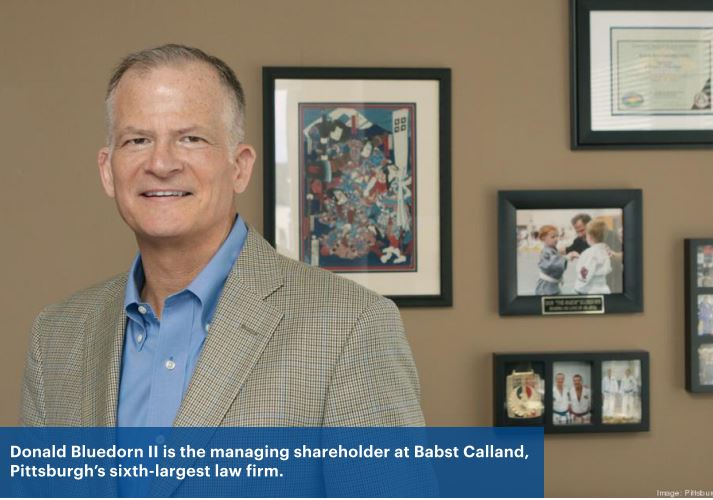 Donald Bluedorn II built most of his career at Babst Calland and, in mid-2017, became just the second managing shareholder in the law firm’s 33-year history. In June, he took Babst Calland into Texas via a merger with The Chambers Law Group, based in Houston. Bluedorn, who also practices the martial art of Brazilian jiu-jitsu, is focused on energy and natural resources and environmental work.
You have an engineering degree. Did that figure into your decision to be a lawyer?
My father was the first person in our family to go to college — he got an engineering degree, then went to night school and got an MBA and then a law degree. He worked for the local power company and ran a country practice out of our farm. I’d always wanted to be a lawyer. My dad said, “You like science and math, get an engineering degree. If you decide not to go to law school, you can do something with that. With a political science degree, you’re committed to going to law school.” By the time I got to my senior year in college, I really wanted to go into law. But in some ways, engineering was a fantastic background: It taught economic rigor, discipline and to think problems through in a logical way. No one has ever hired me as a lawyer for my engineering skills, but it helps me to understand the science behind what we’re doing and to engage with the engineers or consultants clients might be using. It worked out the way my dad intended.
How does a farm kid from New Castle turned law firm leader wind up practicing jiu-jitsu?
I’ve done martial arts since I was a teenager, picked it up in college. I did a form of Japanese karate for 25 years, and I’ve been doing jiu-jitsu since 2006, training at a place in the South Hills. It’s a great form of exercise and self-defense, almost like meditation. No matter how much I have going on or how fast my brain is working, as soon as I start doing it, it’s all I think about. I walk out completely refreshed and feel like a million bucks.
Babst Calland is Pittsburgh’s sixth-biggest law firm, but it was a rambunctious spinout in the late 1980s when you joined. What was the attraction?
I started with another large firm, Eckert Seamans Cherin & Mellott LLC, and at the time, I was very attracted to sophisticated transactions, and I didn’t think the fit was ideal for me. I knew people who’d come to Babst. I interviewed at the end of 1987, I attended the firm’s holiday party and started my first work day in January 1988. It was a very small firm. We hadn’t done any buildout in the space at Two Gateway — the guy in the office next to me had a door too narrow to fit a desk so he worked off a folding table.
The merger with Chambers was really a big move for Babst Calland. How did it come about?
We looked at it very hard for about 18 months, and from a business perspective, there was a natural fit. We’re already doing a significant amount of work in the Marcellus and Utica shale plays, and many clients are also doing work in the Permian. We took a very strategic approach — it was important not to come in as carpetbaggers but to have a group that was well-respected and already doing the work. We didn’t want to cobble together people and hope the chemistry was right. We were very fortunate to enter into discussions with Les Chambers and others at his firm. It’s already starting to pay off by doing more work for existing clients and getting new ones.
Could you see doing more such deals?
It’s client-driven. We never thought we’d want to be in X location, have Y number of lawyers or Z number of offices. But we’re always evaluating opportunities.
How has your Washington, D.C., office driven the firm’s work with autonomous vehicles?
When we opened Washington, it was natural. We were doing so much energy work in Marcellus and Utica that pipeline safety was very important to us. Transportation and mobile emerging technologies was a natural add-on. It shares a common regulatory base and that came back and started to grow in Pittsburgh. We have lawyers practicing back and forth between the two offices. We refer to it as emerging technologies, but it’s heavily autonomous vehicles with deal work going on in Pittsburgh.
What’s your role in expanding the practices?
Shortly after I became managing shareholder, someone asked me, “What’s your job?” Well, my job is not to screw it up. The firm is in a good place and everyone is happy. I could hold on to whatever we are today, and in 10 years, I will have failed because the pace will have evolved, people will have expectations. But to forget what we are, what our business model is and our culture is, and fly off the handle to do new things just to do new things, I can’t do that either. My job is to stay between those, hopefully down the middle. We want to grow in multiple dimensions as opposed to a lateral bolt-on, and we’re looking for natural synergies.
BIOBOX
Title: Managing shareholder, Babst Calland
Age: 58
Education: B.S., electrical engineering, Grove City College; J.D., University of Pittsburgh School of Law
Residence: Blackridge
First job: Working at the Lawrence County fairgrounds
Family: Wife Amy; son Zachary, 28; daughter Mackenzie, 26
Hobbies: Brazilian jiu-jitsu
Causes: Communities in Schools of Pittsburgh and Pittsburgh Legal Diversity and Inclusion Coalition
Click here for PDF.
Institute for Energy Law Oil & Gas E-Report
(by Anthony DaDamo)
“My possession of said land has been, and is, actual, hostile, visible, notorious, exclusive, continuous and peaceable.” One of several cotenants to land in northern West Virginia attested to this in an affidavit in 1903. While it is clear that the affiant was attempting to adversely possess the property, can one cotenant, who has an equal right to the possession of commonly held property along with all other cotenants, adversely possess the interests of his cotenants? West Virginia courts recognize the doctrine of ouster, which allows a cotenant in possession to acquire all interest of his or her cotenants in property, similar to adverse possession. As with its sister concept, adverse possession, recorded evidence of ouster is difficult to identify. In situations satisfying the elements for ouster, identifying and applying the principle is an effective way to clear clouds on title.
West Virginia courts recognize that the ouster of a cotenant may occur when all elements of adverse possession are met and there are objective facts to show specific intent to oust the cotenant. Ouster requires a tenant in common to occupy common property openly, notoriously and exclusively as the sole owner, while keeping up improvements, paying the real estate taxes and receiving the rents and profits. Proof of these elements shows an intention to ignore the rights of the ouster’s cotenants and such acts amount to an expulsion of non-possessing cotenants. The ouster’s possession will be regarded as adverse to his cotenants from the time the cotenants are shown to have knowledge of such acts and claims. The ousting cotenant must take actual possession of the property and claim title to the entire property for a period that satisfies the statute of limitations for adverse possession (10 years in West Virginia). Obtaining an interest in property by deed is not enough to affect ouster; the ousting cotenant must take actual possession of the land.
For the full article, click here.
For the full report, click here.
Smart Business
(by Jayne Gest with Kevin Douglass)
Many business owners claim to be blindsided when a co-owner files a lawsuit against them detailing a list of grievances. The truth is that business owners often ignore disagreements with co-owners for years or even decades by focusing on pressing day-to-day business matters.
If your company does not address owner conflicts and succession planning issues, these matters will eventually disrupt, impact or injure the business. But with the right approach — and the right facilitator — these challenges can be identified and resolved.
“Disagreements among co-owners of a business are natural. They come up frequently. The key is how owners address those conflicts. Even a company with one owner eventually has to deal with succession issues to avoid potential tension between family members or others vying to be the next generation of owners,” says Kevin Douglass, shareholder at Babst Calland.
Smart Business spoke with Douglass about conflict resolution among business owners.
What events can trigger an escalation of a disagreement between owners?
The reasons why a disagreement may bubble to the surface are almost endless. One trigger is business financial health. If the company is doing very well, owners may feel entitled to more compensation or at least more input into how additional profits will be invested. If the business is struggling, an owner’s benefits may need to be decreased and tough decisions made about the company’s direction.
Other reasons for conflict include a change in an owner’s level of commitment or job performance, a desire to change the governance structure, conflicting business strategies, and compensation and benefit differences. Personal changes may also spark controversy, such as an owner’s marriage or divorce, owner children who are employed by the business, personal finances or advancing age.
It is surprising how often business partners, including those in the same family, do not openly voice their concerns. If co-owners are not comfortable discussing issues or sharing information, resentment festers and grows.
What are the risks of ignoring owner disagreements?
Owner disagreements, or failing to address succession issues, can spill over into business operations and finances. Employees, lenders, customers, vendors and others can easily become aware of, and even embroiled in, the drama. They may be confused about which owner is in charge. If left unchecked, the reputation and health of the business may be threatened. Just as significantly, relationships on a professional, personal and family level may be destroyed, if not addressed thoughtfully and with sensitivity.
Some owners resort to litigation to obtain the satisfaction they believe they are entitled to — and the expense, stress and distraction of co-owner litigation is never positive.
How can owners resolve their underlying issues more quickly?
An owner willing to address an issue with a co-owner head-on is often in the best position to resolve it. However, given the sensitivity of all the moving parts, including each owner’s legal rights and vested interest in the outcome, it frequently makes sense for owners to separately consult with an attorney for a comprehensive and objective assessment of the issues, risks and alternatives for resolution.
As part of that process, it is important to understand not only why the disgruntled owners are upset, but also what owners hope to achieve and whether their expectations are realistic. After fully vetting an owner’s desires and legal rights, finding a solution may include answering difficult questions. Do the owners want to continue in business together, or separate via a buyout? Do the owners share the same vision for the company’s future? Does the ownership, compensation or governance structure need to be redefined? Are new leaders and investors needed? Should the business be sold? Should a strategic or succession plan be developed, and if so, what should it look like?
Any resolution of issues involving owner conflict or succession should strive to satisfy, or at least account for, the concerns of all owners and interested parties. Unlike a winner-takes-all litigation setting, an opportunity exists to develop workable solutions for owners while preserving and protecting the business. Wise owners take advantage of that opportunity.
For the PDF, click here.
For the full article, click here.
The Legal Intelligencer
(by Stephen Antonelli and Carly Loomis-Gustafson)
In mid-June, in a unanimous opinion, the Pennsylvania Supreme Court articulated a new work product doctrine waiver analysis in BouSamra v. Excela Health, No. 5 WAP 2018 (Pa. June 18, 2019). While the decision will be seen as a victory for corporate defendants in that it provides clarity concerning waiver of the attorney work product doctrine related to communications and consultations with third parties in anticipation of litigation, it should also be read as a cautionary tale in support of continued mindfulness in dissemination of privileged information.
The decision stems from a discovery dispute in a defamation case commenced by Dr. George R. BouSamra against Excela Health Westmoreland Regional Hospital and others. BouSamra filed suit after another cardiologist affiliated with Excela accused BouSamra and his colleague, Dr. Ehab Morcos, of regularly overestimating arterial blockages and, as a result, performing improper and medically unnecessary stenting. As part of an attempt to manage potential public relations issues stemming from the results of two peer review studies related to the accusations, Excela’s in-house counsel forwarded an email containing privileged information that it had received from outside counsel to a member of a third-party public relations firm, who then forwarded the email to other members of the firm.
After noticing the emails between Excela and its public relations firm on Excela’s privilege log, BouSamra filed a motion to compel production of the emails. A special master assigned by the trial court determined that Excela had not waived any privileges. The trial court sustained BouSamra’s exceptions to the special master’s recommendation, noting that the third-party was not an agent of Excela’s counsel. It therefore concluded that the attorney-client privilege had been waived. Neither the trial court nor the special master discussed waiver of the work product doctrine. On appeal, a unanimous panel of the Pennsylvania Superior Court affirmed the trial court’s order with respect to the attorney-client privilege, and also found the work product doctrine to be inapplicable. The Superior Court’s decision was based, in part, upon its reasoning that the document at issue belonged to Excela rather than its outside counsel, and that it had not been shared with the public relations firm to assist outside counsel with preparing for litigation.
After granting Excela’s petition for allowance of appeal, the Pennsylvania Supreme Court affirmed in part and reversed in part. The court agreed with BouSamra and ruled that Excela had indeed waived the attorney-client privilege when it shared the protected communication with the public relations firm on the grounds that the third-party firm was not an agent of Excela that was facilitating an ability to provide legal advice. The court reversed, however, on the issue of whether the work product doctrine had been waived. The court articulated a new work product waiver analysis by holding that the privilege is not waived merely by the disclosure to a third party, “unless the alleged work product is disclosed to an adversary or disclosed in a manner which significantly increases the likelihood that an adversary or anticipated adversary will obtain it.”
In announcing this new rule, the court acknowledged that “a fact intensive analysis is required” to determine whether the privilege had been waived. As a result, and because the factual record was insufficient for it to conduct the waiver analysis, the court remanded the matter to the trial court for “factual finding and application of the newly articulated waiver analysis,” as it is the role of the trial court to determine which facts and circumstances should bear the most weight in any given analysis.
In its opinion, the court noted the distinguishing characteristics of the attorney-client privilege and the work product doctrine: disclosure to a third party generally waives the attorney-client privilege, but the same cannot be said for application of the work product doctrine because disclosure does not always undermine its purpose. Stated differently, the attorney-client privilege “is designed to protect confidentiality, so that any disclosure outside the magic circle is inconsistent with the privilege; by contrast, work product protection is provided against adversaries.” Furthermore, the protection afforded by the attorney-client privilege belongs to the client and protects disclosure made to their own attorney, while the work product doctrine belongs to the counsel, as it protects disclosure of the attorney’s mental impressions, conclusions, opinions, memoranda, notes, summaries, legal research and legal theories.
Even though the BouSamra opinion will likely be welcomed by corporate entities and the defense bar, it should not be read as providing blanket protection for all communications that might, in any way, constitute an attorney’s work product. The court simply established a means by which to determine if the purpose of the doctrine has been undermined by focusing the analysis to disclosure to an adversary, pursuant to the essential purpose of the Pennsylvania Rule of Civil Procedure 4003.3.
Communications between attorneys or clients with third parties, especially in the context of seeking consultation for a real or potential crisis, can often occur at a moment’s notice. Despite BouSamra, attorneys should continue to carefully consider the consequences of sharing information and the manner in which the information is shared. In other words, attorneys—whether outside or inside counsel—should not view BouSamra as an invitation to be less careful with their third-party communications, especially given the fact that courts have yet to apply the requisite “fact intensive analysis” to the new test.
As addressed by Justice Christine Donohue in her concurring opinion, the court’s grant of allocatur “presumed that the documents at issue were otherwise (i.e., absent waiver) protected by the work product doctrine.” The unanimous majority opinion then “makes the same presumption, as it merely announces that the documents are attorney work product without any disclosure of the nature of the contents of those documents (including whether or not they were prepared in litigation).” The court’s decision not to provide the retrospection that may be helpful to attorneys in determining, prior to disseminating information, how a court may classify work product in a specific instance leaves room for differing opinions on the issue. In other words, there must be an analysis of whether the documents at issue actually qualify as work product, which is often broadly defined as the impressions, conclusions, opinions, memoranda, notes, summaries, legal research and legal theories of an attorney.
Although BouSamra provides clarity and comfort to attorneys who wish to more freely communicate with third-party consultants, it does not open the door for protection of haphazard communications with third parties under the guise of work product protection.
Stephen A. Antonelli is a shareholder in the employment and labor and litigation groups of Babst Calland Clements & Zomnir. His practice includes representing employers in all phases of labor and employment law, as well as matters of general litigation. Contact him at santonelli@babstcalland.com.
Carly Loomis-Gustafson is an associate in the litigation group of the firm, where she assists in the ligation of a wide variety of legal matters. Contact her at cloomis-gustafson@babstcalland.com.
For the full article, click here.
Babst Calland is pleased to announce that five lawyers were selected as 2020 Best Lawyers “Lawyer of the Year” in the Pittsburgh, Pa. and Charleston, W. Va. (by BL Rankings). Only a single lawyer in each practice area and designated metropolitan area is honored as the “Lawyer of the Year,” making this accolade particularly significant.
Receiving this designation reflects the high level of respect a lawyer has earned among other leading lawyers in the same communities and the same practice areas for their abilities, professionalism, and integrity. Those named to the 2020 Best Lawyers “Lawyer of the Year” include:
Donald C. Bluedorn II, Environmental Law “Lawyer of the Year” in Pittsburgh, Pa. – In addition to the “Lawyer of the Year” award, Donald Bluedorn was also listed in the 2020 Edition of The Best Lawyers in America in Environmental Law, Litigation – Environmental, and Water Law.
Kevin J. Garber, Energy Law “Lawyer of the Year” in Pittsburgh, Pa. – In addition to the “Lawyer of the Year” award, Kevin Garber was also listed in the 2020 Edition of The Best Lawyers in America in Environmental Law, Natural Resources Law, Energy Law, Water Law, and Litigation – Environmental.
Blaine A. Lucas, Litigation – Land Use and Zoning “Lawyer of the Year” in Pittsburgh, Pa. – In addition to the “Lawyer of the Year” award, Blaine Lucas was also listed in the 2020 Edition of The Best Lawyers in America in Energy Law, Land Use and Zoning Law, Municipal Law, and Litigation – Land Use and Zoning.
Timothy M. Miller, Oil and Gas Law “Lawyer of the Year” in Charleston, W.Va. – In addition to the “Lawyer of the Year” award, Timothy Miller was also listed in the 2020 Edition of The Best Lawyers in America in Energy Law, Oil and Gas Law, Commercial Litigation, Bet-the-Company Litigation, and Litigation – Environmental.
Christopher B. “Kip” Power, Litigation – Environmental Law “Lawyer of the Year” in Charleston, W.Va. – In addition to the “Lawyer of the Year” award, Kip Power was also listed in the 2020 Edition of The Best Lawyers in America in Natural Resources Law, Energy Law, Commercial Litigation, Mining Law, Oil and Gas Law, Litigation – Regulatory Enforcement (SEC, Telecom, Energy), Litigation – Environmental, Litigation – Land Use and Zoning, and Litigation – Municipal.
In addition, 38 Babst Calland lawyers were selected in 26 practice areas for inclusion in the 2020 Edition of The Best Lawyers in America (by BL Rankings), the most respected peer-review publication in the legal profession:
- Justin D. Ackerman – Real Estate Law
- Richard J. Antonelli – Litigation – Labor and Employment, Labor Law – Management, Employment Law – Management
- Chester R. Babst – Environmental Law, Litigation – Environmental
- Steven F. Baicker-McKee – Environmental Law, Commercial Litigation, Litigation – Environmental
- Donald C. Bluedorn – Environmental Law, Water Law, Litigation – Environmental
- Dean A. Calland – Environmental Law
- Matthew S. Casto – Commercial Litigation
- Frank J. Clements – Corporate Law
- Kathy K. Condo – Commercial Litigation
- James Curry – Oil and Gas Law
- Julie R. Domike – Environmental Law, Litigation – Environmental
- Kevin K. Douglass – Natural Resources Law
- Christian A. Farmakis – Corporate Law
- Kurt F. Fernsler – Construction Law, Litigation – Construction
- Kevin J. Garber – Environmental Law, Natural Resources Law, Energy Law, Water Law, Litigation – Environmental
- Norman E. Gilkey – Bankruptcy and Creditor Debtor Rights / Insolvency and Reorganization Law, Litigation – Bankruptcy
- Steven M. Green – Energy Law
- Lindsay P. Howard – Environmental Law, Litigation – Environmental
- D. Matthew Jameson – Construction Law, Litigation – Construction
- Richard J. Lolli – Construction Law
- Blaine A. Lucas – Energy Law, Land Use and Zoning Law, Municipal Law, Litigation – Land Use and Zoning
- John A. McCreary – Labor Law – Management
- Janet L. McQuaid – Environmental Law
- James D. Miller – Litigation – Construction
- Timothy M. Miller – Energy Law, Commercial Litigation, Bet-the-Company Litigation, Oil and Gas Law, Litigation – Environmental
- Jean M. Mosites – Environmental Law
- Christopher B. Power – Environmental Law, Natural Resources Law, Energy Law, Commercial Litigation, Mining Law, Oil and Gas Law, Litigation – Regulatory Enforcement (SEC, Telecom, Energy), Litigation – Environmental, Litigation – Land Use and Zoning, Litigation – Municipal
- Joseph K. Reinhart – Environmental Law, Natural Resources Law, Energy Law, Litigation – Environmental
- Bruce F. Rudoy – Mergers and Acquisitions Law, Corporate Law
- Charles F.W. Saffer – Real Estate Law
- Richard W. Saxe – Construction Law, Litigation – Construction
- Mychal Sommer Schulz – Litigation – ERISA
- Mark D. Shepard – Commercial Litigation, Bet-the-Company Litigation, Litigation – Environmental
- Steven B. Silverman – Information Technology Law, Commercial Litigation
- Laura Stone – Corporate Law
- Robert M. Stonestreet – Environmental Law, Energy Law, Commercial Litigation
- David E. White – Construction Law, Litigation – Construction
- Michael H. Winek – Environmental Law
Best Lawyers undergoes an authentication process, and inclusion in The Best Lawyers in America is based solely on peer review and is divided by geographic region and practice areas. The list has published for more than three decades, earning the respect of the profession, the media, and the public as the most reliable, unbiased source of legal referrals. Its first international list was published in 2006 and since then has grown to provide lists in over 65 countries.
The Legal Intelligencer
(by Jean Mosites and Matthew Wood)
Editor’s note: Author Jean M. Mosites of Babst, Calland, Clements & Zomnir represents MSC in this litigation. Matthew C. Wood, an associate with the firm, reported on the decision.
On July 22, the Pennsylvania Commonwealth Court issued an opinion addressing an industry trade group’s challenges to parts of the state’s unconventional well regulations (25 Pa. Code § 78a). The regulations impose obligations on the development of natural gas wells in unconventional formations such as the Marcellus Shale and Utica. In 2016, petitioner, the Marcellus Shale Coalition, (MSC) challenged specific portions of the new regulations governing public resources, area of review, on-site processing, well development and centralized impoundments, site restoration, spill remediation and waste reporting. Following its August 2018 decision largely invalidating the public resource provisions challenged in count one of MSC’s petition, and oral argument on the remaining counts in October 2018, the court’s en banc panel decided applications for partial summary relief by MSC and respondents, the Department of Environmental Protection (DEP) and the Environmental Quality Board (EQB).
In its petition, MSC contended that the DEP and EQB lacked statutory authority to adopt the rules, that the new regulations conflicted with current law and were unconstitutional special laws, and that the new regulations were unreasonable. The agencies largely countered that they derived their authority from multiple statutory sources and that the new regulations were necessary for the protection of the environment.
The court reviews the challenges to regulations under the three-part standard articulated in Tire Jockey Services v. Department of Environmental Resources, 915 A.2d 1165, 1187 (Pa. 2007). Under Tire Jockey a regulation is valid if it was adopted within the agency’s granted power, issued pursuant to proper procedure, and is reasonable. Respondents moved for partial summary judgment only on the first part of the three-part test—whether the agencies had statutory authority to promulgate, implement, and enforce the regulations. On the three counts where MSC did not cross move, the court did not reach the third part of the test, whether the regulations were reasonable.
The Unconventional Well Regulations
The court’s opinion is the latest in a series of decisions considering specific elements of MSC’s challenge. Following the passage of Act 13 of 2012 (which enacted more stringent environmental standards regarding shale drilling), the new regulations became effective in October 2016. They amended Pennsylvania’s then-current oil and gas well regulations by adding a new chapter to include additional requirements for unconventional well development. Shortly thereafter, MSC filed its eight-count petition with the court, seeking pre-enforcement review, asserting the substantial impact the new rules would have on industry operations, and requesting an order enjoining enforcement of the regulations.
MSC obtained partial interim relief on four of its counts, which the agencies appealed to the Pennsylvania Supreme Court. In July 2018, the Supreme Court affirmed in part and reversed in part. Injunctions remain in place for area of review obligations related to off-site wells and the obligation to close or re-permit centralized impoundments, which operate under existing permits to store produced water for reuse. The injunction related to public resources has been replaced by a decision on the merits when the Commonwealth Court reviewed and decided MSC’s application for summary relief on count one. The court invalidated new definitions of “public resources” and confirmed the scope of DEP’s consideration of public resources. The court’s instant decision addressed the parties’ respective applications and cross-applications for partial summary relief on counts two through seven of MSC’s petition.
The Court’s Decision
The decision addressed select portions of the challenge and the regulations.
In count two, the area of review regulations would obligate a well operator to identify and, regardless of access, monitor all active, inactive, orphan, abandoned, and plugged wells it does not own within 1,000 feet of its well; and plug any such wells, should they be impacted by the operator’s hydraulic fracturing activities. The court held “that the agencies have failed to identify any statutory authority to justify regulations that impose entry, inspection and monitoring obligations with respect to wells on the lands of others and over which the stimulating well operator has no control, particularly in the absence of any actual pollution or threatened pollution on those lands attributable to the stimulating well operator’s activities.” The court determined, however, that the agencies had legislative authority to require a well operator to conduct a survey of the area around its well, to the extent that the survey did not require access to property not owned or operated by the well operator.
On count three, the court denied MSC’s application for summary relief on regulations governing on-site processing. MSC argued that subsection 78a.58(f) conflicted with an express exemption in Act 13. The court found no conflict between the parties’ positions, in light of the DEP’s briefing whereby it informed the court that the DEP would not require bonding or permitting under the Solid Waste Management Act (SWMA) for any onsite waste processing.
Regarding the re-permitting of centralized impoundments under the SWMA (count four), MSC’s petition argued the regulation conflicted with established law, was an unconstitutional special law, and was unreasonable. The court agreed that the SWMA did not authorize the DEP to require permits for waste storage impoundments, but found broad statutory authority under the Clean Streams Law. The court reached no conclusion as to whether the new obligation to obtain new permits was reasonable. Regarding the well development impoundment requirements, MSC’s petition contended that the new obligations amounted to a constitutionally prohibited special law that improperly targeted this industry without a rational basis to create higher standards than those for other industries. The court noted a lack of information comparing well impoundments across industries and denied the agencies’ application for summary relief.
The court sided with MSC on its challenge to the requirement that a well operator restore areas of its well site to “approximate original conditions” within nine months of completing drilling. MSC argued, and the court agreed, that the obligation conflicted with the restoration requirements in Act 13 and granted MSC’s application for summary relief. The court otherwise denied MSC’s application and granted the agencies’ application for summary relief on count five.
The court declined to rule on requirements governing spill remediation (count six), which among other things, require operators to follow new and unique obligations to remediate spills or releases in areas on or adjacent to a well site or access road, concluding it was not ripe for review. Writing for the court, Judge P. Kevin Brobson stated, “Here, absent a regulated spill, no immediate obligation flows to the industry to comply with the spill remediation regulation and thus no current hardship is evident.”
Conclusion
The court’s opinion provides its interpretation of the applicable law on six counts, addressing the applications for partial summary relief before it. As noted above, the court did not reach all questions presented by MSC’s petition.
The case is Marcellus Shale Coal. v. Department of Environmental Protection, No. 573 M.D. 2016 (Pa. Commw. Ct. July 22, 2019).
Jean M. Mosites is a shareholder in Babst, Calland, Clements & Zomnir’s environmental, energy and natural resources, and the public sector groups. Her practice includes client counseling on environmental compliance in the energy sector, resolving liabilities under federal and state remediation programs, as well as administrative appeals and environmental litigation in state and federal courts. Contact her at jmosites@babstcalland.com.
Matthew C. Wood is an associate in the firm’s environmental group. Contact him at mwood@babstcalland.com.
For the full article, click here.
Law360
(by Keith Coyle)
The Gas Pipeline Advisory Committee, or GPAC, the federal advisory committee that reviews the U.S. Pipeline and Hazardous Materials Safety Administration’s gas pipeline safety rulemaking proposals, met in Washington, D.C., late last month to consider proposed changes to PHMSA’s regulations for onshore gas gathering lines. Driven by recent developments in the oil and gas industry, particularly the expansion of pipeline infrastructure in the nation’s shale plays, PHMSA published a notice of proposed rulemaking in April 2016 that contained significant amendments to the federal safety standards and reporting requirements for rural gas gathering lines.
While the Trump administration had signaled a willingness to pursue a more measured approach, the GPAC largely endorsed the prior administration’s position, a decision that could ultimately produce a final rule with far-reaching impacts for the industry. According to PHMSA’s latest estimates, the GPAC’s recommended proposal would make about 90,000 miles of additional gas gathering lines subject to the agency’s gas pipeline safety standards. The Trump administration’s alternative would only extend the agency’s gas pipeline safety standards to about 25,000 miles of additional gas gathering lines greater than 12 inches in diameter.
The GPAC’s decision to back more ambitious rules for rural gas gathering lines could represent a dramatic turning point for the industry. Most of the nation’s gas gathering infrastructure has remained outside the reach of PHMSA’s jurisdiction for decades, due to a long-standing statutory exemption and the absence of sufficient safety data to justify federal regulations.
But the emergence in recent years of larger-diameter, higher-pressure gas gathering lines in the nation’s shale plays has raised concerns about the need for new safety standards and reporting requirements. Whether those concerns warrant the expansive rules contemplated by the GPAC, which would extend PHMSA’s safety standards to approximately 32,000 miles of 8-inch-diameter gas gathering lines in sparsely populated rural locations, will likely remain the primary point of contention throughout the remainder of the rulemaking process.
For the full article, click here.
For a link to the article, click here. (subscription required)
Smart Business
(by Jayne Gest with Justine Kasznica and Timothy Goodman)
At times, automated vehicles (AV) have dominated the headlines, so it can be easy to forget that the technology is still in the early stages of development and commercialization.
Justine Kasznica, shareholder at Babst Calland, is routinely asked: Why are AV companies and their automotive partners missing their stated deployment dates?
“This question raises an important point about current challenges to AV commercialization, with direct analogy to other autonomous mobility platforms, such as drones, personal delivery robots and more,” she says.
Some resources are being held back by the industry because of regulatory uncertainty, safety and security concerns, and the need for infrastructure that supports the technology, says Timothy Goodman, shareholder at Babst Calland.
“Even in view of this, progress is happening, particularly with regard to electrification and advanced driver-assistance systems (ADAS),” he says.
Smart Business spoke with Kasznica and Goodman, in the firm’s Mobility, Transport and Safety practice group, about AV development and commercialization.
Why should business executives stay aware of AV and other mobility development?
Automation has penetrated every segment of industry. In fact, warehousing, shipping, logistics and transportation are becoming more automated at a greater pace than ever before. In the future, whether it’s a drone, a legged robot or a wheeled delivery vehicle that solves the last mile problem, nearly every business will be impacted by AV. In addition, there’s plenty of opportunity to participate in this mobility evolution, even if it’s indirectly.
How is regulatory uncertainty playing a role in AV commercialization?
The federal government controls motor vehicle safety, with input from the automotive industry. Historically, National Highway Traffic Safety Administration regulations assumed vehicles would have a steering wheel, brake pedal and driver. The rules need to catch up to AV technology, which may or may not have these legacy items. However, federal rulemaking can take years, and this technology is changing rapidly.
In the absence of a strong federal framework, states are stepping in. A patchwork of laws ranges from hands-off and hesitant, to the proactive approach of Pennsylvania and California, which want to lead the way in developing sound regulations for AV testing and deployment. In addition, industry groups are creating voluntary standards for AV companies, which may influence future legislation.
The lack of a consistent regulatory frameworks had led many AV companies to start missing their projected targets for commercial deployment, in part because these regulations often dictate design features in their products.
What other challenges need to be overcome?
Autonomy is described in different levels, from zero to five. The technology is currently at level two, which is partial automation, i.e. lane assist, where the driver is still critical. Moving up to level three, four or five will require more than regulatory certainty — although that’s a big part of it. There are many transportation and infrastructure factors, like the advent of 5G, that need to catch up to the technology. This, in turn, further complicates AV development cycles.
The industry — and regulators — want AV systems to function well and not take unreasonable safety risks. AV systems in beta mode can become confused by unusual conditions, such as dust/rain/snow, pedestrians or unique road obstacles. Built-in redundancies are also required to combat software fails, while expensive and complicated technology, production cycles and implementation delays create barriers. Other concerns related to the cybersecurity and data privacy of integrated software systems need to be fleshed out before there will be full-scale commercialization. Solutions will require industry collaboration, public-private partnerships and data sharing.
While level five automation is years away, it will happen. Regulators are still trying to figure out how to promote safety without chilling innovation or picking winners and losers. In turn, resources are being held back by companies until there is more clarity with regard to regulations and the science.
For the PDF, click here.
For the full article, click here.
Legaltech News
(By Christian A. Farmakis)
Stories of how AI will change the legal ecosystem forever are endless, yet ‘rubber meets the road’ proof that this is actually happening are few and far between. Here’s what one firm learned about knowing what AI can do and what they didn’t know it could do.
Like many law firms, Babst Calland is acutely focused on providing the best client service. However, pick up any corporate counsel survey and you quickly realize that the lack of quality legal service delivery by outside counsel is the number one point of dissatisfaction by GCs. While there’s disagreement between firms and clients about the degree of top-notch service delivery, there’s absolute agreement in identifying technology as the greatest service and innovation accelerator.
Enter artificial intelligence and machine learning, the proverbial silver bullets for every law firm looking to ‘do more with less’ and satisfy every client need. Stories of how AI will change the legal ecosystem forever are endless, yet ‘rubber meets the road’ proof that this is actually happening are few and far between. In fact, according to a Bloomberg Law survey on the state of legal operations and legal technology released during the recent Corporate Legal Operations Consortium (CLOC) Institute annual meeting, less than 25 percent of survey respondents indicated that they are using legal technology with artificial intelligence or machine learning. And of those deploying AI, I guarantee not all are game changing.
Our firm, along with our affiliate technology division Solvaire Technologies, are not only AI believers but after exhaustive AI tool evaluations, trials, and numerous AI projects under our belt, we have become our clients’ go-to resource in how we can leverage AI for their benefit. Our firm, with the guidance of Solvaire, has developed its own sophisticated internal systems and processes to better serve clients, and now with AI tools like Diligen, it can more rapidly and accurately identify and extract key clauses in hundreds of thousands of contracts.
We spent the first 36 months of our AI journey reviewing nine different due diligence and contract assistant AI tools, and, within the last 12-18 months, have incorporated specific AI tools as part of the firm’s due diligence, content management, discovery process. With that being said, we are all the wiser when it comes to knowing what AI can do and what we didn’t know it could do. Here are some learnings:
“Taking Out the Trash” with AI: New tools are helping us group document types and get a better overall sense of the type of content our clients have and what they need to focus on. For example, when we have a due diligence project, our ability to get back to our client within the first 48-72 hours with a better sense of the scope of documents and relevant document categories is critical. Clients can then go back to their departments and practice groups internally and better assess and deploy resources as needed since they have a better understanding of the ‘where’ and ‘what.’
Key AI ingredients … Relevancy and Accuracy: We used to spend a lot of time finding the stuff we needed to review, which meant we reviewed unimportant documents and content to get to the relevant information. The ability with AI contract assistant tools to better catalog disparate document sets and then, through complex clause extraction, go directly to the needle in the haystack versus going through every piece of straw to find the needle has been game changing for service delivery.
Training Makes Perfect: Some tools are better than others at allowing you to train it to identify new types of clauses quickly. Some tools are more rigid and require the vendor to be involved in the training. Due diligence projects are always time sensitive so there’s rarely enough time to wait for this external training. It’s important to understand what your requirements are in a specific time frame. Preferably, find an AI tool which is trained to find the most important clauses for your client’s needs out-of-the-box, and which can be quickly trained to find new concepts on the fly.
AI Lets You ‘Think Big’: Since deploying AI tools to help address our clients’ due diligence and review needs, we have been able to do more, quicker, more accurately and on time while offering flat fee predictable pricing. We can now take on bigger projects—and deliver them faster—thanks to our streamlined, best practices process.
Sweat the Small Stuff: For us, the biggest challenge when working with AI tools is that they are typically not being designed by lawyers and legal professionals who deeply understand the due diligence or discovery process. Vendors will offer up provisions that we rarely use or are not critical to the due diligence process, which tells us they don’t understand our business. When finding the perfect AI tool for your specific process and client need, it is critical that everybody speaks the same language. Streamlined functions and simple user interfaces in our AI tools are preferred.
Less + Less = More: A big challenge Babst Calland and many firms face with AI is most providers’ lack of big picture understanding related to more efficient legal service delivery. This often starts and ends with pricing; efficiency gains on the client end do not necessarily translate into extraordinary profit gains on the firm and vendor end. The gains are realized on the process improvement and service delivery end (something that quite frankly, most law firms don’t desire or seek). Law firms need to be able to drive client value based on a valuation process that works for everybody—the client, the law firm and the AI vendor. Law firms that fail at striking that delicate balance will fail in the age of AI.
Invisible AI: Well over a year into leveraging AI to deliver better and faster for our clients, we never hear “wow, we are so excited that you used AI.” Instead, we hear “I can’t believe how fast and accurate that was!” or “we would have never been able to do that.” We do not tout AI as the silver bullet but have silently and effectively worked it into our best practice delivery service model.
Christian Farmakis is a shareholder, management committee member and chairman of the board of directors at Babst Calland, and president of Solvaire Technologies. Having a reputation for delivering reliable, practical, and efficient business-oriented advice to his clients, he is always seeking better ways to serve them. Leveraging technology and developing measurable processes and quality standards to undertake large diligence and document management projects on time and on budget are just two of the ways that make him and his team a legal provider of choice.
For the full article click here.
Reprinted with permission from the July 11, 2019 edition of Legaltech News © 2019 ALM Media Properties, LLC. All rights reserved.
The PIOGA Press
(The 2019 Babst Calland Report)
This article is an excerpt of The 2019 Babst Calland Report, which represents the collective legal perspective of Babst Calland’s energy, environmental and pipeline safety attorneys addressing the most current business and regulatory issues facing the oil and natural gas industry. A full copy of the report is available by writing info@babstcalland.com.
Pennsylvania
Emerging trend of allocation wells and cross unit drilling in the Appalachian Basin
Allocation wells and cross unit drilling have the potential to create more economic wells using longer laterals, while overcoming unit size limitations commonly found in oil and gas leases. An allocation well is a lateral wellbore that crosses multiple lease boundaries of tracts that have not been pooled or unitized. Similarly, cross unit drilling involves laterals that traverse multiple units.
The use of allocation wells and cross unit drilling in Texas and Oklahoma has evolved out of legislation, administrative rulings and case law. Allocation drilling and cross unit drilling are not yet widely used in the Appalachian Basin, but as drilling technology evolves it is likely that operators will look to the feasibility of employing that technology across the basin.
The biggest risk with allocation wells in the Appalachian Basin is the lack of specific authority under most standard Appalachian Basin leases granting the operator the authority to drill allocation wells. Consequently, possible claims might be asserted challenging an operator’s transportation of non-native gas across leased lands or the commingling of native and non-native gas produced from separate units or leases. Another issue associated with the potential use of allocation wells is determining the appropriate method of allocating production royalties between the different lessors. Absent an agreement between the lessors, there is no comprehensive guidance in the Appalachian Basin for the appropriate method for allocation of royalties between lessors from production via an allocation well.
There are signs that these risks and unanswered questions will be addressed in the near future. In 2019, House Bill 247 was introduced in the Pennsylvania House of Representatives which provides for a process and accounting method for allocation wells. Similarly, operators in Texas and Oklahoma are beginning to obtain production sharing agreements from the various lessors that explicitly govern how payments will be made via production from an allocation well. This is a practice that could work in the Appalachian Basin if operators include allocation well language in a standard lease form or amend existing leases to allow for allocation wells.
Briggs v. Southwestern Energy
In November 2018, the Pennsylvania Supreme Court agreed to hear the appeal of the Superior Court’s decision in Briggs v. Southwestern Energy Production Company, which held that the rule of capture does not preclude liability for trespass due to hydraulic fracturing. The Supreme Court’s acceptance of the appeal and the court’s rephrasing of the question it will decide has led the Pennsylvania Independent Oil & Gas Association, Pennsylvania Chamber of Commerce, American Petroleum Institute and other industry groups to file friend of the court briefs advocating that the decision be overturned. The Supreme Court reframed the issue as:
Does the rule of capture apply to oil and gas produced from wells that were completed using hydraulic fracturing and preclude trespass liability for allegedly draining oil or gas from under nearby property, where the well is drilled solely on and beneath the driller’s own property and the hydraulic fracturing fluids are injected solely on or beneath the driller’s own property?
On January 30, 2019, Southwestern Energy filed its brief with the court. In addition, various amicus briefs were filed in support of overturning the Superior Court’s decision. The Briggs’ brief was filed on April 3, 2019, and reply briefs are expected to follow. Oral argument has yet to be scheduled.
Interpretation of oil and gas reservations in conveyances
The holding in a recent Superior Court unpublished decision, Julia v. Huntley, is a reminder that exception and reservation clauses should be specific and any restrictions or limitation to an interest should be clearly expressed. The Julia court resolved a deed interpretation issue on whether a 1931 exception and reservation of an oil and gas interest applied only to the lease then in effect or to all subsequent leases. The court held that the reserved interest survived the expiration of subsequent 1933 lease recited in the deed. The oil and gas reservation stated that the conveyance was “made subject to the terms, conditions and stipulation of a certain lease entered into by the said William E. Huntley with Northern Pa. Development Co.” and reserved to the grantor, and his heirs, “one-half of any and all royalties and income or return from any oil or gas which may be produced on or from the premises hereby conveyed.” On appeal, the plaintiff argued that the deed only reserved onealf of the royalty payments from the oil and gas produced under the then existing lease. Ultimately, the Superior Court disagreed, holding that the reservation clause successfully reserved to the grantor one-half of the royalties under any future lease. By the intentional placement of the word “and” between the clauses “one half of any and all royalties” and “income or return from any oil or gas,” the grantor intended to reference circumstances in addition to the lease, i.e., royalties and oil and gas rights. The court further reasoned that if the grantor had sought to limit the reservation to the then existing lease, he would have included “language reflecting that intent.”
West Virginia
Co-tenancy reform implementation begins
Development of co-owned properties has often been delayed or even avoided because West Virginia courts long followed a minority position requiring 100 percent consent from co-owners. To alleviate that constraint, the legislature passed HB 4268, entitled the “Co-Tenancy Modernization and Majority Protection Act,” which went into effect on July 1, 2018. The act permits operators to develop certain mineral tracts with less than 100 percent consent from co-owners by providing a statutory defense to claims of trespass and waste where the specific requirements and procedures of the act are followed. The act applies solely to the formation targeted for development. If additional formations are developed later, the operator must also comply with the act as to those formations.
Eligibility under the act is determined by three criteria, including whether: (1) the tract has seven or more “royalty owners;” (2) the operator has made “reasonable efforts” to negotiate with all royalty owners to develop the tract; and (3) the operator has secured consent to develop the oil and gas from at least three-fourths of the royalty owners. Consent to develop typically means obtaining a lease, but can also include acquiring fee title, subleases, farmouts and other joint venture arrangements.
The act addresses both unwilling royalty owners and unknown or unlocatable owners. For unwilling owners, the operator is required to give the unwilling owner a final lease offer and provide notice of their right to elect either a production royalty or to participate in development. The operator must then send a final lease offer which advises that if the lease offer is not accepted, the operator is proceeding under the act and sets forth the owner’s election rights. The owner then has 45 days to either accept the lease offer or elect either a production royalty or to participate in development. An owner who doesn’t respond is deemed to have elected a production royalty.
Owners who elect to share in production receive their pro rata market share of revenue and costs to be calculated once their share of production is double their share of the costs. These owners are also subject to, and benefit from, the terms governing participation in deep wells under W.Va. Code §22C-9-7(b)(5)(B). Owners who elect or are deemed to have elected a production royalty are entitled to the highest royalty rate paid to other co-owners of the tract and to a bonus based on a net weighted average of bonus, rentals and other nonroyalty payments. The owner is also entitled to the most favorable lease terms granted to other owners.
Finally, there are certain lease provisions which may not be enforced against a nonconsenting co-owner including arbitration, choice of law, title warranty, injection wells and storage rights. In essence, a statutory lease is created under the terms set by the act. A nonconsenting owner who doesn’t agree with the terms of the production royalty has 30 days from the end of the election period to file an appeal to the Oil and Gas Conservation Commission. Although the act does not require that the operator record its development plan, an operator filing of some form is beneficial to put third parties on notice of the targeted formation.
For unknown or unlocated owners, the election process does not apply, and those owners are automatically provided a production royalty. The operator is required to search certain sets of public records and other sources to attempt to identify and/or locate owners.
Although not required, it is recommended that these efforts be documented by affidavit or other means to demonstrate compliance with the Act. In summary, the act is a positive step forward for operators in developing co-owned properties.
Clarity on title issues involving tax sales
An analysis of tax sales and the interests that they convey is critical to determining correct oil and gas ownership. A relatively common problem arises when the tax sale involves an interest that is assessed multiple times.
Since 2016, the West Virginia Supreme Court of Appeals has issued three opinions stemming from the duplicate assessment of oil and gas interests located in Harrison County. Most recently, in L&D Investments, Inc. v. Mike Ross, Inc., the court reaffirmed long-standing precedent holding that in the case of two assessments of the same land under the same claim of title, the state can only require one payment of taxes under either assessment.
In L&D Investments, the oil and gas underlying a parcel was severed from the surface in 1903 and conveyed through various instruments to several parties. From 1946 through 1999, 100 percent of the interest was assessed under one “master assessment.” In 1988, the county assessor’s office reworked its real property assessments to include production-based assessments for the same properties that were also subject to the master assessment in the personal property tax books. As to those properties where the personal property assessment could not be matched with a real property assessment, a double assessment occurred.
In 2000, taxes under the master assessment became delinquent and the tax lien was purchased at tax sale by the respondent. At the time of the tax sale, L&D Investments’ predecessors were paying the production-based tax assessments for the owners’ undivided interests in the mineral tract. The court found that the production-based assessments were double assessments because they covered the same interests encompassed by the master assessment. Since L&D Investments’ predecessors continuously paid the production-based assessments, the court held that those payments were all that the state could require and ruled that the tax deed issued to respondent was void as a matter of law. Further, the court held that L&D Investments’ claims were not time barred by W.Va. Code §11A-4-4 because tax sales that are the result of duplicate assessments are not subject to a statute of limitations.
Ohio
Dundics and landman registration statute
On September 25, 2018, the Ohio Supreme Court ruled in Dundics v. Eric Petro. Corp. that independent landmen, who acquire oil and gas leases on behalf of operators, are required to be licensed real estate brokers under O.R.C. §4735.01(A) since an oil and gas lease constitutes “real estate” as defined in O.R.C. §4735.01(B). The court found that the statute was unambiguous as to the definition of “real estate” and “real estate broker,” and it did not provide for an exception for independent landmen. The court stated that determining whether a landman should be required to be a licensed real estate broker is a policy decision for the Ohio General Assembly and not the court’s responsibility to create an exception that clearly does not exist in the statute.
Following the Dundics decision, the Ohio General Assembly acted in response to the ruling and passed SB 263, effective March 19, 2019. SB 263 revised O.R.C. §4735 to specifically exclude from the licensed real estate broker requirement an “oil and gas land professional” employed by a person or company for which they are performing his or her duties or a professional that complies with the conditions of O.R.C. §4735.023(A). The statute defines an oil and gas land professional as a “person regularly engaged in the preparation and negotiation of agreements for the purpose of exploring for, transporting, producing, or developing oil and gas mineral interests, including, but not limited to, oil and gas leases and pipeline easements.”
It also requires an independent professional to register annually with the superintendent of real estate and pay an annual fee set, which shall not exceed $100. O.R.C. §4735.023. In order to register with the superintendent, the professional must provide evidence of membership in good standing in a professional organization with an established set of performance and ethics standards. Additionally, prior to beginning negotiations with a landowner, the professional is required to disclose that he or she is a registered oil and gas land professional and a member of a landman professional organization, but is not a licensed real estate broker.
Under this new legislation, a registered, independent landman is no longer required to be a licensed real estate broker in order to acquire oil and gas leases. However, this exception does not apply to fee simple transactions involving oil and gas rights, which continue to require the landman to be a licensed real estate broker.
Developments in Marketable Title Act and Dormant Mineral Act
Ohio’s Marketable Title Act (MTA) continues to be a contentious statute for disputes involving ownership of oil and gas. The MTA extinguishes various property rights, including severed oil and gas rights, existing prior to the root of title (i.e., the most recent instrument of record older than 40 years) unless an exception applies. As to the exceptions, the MTA provides a mechanism that allows an owner to actively preserve a severed interest from extinguishment. In addition, even with no action by its owner, MTA preserves a severed interest specifically identified in the record chain of title of the individual claiming the extinguished interest. This past year, Ohio courts have applied the MTA to both severed fee and royalty interests, but have undertaken drastically different approaches to whether those interests were extinguished under the statute.
On December 13, 2018 the Supreme Court in Blackstone v. Moore determined that a severed royalty interest had not been extinguished under the MTA because the surface owners’ root of title specifically referenced the severed interest. While the Supreme Court refrained from establishing a bright-line rule as to what information was necessary to distinguish a general reference from a specific reference, the court instead looked to whether the reference to the severed interest included details and particulars to accurately describe the interest. Because the root of title in Blackstone identified the type of interest created and identified to whom the interest was originally reserved, the court found that the reference was sufficiently specific to preserve the interest under the MTA.
The Seventh District Court of Appeals recently issued two opinions which appear to divert from the Supreme Court’s holding in Blackstone. Tasked with determining whether the roots of title contained sufficiently specific references to preserve severed mineral interests from extinguishment under the MTA, in Soucik and Mellott the Seventh District held that because the roots of title contained exceptions, the surface owners were precluded from claiming the mineral interest had been extinguished under the MTA. The Seventh District even held that a perfunctory exception to oil and gas “as heretofore reserved” in the root of title barred the surface owner from claiming title to the mineral interest. These decisions appear to disregard the Blackstone holding requiring a reference to include sufficient details and particulars accurately describing the interest.
Ohio courts also continue to address claims to minerals by surface owners under the Ohio Dormant Mineral Act (DMA). In Soucik and Mellott, the Seventh District confirmed that for a surface owner’s DMA attempt to avoid being declared void, the surface owner must attempt service by certified mail on the holders of the mineral interest. If, after “reasonable due diligence” the surface owner is unable to locate the holders of the mineral interest, then service of notice by publication may be utilized. While refraining from establishing a bright-line rule, the court looked to see if surface owners searched probate and deed records, Ohio Department of Natural Resources records, and conducted an internet search. Additionally, the Seventh District made it clear that, if challenged, the surface owner must be prepared to present their efforts to locate holders in the form of an affidavit before proceeding with notice by publication. The decision calls into question previously completed DMA attempts where notice was served through publication only.
With the likelihood of Soucik and Mellott being appealed, the Ohio Supreme Court will probably have an opportunity to address the apparent conflict between its holding in Blackstone and the holdings in Soucik and Mellott. Although not squarely at issue in Blackstone, the Supreme Court may also address the potential conflict between the MTA and DMA and whether both statutes can be utilized by a surface owner to claim severed mineral interests.
For the full article, click here.
Pittsburgh Catholic
(by Paula A. Smith)
Dwayne Coleman, 24, speaking to a group of graduates at a college signing ceremony in May, said that if someone had told him as a teenager that he would travel to China and teach English he would have never believed them.
But with help from the Crossroads Foundation, his mother and the staff at Cardinal Wright Regional School, he came to believe in his academic abilities and potential for success.
Coleman, who was raised by a single mother with two younger children on Pittsburgh’s North Side, graduated from Central Catholic High School in 2012, thanks to assistance from Crossroads.
For the past nine months he worked with the Rand Corp. on the Phresh Project for Pittsburgh Hill/Homewood Research on Neighborhood Change and Health.
“Crossroads really fosters a sense of community,” Coleman said. “It’s easy for students like us to feel out of place because of having a lower socioeconomic background or for being disadvantaged students. But Crossroads provided financial support and tried to make sure the emphasis was on the whole person.”
The Crossroads Foundation is an organization like no other in Pittsburgh. It is a college preparatory program that began with 11 students in 1988 and recently celebrated its 30th academic year with 580 alumni.
Crossroads provides an integral approach committed to helping promising students of all ethnicities with a limited income to obtain a quality Catholic high school education and receive academic support to attend college. Students do not need to be Catholic.
Esther Mellinger Stief, executive director of Crossroads, said, “I make sure Crossroads keeps its commitment to every scholar of providing financial support, but more than that, the opportunities these young people need to fulfill their potential.
“Every young person has innate potential, but not every young person has a path for that potential,” she said. “We provide that path for them.”
Students are recommended to the scholarship program by their principals and teachers. A partnership is created with the student, family, school and community.
“Scholars will be most successful if their families are part of their journey,” Steif said.
The scholars are enrolled from the city of Pittsburgh and nearby suburbs. Acceptance is based on income, potential, significant obstacles that might interfere with a student’s academic pursuits and a need for support to achieve success. Three significant risk factors for students are poverty, neighborhoods with poorly performing public schools and personal circumstances.
Six Catholic high schools with outstanding academics and extracurricular opportunities are available for scholars to attend: Bishop Canevin, Oakland Catholic, Central Catholic, Seton LaSalle, Our Lady of the Sacred Heart and Serra Catholic.
The program assists with tuition costs since applicants come from low-income families. All families pay something, including personal expenses, lunches and social activities. Scholarship funds go directly to the schools for four years. Scholars never need to pay it back.
“What is truly unique is we’re not just about tuition support,” said Stief about the nonprofit organization. “We offer year-round holistic programming that includes summer workshops, college experiences and counselor support in school, which is unusual.”
Additional services include English and mathematics enrichment programs, SAT and ACT preparation classes, tutoring and peer mentoring.
Coleman went on to earn a bachelor’s degree in political science and international studies with a minor in Chinese language in 2016 from Case Western Reserve University in Cleveland, Ohio.
While an undergraduate, he studied abroad and received a certificate in Chinese language, culture and business from Capital University of Economics and Business in Beijing.
Following graduation, he worked for 14 months with Aston International Educational Co. in Xi’an, Shaanxi Province, and co-taught English and SAT preparation with a Chinese instructor to Chinese students and technical executives.
In August, Coleman plans to attend St. John’s University School of Law in Jamaica, Queens, New York. Thanks to a full-tuition scholarship, his career objectives are to pursue international studies in law, obtain a law degree, a master’s in business administration, and work in law and business.
The key to the overall success of the scholars is the counseling they receive through Crossroads.
St. Joseph Sister Sandy Kiefer, director of academics, was the first employee to be hired and is a former director of the organization. She has been ministering in the program for 29 years. The counselors provide guidance and work one-on-one with the students in their schools.
“I love it,” Sister Sandy said. “It’s very inspiring. When students come in, they’re nervous and not sure of a career path. Our team helps them begin to explore their own potential and envision themselves as college students and professionals.”
For the team, triumph is measured in the long term, she said. That means scholars pursue careers in which they are able to achieve personal goals and give back to the community. Scholars serve 20 hours a year in volunteer programs.
Stief credits Dean Calland, board president, as a crucial component in the success of Crossroads and its impact on young people.
“His visionary leadership has helped us build a sustainable organization,” she said.
There are 130 students enrolled in six Catholic high schools for the fall, with the largest class of 38 freshmen.
A recent study of Crossroads graduates from 2010-2018 indicates high rates of educational achievement:
- 100 percent high school graduation rate.
- 96 percent college enrollment rate; more than 90 percent in four-year degree programs.
- 72 percent college graduation rate within six years.
Collectively, 70 percent of the students are minorities and 70 percent are the first generation in their family to earn a college degree.
“This year, everyone is going to college,” Stief said.
Michele Betts is the mother of Nyla Betts, 18, who graduated this year from Oakland Catholic High School. Her daughter was one of 27 graduating scholars honored at Crossroads’ Annual Senior Recognition Dinner in April. Nyla received six college acceptances, and plans to attend Robert Morris University to pursue a degree in criminal justice.
“Crossroads has been very beneficial and supportive, especially in academic work and in sensitive subjects such as racial diversity, inclusion and financial support,” Michele said.
Crossroads was founded by Susie Gillespie and her father, Edward Ryan, businessman and founder of Ryan Homes. As a 16-year-old high school student in the 1960s, she tutored students weekly for two years at the former Epiphany School in Pittsburgh’s Uptown neighborhood and the former St. Richard School in the city’s Hill District.
Gillespie felt God planted a seed in her heart when she recalled driving home across the Fort Pitt Bridge after hearing stories from the students who were experiencing many obstacles in their lives. She realized she was living in “a very different world.”
When her father asked her in the 1980s what she wanted to do with her life, Gillespie remembered the children she tutored as a teenager. She met with four Catholic grade school principals: Mercy Sister Elizabeth Ann Herbert at St. Agnes in Oakland (who died June 22 at age 90); St. Joseph Sister Valerie Zottola, Holy Rosary in Homewood; St. Joseph Sister Margery Kundar, St. Benedict the Moor; and a former St. Joseph sister at St. Canice.
All of the principals had capable students with limited incomes who could benefit from a Catholic high school education, and they combined to form Crossroads’ first class.
“The sisters had such understanding hearts and knew how best to develop the students’ God-given talents and abilities,” said Gillespie, who recalled the first year of the program as a learning process for everyone. She worked with the organization for the first 25 years.
“We all need somebody to believe in us,” she said. “We knew these kids needed someone to believe in them. They deserve a good education, they can do it. When they believe in themselves they realize that, through the grace of God in their lives, nothing will be impossible.”
For the full article, click here.
Babst Calland congratulates our friends at LifeWhere on their successful exit. We are proud to have represented you from formation through exit. Resideo and the LifeWhere team are well-positioned to continue the growth opportunities afforded by the LifeWhere technology.
Chris Farmakis, Sara Antol and Michael Fink from Babst Calland’s Emerging Technologies Group represented LifeWhere in the sale.
For more information, click here.
Smart Business
(by Jayne Gest with Carl Ronald)
Intellectual property (IP) drives value, especially in industries like robotics or medical devices. However, engineers would rather be developing new products. They dislike spending time on invention disclosures. Carl Ronald, shareholder at Babst Calland, believes patent attorneys can help fill this gap in younger companies that have started taking on outside investors.
“Sometimes, I will get a call from an engineering manager who just approved an employee request to present a poster at a conference. They’re wondering, ‘Is this is something that could affect patentability? Can you look at it? The conference is in five days,’” Ronald says.
It’s better to be proactive and strategic, where an attorney works with your engineering team — reducing the barriers to getting disclosures on paper, identifying what you should patent and what you should keep secret.
Smart Business spoke with Ronald about developing relationships between engineers and attorneys to build up an IP portfolio.
Why is it important to involve a patent attorney early in the development pathway?
It is critical to set the tone early. Executives that position the business as an innovative company need to make sure their employees are educated about IP, and that the organization is utilizing patents, trade secrets and other forms of IP to protect that value.
Let’s say, a Ph.D. student working with a company wants to publish an article. Some magazines have confidentiality around peer reviewers and some do not. So, a submittal to peer review could be a disclosure that could destroy novelty, thus destroying patentability. While in the U.S., you can disclose something and still file a patent within a year, overseas that is not the case.
Some engineers know about IP but do not understand the nuances around publication or the differences between U.S. and foreign patent laws; others know very little. And some feel hopeless, that the idea will be stolen anyway. If a patent attorney is brought in early, he or she can educate the R&D team about the IP process and pitfalls, while helping establish invention disclosure and incentive programs. This also applies to companies with in-house counsel; they typically prefer to work with an expert who deals with IP every day when these issues arise.
What are invention disclosure and incentive programs? How can an attorney help?
Invention disclosure programs are an organized way to identify and evaluate IP. An invention disclosure document is usually completed by an engineer if the group thinks it has solved a problem in a novel way. This starts the process to see if it infringes on someone else’s IP and protects the advancement if the team is creating something new.
In incentive programs, employees are rewarded, through money or stock, if the company files a patent application that lists them as the inventor. Employees may get another reward if a patent issues. Once incentives are attached to disclosures, the number of disclosures typically increases.
Traditionally, a three- or four-page invention disclosure provides an explanation of the problem being solved, along with the proposed solution. Some members of an engineering team lack interest in finding time to take on the burden of completing this document; having a patent attorney the engineer already knows can help. The attorney can touch base at critical junctions, such as a sprint review, to see what problems have been solved and take verbal disclosures, if appropriate. Or, engineers could email minimal disclosures as they go, and the attorney reviews those with the engineering manager or chief technology officer.
If these procedures are easier to follow, and properly incentivized, then the R&D team and attorney can work together to ensure IP value is maximized.
Why aren’t more companies working closely with an IP attorney early in the product development lifecycle?
While some companies feel they can handle IP on their own, others are concerned about cost. Many law firms, however, are starting to think outside the box with alternative fee arrangements, such as a flat fee for service or a lower initial rate until an agreed-upon amount of capital is raised. If you have an innovative company in a competitive market, it’s never too early to introduce a patent attorney to your engineering team.
For the PDF, click here.
For the full article, click here.