Environmental Alert
(Christopher (Kip) Power, Robert Stonestreet and Joseph (Jed) Meadows)
Several organizations have filed a lawsuit seeking to invalidate regulations intended to restore state agencies as the primary regulators of most coal mining operations. On April 20, 2026, Citizens Coal Council, Appalachian Voices, and the Sierra Club (Plaintiffs) filed a civil action against Interior Secretary Doug Burgum, challenging the Office of Surface Mining Reclamation and Enforcement (OSM)’s February 19, 2026, revisions to its regulations governing oversight of state mine regulatory programs under the federal Surface Mining Control and Reclamation Act of 1977 (SMCRA). Citizens Coal Council, et al. v. Burgum, 1:26-cv-01348-RBW (D.C. D. Ct.). Asserting that the changes made by the 2026 revisions to those regulations (the “SMCRA Oversight Rules”; generally, 30 C.F.R. Parts 730 – 746) are “arbitrary, capricious, and otherwise inconsistent with law,” the Complaint largely seeks a return to the 2024 version that was put into effect under the Biden administration.
In their Complaint, the Plaintiffs allege that the 2026 changes “unlawfully modified important provisions of the [prior SMRCA Oversight Rules].” Complaint, at ¶ 3. Notably, the Plaintiffs previously challenged the 2020 version of the Oversight Rules (promulgated during President Trump’s first term) for many of the same reasons, but ended that challenge when the Biden administration promulgated the 2024 version of the same rules.
OSM’s 2026 revisions to its SMCRA Oversight Rules were indeed intended to return them largely to their 2020 form (the “2020 Rule”), “maintain[ing] SMCRA’s deference to primary states and limiting the scope of [Ten Day Notice] issuance by OSM.” (See Environmental Alert: “OSM Finalizes Oversight Rules to Closely Resemble 2020 Version”). Under SMCRA, a “Ten Day Notice” is issued to a state agency that is primarily responsible for administering that law’s requirements (known as a “primacy state”) whenever OSM determines that there may be a violation of the approved program at a particular mining operation permitted by the state. Oftentimes, such TDNs are requested by environmental groups who are heavily involved in numerous actions challenging coal mining in primacy states. As described in our February 25, 2026 Environmental Alert, in 2024 the Biden administration revised the 2020 SMCRA Oversight Rules by (among other things): (1) allowing citizens to report alleged SMCRA violations directly to OSM, without providing notice to the relevant state regulatory authority; and (2) “authoriz[ing] OSM to issue [Ten Day Notices] based on programmatic (rather than site-specific) concerns[]” (the “2024 Rule”). The 2026 Rule reversed these changes, along with others, noting that the 2024 Rule contributed to increased administrative costs and decreased efficiency. These are just two of several changes that are subject to this new legal action challenging OSM’s 2026 regulations.
For questions about challenges to the revised SMCRA Oversight Rules or other issues arising under SMCRA and/or counterpart state programs, please contact Christopher B. (Kip) Power at (681) 265-1362 or cpower@babstcalland.com; Robert M. Stonestreet at (681) 265-1364 or rstonestreet@babstcalland.com; Joseph (Jed) Meadows at (681) 265-2111 or jmeadows@babstcalland.com; or your Babst Calland relationship attorney.
Energy and Natural Resources Alert
(by Sean McGovern and Jordan Brown)
The Pennsylvania Department of Environmental Protection has issued two new Standard Operating Procedures (SOPs) for civil penalty assessments related to unconventional and conventional oil and gas wells and a new SOP for identifying, tracking, and resolving oil and gas violations:
These SOPs supersede the Civil Penalty Assessments in the Oil and Gas Management Program (Doc. ID No. 550-4180-001, issued January 12, 2002) and the Standards and Guidelines for Identifying, Tracking, and Resolving Oil and Gas Violations (Doc ID. No. 820-4000-001, issued January 17, 2015) Technical Guidance Documents (TGDs), respectively.
The Department’s transition from TGDs to SOPs represents a significant procedural shift. TGDs undergo public comment periods and structured review processes with opportunity for the regulated community to participate, whereas SOPs are internal agency documents that the Department can revise at its discretion without public input. This transition provides the Department with greater administrative flexibility but reduces opportunities for stakeholder engagement.
Conventional and Unconventional Civil Penalty SOPs
Changes common to both civil penalty SOPs (Conventional and Unconventional) include, but are not limited to the following:
-
- Statutorily Based Penalty Ranges
The SOPs now clarify the full civil penalty ranges authorized under the 2012 Oil and Gas Act. While these statutory maximums have existed since 2012, the new SOPs provide detailed guidance on how the Department will calculate penalties within these ranges.
- Environmental Justice Areas
Both SOPs now explicitly incorporate environmental justice (EJ) considerations into penalty assessments. Penalties may be increased where violations impact or have the potential to negatively impact residents in Environmental Justice Areas.
- Stronger Unilateral Enforcement Posture
While the 2002 TGD permitted the Department to deviate from guidelines in appropriate circumstances, the new SOPs contain more explicit and emphatic language stating that if an operator refuses to settle, the Department may impose a larger civil penalty in unilateral enforcement actions. This represents a more aggressive enforcement stance than previously articulated by the Department.
- Expanded Water Supply Impact Categories
The “Impact of Violations” section in both SOPs now includes:
-
- Both public and private water supplies (previously only public supplies were explicitly addressed in the prior technical guidance document);
- Broader range of impacts beyond combustible gas migration, including impacts to both public and private water supplies, as well as other types of contamination and supply loss scenarios affecting any source of water used for human consumption, agriculture, or industrial purposes;
- A Separate “Moderate” category with detailed criteria (previously combined “Moderate to Low”); and
- Updated terminology from “explosive nature of gas contamination” to “migration of combustible gas”.
-
- Escalating Penalties for Continuing and Uncorrected Violations
The Department can elevate the willfulness category for violations that remain outstanding after receiving Notice(s) of Violation (uncorrected violations). Uncorrected violations are singular incidents that have not been remedied after the Department has issued notice to the operator, but do not involve ongoing discharges, damage, or conditions. In contrast, continuing violations involve ongoing discharges, damage, or conditions that persist over time and are observed continually, and such violations are subject to daily penalties for each day the violation continues. For example, a negligent violation may be reclassified as “reckless” after prior warning via NOV by the Department or “deliberate” when the operator has prior knowledge that the action or inaction constitutes a violation.
- Enhanced Confidentiality Protections in Documentation
The “Documentation” section of the SOPs now explicitly states that some records and evidence collected during penalty assessments will be treated as confidential information. SOP civil penalty worksheets completed by the Department to support proposed civil penalty offered to operators in the context of settlement discussions.
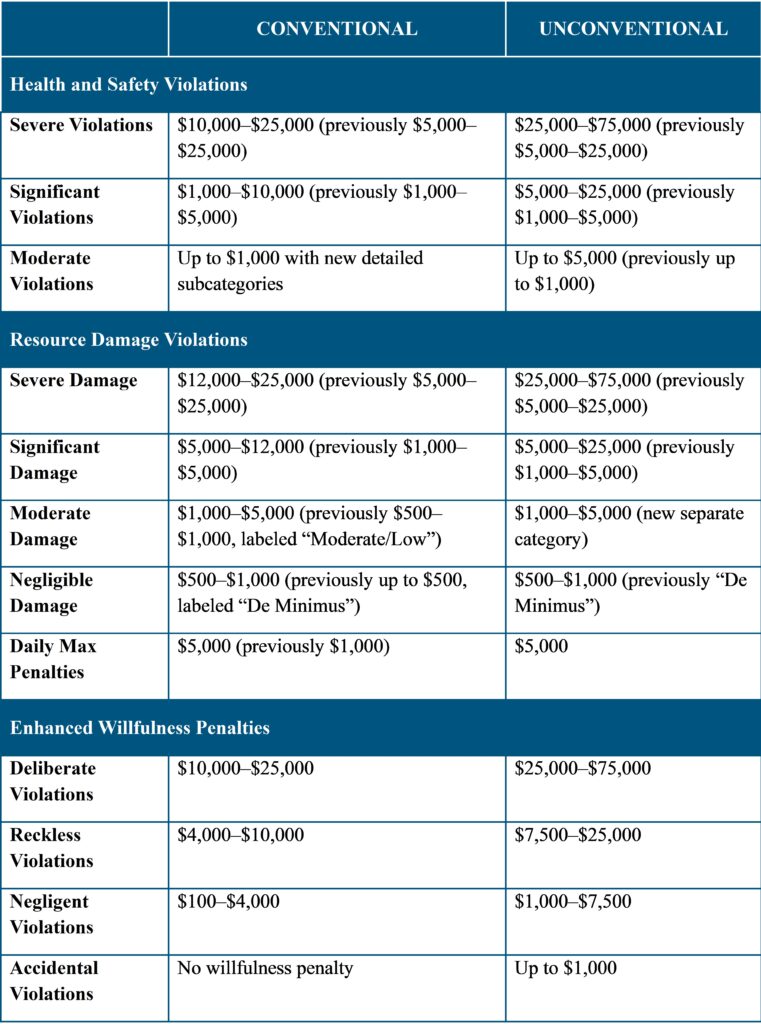
- Changes to Penalty Amounts
- Doubled Repeat Violator Enhancement for Unconventional Operators
A key difference between the conventional and unconventional civil penalty SOPs is the violator’s history multiplier applied when operators have a record of recent similar violations. For conventional operations, the maximum penalty enhancement remains at 10% of the penalty subtotal (unchanged from the 2002 TGD), while for unconventional operations, the maximum enhancement has doubled from 10% to 20% of the penalty subtotal.
SOP for Identifying, Tracking, and Resolving Oil and Gas Violations
The SOP for Identifying, Tracking, and Resolving Oil and Gas Violations introduces several important procedural updates. Environmental justice considerations are now integrated into inspections, enforcement priorities, and penalty evaluations, with new enforcement priorities for violations impacting Environmental Justice Areas and the involvement of Regional EJ Coordinators. The Department’s inspection program has been updated to include a 15-year baseline inspection cycle for all operational wells, reduced inspection frequency for gas storage wells, enhanced plugging oversight, and new inspection types such as compliance schedule evaluations. Certain inspection types, such as road spreading inspections, have been eliminated. Permitting and reporting requirements have also changed, with the removal of some notification requirements and the addition of new ones, including notifications for horizontal directional drilling, modular storage structure installations, well communication incidents, and specific gas storage well activities. Water supply investigation procedures have been significantly updated, introducing new tracking and reporting systems, a streamlined notice process, and a two-tier notification approach based on the findings of the Water Quality Specialist.
These SOPs represent substantive changes from the prior TGDs and formalize the Department’s practices moving forward regarding oil and gas compliance and enforcement matters. All oil and gas operators should review their compliance programs in light of these enhanced penalty provisions and enforcement procedures, as these SOPs are immediately effective and are already being implemented by the Department.
If you have any questions about the applicability of the new civil penalty SOPs to your operations, please contact Sean M. McGovern at (412) 394-5439 or smcgovern@babstcalland.com or Jordan N. Brown at (202) 853-3459 or jbrown@babstcalland.com.
Environmental Alert
(by Lisa Bruderly and Mackenzie Moyer)
On April 30, 2026, the Pennsylvania Supreme Court released a long-awaited opinion about the ability of a municipality to assess charges to manage stormwater runoff. Borough of West Chester v. Pennsylvania State System of Higher Education, No. 9 MAP 2023. In the opinion, the Pennsylvania Supreme Court affirmed the unanimous 2023 Commonwealth Court opinion holding that stormwater management charges are taxes, not fees, and, thus, tax-exempt entities are immune from paying such charges. The Commonwealth Court based its decision on findings that the Borough did not enter into a voluntary, contractual relationship with the University, and the University did not receive discrete benefits through payment of the stormwater charge.
As background, the Home Rule Municipality of the Borough of West Chester owns and operates a small municipal separate storm sewer system (MS4) as part of its stormwater management system. In 2016, the Borough adopted an ordinance imposing a “stream protection fee,” otherwise known as the stormwater charge, upon owners of developed property who the Borough claimed benefitted from the stormwater management system to manage and control their stormwater entering the system. The amount of the stormwater charge is calculated based on the amount of impervious surface on the property.
Accordingly, the Borough sent West Chester University invoices for payment of the charge, in the amount of approximately $132,000 per year. However, the University did not pay the invoices, arguing that the charge was a tax, and, thus, the University was exempt from payment as an entity of the Commonwealth.
In affirming the Commonwealth Court, the Court identified a two-step test for distinguishing a fee for a service from a local tax, in which the Court first examined whether the municipality is performing the service in a “quasiprivate or public capacity.” If acting in a quasiprivate capacity, the Court would then determine whether “the associated charge is measured by the service rendered.” Looking at documents, including the relevant ordinance, the Court concluded that the Borough provides stormwater management in the Borough’s public capacity. As such, analysis of the second step of the test was not necessary. The Court held that, “Where a municipality is duty bound to provide a service for the public benefit and in the absence of a voluntary, contractual relationship between itself and those receiving the service, the associated charge is a tax.”
This holding will certainly impact municipalities’ abilities to raise funds to implement stormwater management and pollution control. An amendment to the Municipality Authorities Act signed by Governor Corbett in 2013, allowed certain local governments to create stormwater authorities. Such stormwater authorities are authorized to impose fees, but not taxes. The Court’s opinion raises questions about the continued ability of stormwater authorities to assess stormwater management charges to implement, manage, and update stormwater management controls. It also raises broader questions about a municipal authority’s ability to assess other fees against tax exempt entities. In its opinion, the Supreme Court acknowledged that there will be difficulties “in navigating the regulatory landscape and the environment problems posed by unmitigated stormwater,” but that the Court must adhere to the “basic principles that define taxation.”
Babst Calland attorneys continue to track these developments and are available to assist with stormwater-related matters. For more information on this development and other water matters, please contact Lisa Bruderly at (412) 394-6495 or lbruderly@babstcalland.com, Mackenzie Moyer at (412) 394-6578 or mmoyer@babstcalland.com, or any of our other environmental attorneys.
Environmental Legal Perspective
(by Tim Bytner)
The phrase “Comprehensive Environmental Response, Compensation and Liability Act,” or “CERCLA” for short, is something that pricks the ears of environmental managers and counsel, but usually not in a good way. Certainly, the mere mention of an EPA104(e) information request is something that can cause the hands to get clammy even for the most seasoned environmental managers and in-house counsel. The concerns are not unfounded. Being named as a potentially responsible party (“PRP”) for a contaminated site, whether it be as an owner, operator or an arranger, usually is the start of a process that can take a few years to decades to complete.
I consider myself very fortunate that my career in the environmental industry has touched on just about every stage of a contaminated site. Having been an environmental consultant prior to (and during) law school, there was a time when I was the person collecting samples and preparing various plans and technical reports. Now having practiced environmental law for more than 18 years, I’m the person directing responses to information requests and negotiating with agency counsel and other PRPs on remedial investigations, cost sharing, feasibility studies, etc. Over the years, I’ve had multiple conversations with clients that began with “I just received this letter…” or “…have you seen the news today?”
It can be quite difficult to see an end to the CERCLA process, but endings can and do happen. To date, 460 sites have been removed from the National Priority List (“NPL”).[1] Some of these sites were removed from the NPL because of what I would generally term as “administrative” reasons, meaning that the site is still undergoing some form of remediation, it’s just no longer appropriate to maintain on the NPL. But there are sites that were removed from the NPL because the remedial work had been completed to an extent which rendered the site suitable for some form of future use.
For example, the Pioneer Sand Company Superfund Site, located near Pensacola Florida was added to the NPL in 1983 due to suspected contamination from the disposal of various phenols, resin compounds, plating sludges, etc. After cleanup, the site was removed from the NPL in 1993. Groundwater monitoring and operation/maintenance activities continue, but the site now presents a great opportunity for reuse, so long as the reuse is consistent with the implemented remedy. [2]
Compatibility with the remedy is the key for reuse of any contaminated site, and it is important to keep potential reuse in mind throughout the process such that the remedy can be tailored to the extent practicable to maximize reuse.
In cases that I have been involved with, the remedy often involved the construction of some form of cap to act as a barrier between the aboveground environment and any contaminated materials that remain in place below. Reuses of sites with a cap typically involve activities and/or construction that do not compromise the cap.
Another form of remedy, and one which often accompanies the implementation of a cap, is the use of institutional controls such as a restriction on the use of groundwater and/or a restriction on the use of the site for residential purposes. Although these types of restrictions prohibit the site from certain forms of redevelopment, plenty of possibilities remain.
I’ve seen many uses of sites that formerly were, and even currently are, on the NPL including warehousing, parking lots, self-storage units, nature preserves, manufacturing, etc. More recently, AI has fueled a significant demand for data centers. To that end, the EPA has developed a guidance document, which provides useful information on the criteria needed for the redevelopment of a site for use as a data center.[3] Data centers represent a prime opportunity for reuse of a contaminated site with the possibility of significant benefits, not only to the landowner but to the surrounding community as well.
The important aspect to keep in mind for any contaminated site, whether it is regulated through CERCLA or through state means, is that the space will still exist after the remediation is complete. The options for using that space are limited only by the entrepreneur’s imagination.
Tim Bytner focuses his practice primarily on federal and state environmental regulation and litigation. He advises clients on matters involving the remediation and reuse of contaminated properties under both state and federal jurisdiction and counsels clients in environmental compliance issues involving the Clean Air Act, Clean Water Act, RCRA, EPCRA, CERCLA, and a wide variety of state regulatory issues. He also has experience in environmental emergency response and the Spill Prevention, Control, and Countermeasure Rule, the Facility Response Rule, and various state planning requirements.
____________________________
[1] Environmental Protection Agency, Deleted National Priorities List (NPL) Sites – by State (April 8, 2026), https://www.epa.gov/superfund/deleted-national-priorities-list-npl-sites-state.
[2] Environmental Protection Agency, Site Redevelopment Profile: Pioneer Sand Company Superfund Site (March 31, 2026), https://semspub.epa.gov/work/HQ/403575.pdf.
[3] Environmental Protection Agency, Guidance on the Redevelopment of Superfund and Brownfield Sites as AI Data Centers, EPA-540-S-26-001 (January 2026), https://www.epa.gov/system/files/documents/2026-01/guidance-on-the-redevelopment-of-superfund-and-brownfield-sites-as-ai-data-centers.pdf.
Environmental Alert
(by Ben Clapp, Gary Steinbauer and Mackenzie Moyer)
On April 13, 2026, the U.S. Environmental Protection Agency (EPA) published a Proposed Rule in the Federal Register that would amend federal regulations related to the disposal and beneficial use of coal combustion residuals (CCR). If finalized as proposed, the amendments would provide increased regulatory flexibility, expand pathways for owners and operators of CCR disposal units to achieve compliance with federal CCR regulations, rescind or reduce the scope of regulations governing certain CCR disposal and storage areas, and reduce restrictions on the beneficial use of CCR. In addition, EPA announced that it is planning to reopen the public comment period for the proposed Federal CCR Permit Program rule, which was originally published on February 20, 2020.
Background
The federal regulation of CCR dates back to 2015, when EPA finalized the first national minimum criteria for the beneficial use and disposal of CCR as a solid waste under Subtitle D of the Resource Conservation and Recovery Act (RCRA). As reported in detail in an earlier Babst Calland Environmental Alert, in 2024, EPA supplemented the 2015 regulations by finalizing what is known as the “Legacy CCR Rule,” which expanded the scope of the federal CCR rules to regulate inactive CCR surface impoundments at inactive electric utilities, otherwise known as legacy CCR surface impoundments and CCR management units (CCRMUs). CCRMUs represent a broad general category of CCR disposal units, including inactive CCR landfills and other land-based disposal areas that had previously not been regulated under EPA’s CCR rules.
Proposed Amendments
The more notable and potentially impactful elements of the Proposed Rule are described below:
- Expansion of Option to Certify Closure by Removal for Legacy CCR Surface Impoundments: The Proposed Rule would create another option to certify closure of legacy CCR surface impoundments by removal if the removal was completed prior to November 8, 2024, under the oversight of a regulatory authority. At present, the closure by removal option for legacy CCR surface impoundments is only available to owners and operators able to certify that a legacy CCR surface impoundment has been closed by removal in accordance with the current rule’s specific performance standards. The proposal would modify this compliance pathway by allowing the owner or operator to certify closure by removal when (i) a regulatory authority played an active role in overseeing and approving the closure by removal and any necessary corrective action pursuant to an enforceable requirement issued on or after October 19, 2015, and (ii) impacts to groundwater were considered by the regulator. Enforceable requirements may include a state or federal permit, an administrative order, or consent order issued under the Comprehensive Environmental Response, Compensation, and Liability Act (CERCLA) or by an EPA-approved state RCRA program. In addition, EPA is soliciting comments on whether this compliance option should be expanded further to include removal-based closures of legacy CCR surface impoundments concluded prior to October 19, 2015, and/or such closures there were not performed pursuant to an enforceable requirement.
- Reduced Limitations on Owner/Operators’ Ability to Defer Certain Legacy CCR Surface Impoundment Closures to Permitting: The proposal would streamline an owner/operator’s ability to defer compliance with federal closure requirements for legacy CCR surface impoundments that (i) completed closure under state law prior to November 8, 2024; (ii) under the oversight of a regulatory authority; (iii) pursuant to an enforceable requirement issued after October 19, 2015; and (iv) have had groundwater monitoring performed, until the facility becomes subject to a EPA-approved state permitting program or the federal permitting program, at which point the permitting authority would make a final determination of whether the facility achieved the performance standards set for the in the federal CCR rules.
- Site-Specific Considerations during Permitting: The Proposed Rule would also create a new compliance pathway allowing for site-specific considerations during permitting for CCR units complying with groundwater monitoring, corrective action, and closure requirements under a federal or state CCR permit. If finalized, the permitting authority could make site-specific determinations regarding the appropriate point of compliance for the groundwater monitoring system, site-specific cleanup levels during corrective action for constituents without federal maximum contaminant levels, and other closure requirements. Owners or operators would still be required to ensure that the unit poses no reasonable probability of adverse effects on human health and the environment. Of particular note, EPA is also soliciting comment on an alternative closure performance standard that would allow owner/operators to close a CCR disposal unit with waste in place that is in contact with liquids, provided that (i) standing liquid and sufficient subsurface liquid is eliminated; (ii) the hydraulic condition within the CCR unit will not adversely impact the stability of the cover system; (iii) the hydraulic condition of the CCR unit will not adversely impact any required corrective actions; and (iv) the hydraulic condition will not result in a reasonable probability of adverse effects on human health and ecological factors as determined through a site-specific assessment. If finalized, this revision to the standards for closing CCR units with waste in place would represent a significant departure from EPA’s recent interpretations of CCR rule requirements to allow for such closure only when “free liquids” have been removed from the unit.
- Rescission or Limiting the Scope of CCRMU Requirements: EPA is proposing to rescind all CCRMU requirements, which would represent a significant reduction in the number of CCR units regulated under the federal rules. In the alternative, EPA is soliciting comments on several potential revisions that may be implemented alone or in combination with one another, including: (i) deferring all CCRMU requirements to permitting; (ii) allowing owner/operators to defer compliance with federal closure requirements for CCRMUs that completed closure under state law prior to November 8, 2024; (iii) exempting past onsite CCR uses that meet the definition of beneficial use; (iv) expanding the roadbed exemption to include railbeds and all roadbed and railbed embankments; and (v) increasing the threshold CCR amounts to be employed in determining whether a land-based accumulation of CCR constitutes a CCRMU. EPA is also soliciting comments on the appropriate scope of the Facility Evaluation Reports (FER) required under the current CCRMU regulations. In the preamble to the Proposed Rule, EPA states that it understands that the FER requirements may need to be modified as well, depending on what is modified for CCRMUs.
- Removal of CCR Dewatering Structures from Regulation: EPA proposes to define “CCR dewatering structures” as “a stationary device, designed to temporarily contain an accumulation of CCR which is constructed of non-earthen materials (e.g., concrete, steel, plastic). The device must be used primarily for dewatering CCR waste to facilitate disposal of CCR solids elsewhere.” As proposed, dewatering structures would not be classified as a CCR surface impoundment or a CCRMU and thus would not be subject to federal CCR regulation. Common dewatering structures may include holding basins, scrubber drying basins, fly ash washdown basins, tanks, or settling ponds.
- Expansion of the Beneficial Use of CCR: EPA is also proposing revisions to the definition of beneficial use by removing the criterion that requires environmental demonstrations for non-roadway uses of more than 12,400 tons of unencapsulated CCR on land. EPA also proposes to exclude the following beneficial uses from federal regulation: (i) CCR used in cement manufacturing at cement kilns, (ii) flue gas desulfurization (FGD) gypsum used in agriculture, and (iii) FGD gypsum used in wallboard.
As noted above, along with the Proposed Rule, EPA announced that in a separate action, it would reopen the public comment period for the Federal CCR Permit Program proposed rule originally published on February 20, 2020. Given the Proposed Rule’s increased deferral of CCR rule compliance determinations to either EPA-approved state permitting programs (at present only four states have such programs) or a federal permitting program, and its contemplated reliance on the permitting authorities to make site-specific, risk-based determinations regarding CCR rule compliance requirements, the finalization of the federal permit program is an integral component of EPA’s efforts to amend the CCR rules.
The public comment period on the Proposed Rule closes on June 12, 2026. EPA plans to hold a virtual public hearing on the proposal on May 28, 2026. Babst Calland attorneys continue to track these developments and are available to assist with CCR Rule-related matters. For more information on this development and other waste matters, please contact Ben Clapp at (202) 853-3488 or bclapp@babstcalland.com, Gary Steinbauer at (412) 394-6590 or gsteinbauer@babstcalland.com, Mackenzie Moyer at (412) 394-6578 or mmoyer@babstcalland.com, or any of our other environmental attorneys.
Public Sector Alert
(by Steve Korbel, Anna Hosack and Alex Giorgetti)
In Columbia Gas of Pennsylvania, Inc. v. Menallen Township, 351 A.3d 326 (Pa. Cmwlth. 2026), the Commonwealth Court struck down a township’s variable street opening inspection fees as applied to a public utility. The Court held that the fees constituted impermissible utility regulation preempted by the Pennsylvania Public Utility Code, 66 Pa.C.S. § 101 et seq. (the “Code”). This decision has immediate practical consequences for every Pennsylvania municipality that charges public utilities permit or inspection fees for work in the public right-of-way.
The Dispute and the Decision
Like most municipalities, Menallen Township (Township) maintained a street opening ordinance that imposed fees on anyone seeking to excavate or open a public roadway. The ordinance included a flat application fee of $150. It also imposed variable inspection fees calculated on a per hour and per square foot basis, intended to fund the Township’s inspection of the utility’s pipe installation work and its monitoring of road conditions following the restoration. Columbia Gas of Pennsylvania, Inc. (Columbia Gas), a public utility regulated by the Public Utility Commission (PUC), challenged the variable fees after the Township assessed inspection charges that far exceeded the flat application amount. Columbia Gas filed a petition for review in the Commonwealth Court’s original jurisdiction, arguing that the inspection fees were preempted under the field preemption doctrine established by the Pennsylvania Supreme Court in PPL Electric Utilities Corp. v. City of Lancaster, 654 Pa. 203, 214 A.3d 639 (Pa. 2019).
The Commonwealth Court left the $150 flat application fee undisturbed, but notably held that the variable inspection fees crossed the line from permissible right-of-way management into impermissible regulation of utility facilities and operations. The Court’s reasoning followed the analytical framework set out in Waterford Township v. PUC, 276 A.3d 301 (Pa. Cmwlth. 2022), which distinguished between two categories of municipal fees. On one side of the line are fees that regulate access to the right of way — permit fees, application fees, and similar charges that control when and how an applicant may open a street. Those remain permissible, even as applied to public utilities. On the other side are fees that regulate the quality of the utility’s work — charges tied to the scope of inspection, the duration of monitoring, or the method of installation. Those fall within the PUC’s exclusive regulatory field and are preempted.
The Court found that the Township’s per hour and per square foot inspection fees were designed to fund the Township’s own heightened inspection of the utility’s construction methods and to monitor the utility’s restoration work over time. That purpose, the Court concluded, placed the fees squarely within the preempted field. The Court noted that the dollar amount alone was not the dispositive factor. What mattered was the regulatory purpose the fees were designed to serve.
What This Means for Municipalities
The Columbia Gas decision does not eliminate a municipality’s authority to charge utilities for street opening permits. It does, however, constrain how those fees may be structured. Municipalities should keep three principles in mind:
- Flat permit or application fees remain on solid ground.Municipalities own their roads and retain authority over their streets and rights-of-way. A municipality may charge a reasonable flat fee to process an application, issue a permit, and manage access to the right-of-way. The fee must relate to the administrative cost of regulating right-of-way access, not to the scope or duration of the utility’s construction activity. This distinction is necessary to avoid allegations of preempted regulations.
- Variable fees related to the size of the excavation, the number of inspection hours, or the length of a monitoring period are vulnerable to preemption challenge when applied to PUC regulated utilities.A municipality that calculates its fee based on the square footage of the cut or the hours its inspector spends watching and monitoring the utility’s crew is, in the Commonwealth Court’s view, regulating the utility’s work — not managing access to the roadway. Such regulation impermissibly treads on the PUC’s preemptive regulation of public utilities.Despite this decision, municipalities still retain their authority as road owners. The right to define the condition in which a road must be returned after an opening — through restoration standards set as conditions of right-of-way access — is grounded in the municipality’s property interest in its own infrastructure, not in the regulation of utility operations. Assessing street opening fees in the wake of Columbia Gas requires careful structuring, but a municipality that works with its solicitor to think creatively about its ordinance and fee structure is not without recourse.
- Municipalities may still impose the full range of their existing fee structures on non-utility applicants — private contractors, developers, cable providers that are not certificated public utilities, and others.The preemption doctrine applies only where the fee functions as a regulation of a PUC jurisdictional utility. The Commonwealth Court’s decision does not apply to non-utility applicants, as the Code and its preemption do not apply to them. A two-tiered fee structure that distinguishes between utility and non-utility applicants is one way to preserve existing revenue from non-utility work while complying with the Court’s holding.
Recommended Steps
Municipalities that currently impose variable inspection or restoration monitoring fees on public utilities should review their street opening ordinances and fee resolutions promptly. In particular, a governing body should work with its solicitor to determine whether its fee structure, as applied to utilities, can withstand scrutiny under the Columbia Gas framework. Where variable fees are assessed against utilities, the municipality should consider whether an amendment to its fee resolution, its street opening ordinance, or both would better align with current law while still protecting the municipality’s infrastructure investment.
Municipalities should also be prepared for utilities to cite Columbia Gas in correspondence challenging existing fee practices. Several utilities have already begun sending letters to municipalities across the Commonwealth requesting fee adjustments. A municipality that has already reviewed its ordinance and, if necessary, adopted a compliant approach will be able to respond to those inquiries from a position of strength.
If you have questions about the Columbia Gas decision and its implications for Pennsylvania municipalities, please contact Stephen L. Korbel (412) 394-5627 or skorbel@babstcalland.com, Anna R. Hosack at (412) 394-5406 or ahosack@babstcalland.com, or Alexander O. Giorgetti at (412) 773-8718 or agiorgetti@babstcalland.com.
Firm Alert
(by Steve Silverman and Katerina Vassil)
Employers who want to protect their trade secrets and goodwill can use several types of restrictive covenants to limit departing employees from harming them in future employment. Two of the most common are non-competition (non-compete) and non-solicitation (non-solicit) provisions that can be included in employment agreements. These provisions are often confused by employers and thought to be equally enforceable, but in practice they are not. The following addresses the differences between these two types of restrictions, their respective limitations on enforcement, and why an employer may want to use one over the other, or even both.
Non-competes restrict a former employee’s ability to work for a competitor or start a competing business within a specific time frame and geographic area. Courts are hesitant to uphold non-compete agreements that overly restrict an employee’s ability to engage in work opportunities within their profession. Non-compete agreements are upheld so long as they are of reasonable duration, geographic scope, and necessary to protect legitimate business interests. If a non-compete agreement is overly broad and fails to identify legitimate business interests to be protected, courts will often refuse to enforce them. A reasonable geographic scope limitation is essential to a non-compete because of the nature of the business interest that the agreement seeks to protect.
Conversely, non-solicit agreements allow ex-employees to work for competitors but restrict them from soliciting customers and clients of the former employer for a specified time period. Non-solicit agreements do not typically include explicit geographic limitations. Instead, geographic limitations implicitly exist in non-solicit agreements based on where the specific customers or clients are located. If these customers and clients are scattered in various locations, an explicit geographic limitation could make the non-solicit agreement overly restrictive and provide insufficient protections for the former employer. Instead, because a non-solicit provision identifies a definitive and finite set of business contacts that the employee is prohibited from contacting or soliciting, such a provision is already limited in geographic scope to exclusively where those specific business contacts are.
As a matter of public policy, courts are often reluctant to limit employees’ future employment as an unfair restraint on trade. For that reason, courts will often closely examine an employer’s right to enforce a restrictive covenant before doing so. But generally, courts are more likely to enforce non-solicit clauses than non-competes. By definition, non-solicit agreements pose less restrictions on the employee’s ability to work in their chosen profession. Theoretically, an employee could begin working right next door to their former employer and would not violate the non-solicit agreement so long as they don’t bring the employer’s customers or confidential business information along with them. It is simply easier to convince a judge that an ex-employee can still earn a living and yet honor his or her non-solicit obligations than it is with a non-compete that may force that employee to move across the country to continue plying his or her trade.
Overall, it is also easier for an employer to meet the legal requirements of a non-solicit than a non-compete. For instance, an employer enforcing a non-compete must show that the geographic restriction is reasonable, justified and not overly broad. An employer enforcing a non-solicit, however, need not prove any of those elements since no geographic restriction is required. Instead, that employer must be able to specifically identify which clients and customers his ex-employee can no longer solicit business from and then justify that restriction. But enforcing a non-solicit provision can also have its own challenges, such as clearly defining and proving what is and is not considered a “solicitation.” Hopefully, good drafting of that provision by an experienced attorney will adequately address that issue. Additionally, the non-solicit should include a “non-acceptance” clause prohibiting the employee from accepting business from those clients or customers who initiate contact with the employee first.
Some employers may want to use a “belt and suspenders” approach by utilizing both non-compete and non-solicit provisions in their employment agreements. The thought being if one is not enforceable, then the other may be. The downside is that some courts that invalidate one may think there is overreaching in trying to enforce the other. Typically, whether to utilize both types of provisions depends on the unique needs of the employer and the particular threats posed by the employee given the nature of their position. For instance, it will be easier to enforce both provisions against a C-Suite employee than it will against a salesperson.
A recent case illustrates the differences between non-competes and non-solicits and yet may also throw some of these distinctions for a loop. On February 18, 2026, the Pennsylvania Superior Court issued a non-precedential opinion in First Nat. Trust Co. v. English et al., No. 1109 WDA 2025 (Pa. Super. Feb. 18, 2026), which is in essence a one-stop shop for all things Pennsylvania restrictive covenant law, with analysis and application of the Pennsylvania courts’ historical handling of non-compete and non-solicit agreements. However, the Superior Court included a deviation from years of established case law on non-solicit principles by saying that non-solicits need a geographic limitation to be enforceable.
If relied on by other courts, this would make non-solicit agreements far more complicated to draft to ensure their enforceability. Employers would be forced to make difficult decisions: either include a broad geographic scope in their non-solicits to guarantee capturing an entire customer base that could not be solicited or self-edit to limit those customers by limiting the geographic scope of the provision to avoid overreaching that would render the provision unenforceable. Just as significantly, this requirement could invalidate literally tens of thousands of current employment agreements containing non-solicits without geographic restrictions. In drafting non-solicits with added geographic restrictions, attorneys could be forced to identify the location of every customer the employer-client seeks to prohibit the employee from soliciting. This would also require these agreements to be regularly updated, raising issues of additional consideration and enforceability. Besides impracticability, this would significantly increase the employer’s legal expenses and potentially throw judicial review of these provisions into disarray. For those reasons, hopefully other courts will see that in this particular instance, the Superior Court simply misspoke when noting that a non-solicit must also have a geographic restriction to be enforceable.
The bottom line is that employers must weigh the potential risks versus potential rewards in deciding whether to bind their employees to non-compete or non-solicit provisions, or even both. Regardless, the ultimate goal is to strike a balance by using those restrictive covenants that protect the employer’s legitimate protectible interests that are narrowly tailored enough to be enforceable.
If you have questions about the use of non-competes or non-solicit agreements under existing state law or how to properly enforce them, please contact Steve Silverman at 412-253-8818 or ssilverman@babstcalland.com or Katerina Vassil at 412-394-6428 or kvassil@babstcalland.com.
Environmental Alert
(Christopher (Kip) Power, Robert Stonestreet and Joseph (Jed) Meadows)
Following up on a proposal published on June 16, 2025 (see Client Alert: “Federal Office of Surface Mining Proposes to Restore Coal Mine Regulatory Oversight Rules”), on February 19, 2026, the federal Office of Surface Mining Reclamation and Enforcement (OSM) finalized revisions to its oversight rules under the Surface Mining Control and Reclamation Act of 1977 (SMCRA), eliminating several aspects of the Biden-era version of the regulations (identified as “Ten-Day Notice and Corrective Action for State Regulatory Program Issues” rule, published in April 2024 (the 2024 Rule)). The new regulations largely return them to the 2020 version of the rule, “Clarification of Provisions Related to the Issuance of Ten-Day Notices to State Regulatory Authorities and Enhancement of Corrective Action for State Regulatory Program Issues,” (the 2020 Rule), adopted during the first Trump administration. Effective March 23, 2026, the new rule (the 2026 Rule) restores the 2020 Rule’s framework promoting states as the primary environmental regulatory authorities for coal mining operations. It does away with programmatic challenges in the guise of state-specific oversight and reinstates provisions requiring that the relevant State agency be given notice and an opportunity to correct any alleged violation brought to OSM’s attention. The new rule also makes some minor revisions to the 2020 Rule’s text to streamline coordination between agencies and to reduce duplicative actions.
States that have obtained OSM approval to administer their own coal mining regulatory program consistent with SMCRA (known as Primacy States) possess primary regulatory power within their borders. OSM retains oversight authority where (1) there is reason to believe SMCRA has been violated and (2) there is reason to believe that a Primacy State has failed to enforce its regulatory programs. Where there is reason to believe SMCRA has been violated, OSM is required to issue a Ten-Day Notice (TDN), giving a Primacy State ten days to respond with either remedial action or providing good cause for not taking remedial action. The 2020 Rule represented OSM’s attempt to (1) enhance the early identification of State regulatory program issues so that they could be corrected programmatically and (2) clarify and reduce duplication in the federal regulations related to OSM’s processing of citizen complaints and the issuance of TDNs to State regulatory authorities. The 2020 Rule largely maintained SMCRA’s deference to Primacy States and limited the scope of TDN issuance by OSM.
OSM re-examined the 2020 Rule under the Biden administration, leading to the 2024 Rule, published on April 9, 2024. Though purportedly meant to “increase efficiency and [] make it easier for citizens to report possible [SMCRA] violations” the 2024 Rule effectively “usurp[ed] SMCRA’s deference to States[.]” According to OSM, the 2020 Rule did so in at least two ways. First, the rule allowed citizens to report potential SMCRA violations directly to OSM without consulting Primacy States. Second the rule authorized OSM to issue TDNs based on programmatic (rather than site-specific) concerns. The introduction of the 2024 Rule led to large increases in both citizen complaints and the number of TDNs issued to Primacy States, representing additional paperwork for OSM and Primacy States “without any clear indication that [the 2024 Rule] improved enforcement or oversight of SMCRA.”
Returning to the 2020 Rule better aligns the federal regulatory scheme with SMCRA and facilitates more efficient coordination between OSM and Primacy States. According to OSM, this maintains cooperative federalism and deference to the States while achieving the goals of SMCRA. For example, OSM may once again rely on information from any source in determining whether a SMCRA violation exists. The 2026 Rule also restores a site-specific format for citizen reporting, by specifying that a citizen’s request for federal inspection “must allege a violation at a specific mine” instead of alleging violations generally. Despite largely returning to the 2020 Rule’s language, the 2026 Rule retains some administrative features of the 2024 Rule, such as granting OSM the ability to group “substantively similar possible violations” into a single TDN, allowing for increased efficiency.
Overall, the 2026 Rule represents a return to a state-focused regulatory scheme, ensuring that Primacy States retain their primary authority to regulate environmental aspects of coal mining operations within their borders. Challenges to the new rule must be filed within 60 days of its publication, in the U.S. District Court for the District of Columbia.
Consistent with the role of Primacy States under SMCRA, OSM also recently granted authority to the West Virginia Department of Environmental Protection (WVDEP) to regulate coal mining operations on federal lands within the state. On February 19, 2026, OSM and West Virginia signed an Amended Cooperative Agreement, giving the WVDEP primary authority to regulate mining of privately owned coal located under federal lands and federally owned coal leased by the U.S. government. See OSM’s announcement here.
For questions about the revised TDN rules or other issues arising under SMCRA and/or counterpart State regulatory programs, please contact Christopher B. (Kip) Power at (681) 265-1362 or cpower@babstcalland.com; Robert M. Stonestreet at (681) 265-1364 or rstonestreet@babstcalland.com; Joseph E. (Jed) Meadows at (681) 265-2111 or jmeadows@babstcalland.com; or your Babst Calland relationship attorney.
Environmental Alert
(by Sloane Wildman and Ethan Johnson)
On February 23, 2026, EPA announced its final rule adding sodium perfluorohexanesulfonate (PFHxS-Na) to the Toxics Release Inventory (TRI) under the Emergency Planning and Community Right-to-Know Act. Businesses in covered industries must now track and report any use or release of PFHxS-Na above the reporting threshold of 100 lbs. The reporting period began January 1, 2026 and the first reports are due July 1, 2027.
PFHxS-Na is the latest PFAS chemical added to the TRI under the 2020 National Defense Authorization Act, which requires EPA to add new PFAS chemicals to the TRI each year. EPA added seven PFAS chemicals to the TRI in 2024 and nine PFAS chemicals in 2025. EPA first announced that PFHxS-Na would be listed on the TRI in October, 2025, after the agency finalized the chemical’s toxicity value. EPA maintains a complete list of PFAS added to the TRI here. Adding PFAS chemicals to the TRI is part of EPA’s broader PFAS action plan that we reported on in our April 30, 2025 Environmental Alert.
Babst Calland’s Environmental attorneys closely tracking EPA’s PFAS actions, and our attorneys are available to provide strategic advice on how developing PFAS regulations may affect your business. For more information or answers to questions, please contact Sloane Wildman at (202) 853-3457 or swildman@babstcalland.com, Ethan Johnson at (202) 853-3465 or ejohnson@babstcalland.com, or your client relationship attorney at Babst Calland.
Firm Alert
(by David White, Marc Felezzola and Angela Harrod)
Given the sharp rise in AI usage, courts have begun wrestling with the extent to which usage of AI tools for assistance with legal issues is protected from disclosure in discovery or otherwise. Early court decisions demonstrate there is considerable risk that communications between a client and an AI platform may not be protected by the attorney-client privilege or work-product doctrine.
The attorney-client privilege generally protects communications between a lawyer and client from disclosure. Similarly, per Federal Rule of Civil Procedure 26(b)(3)(A), the work-product doctrine protects “documents and tangible things that are prepared in anticipation of litigation or for trial.”
Two courts recently released opinions that provide important insights into the risk of accidentally waiving attorney-client privilege or work-product doctrine when a client turns to AI tools. In United States v. Heppner, No. 1:25-cr-00503-JSR, ECF. 27 (S.D.N.Y. Feb. 17, 2026), the court ruled that an individual’s inputs and the resulting outputs generated by a non-enterprise AI tool (meaning a public tool that is generally available at a consumer-level) are not protected by the attorney-client privilege or the work-product doctrine even if the individual using the AI tool was involved in litigation and was seeking legal advice.
The Heppner court held that the attorney-client privilege does not extend to “communications” between an individual and an AI platform, only to communications between a client and its counsel. The court further noted that the AI tool used by the individual in Heppner included a disclaimer that user submissions were not confidential. As such, the court held that the use of the tool constituted a third-party disclosure, which is not protected by attorney-client privilege.
The Heppner court also held that the AI-generated materials were not protected as work product because they were (1) not created by or at the direction of counsel, and (2) were not generated to reflect a legal strategy, especially since counsel was not involved in the AI use. It is unclear if the court would have ruled differently if counsel had instructed its client to use the AI tool.
The court also determined that the use of the AI tool independent of counsel is not work product as the protection only applies to “attorney” work product. The court declined to extend the protection to the client’s own work product.
There have been other cases in which courts have extended the work-product doctrine to include what clients generate for themselves. For example, in the same jurisdiction as Heppner, the court in Felder v. Warner Bros. Discovery, No. 23-Cv-8487, 2025 WL 3628224 (S.D.N.Y. Dec. 15, 2025) specifically held that client-generated non-AI materials are protected as work product.
The court in Heppner did not address whether counsel’s use of an AI tool to inform case strategy would allow the application of attorney-client privilege and/or the work-product doctrine. However, another recent case addressed just that issue.
In Warner v. Gilbarco, No. 2:24-cv-12333, 2026 BL 43591 (E.D. Mich. Feb. 10, 2026), the court held that materials generated by AI tools in litigation preparation were not discoverable. Unlike in Heppner, where the court held that disclosure to a consumer AI tool constituted a disclosure to a “third-party,” thereby destroying the attorney-client privilege, the court in Warner held that generative AI is a tool and not a person, and therefore, disclosure to it did not destroy confidentiality.
The Warner court found no meaningful distinction between using AI tools to prepare case materials and other actions that are historically protected as work product, such as an attorney taking notes during interviews of fact witnesses. The court did not even require a privilege log to be issued specific to the AI-generated materials, ruling that the party could simply object on the basis of attorney-client privilege and/or work-product doctrine.
Because the Heppner court took special notice that the generative AI tools were used by a non-attorney and were not confidential, clients and their counsel must be mindful of what AI tools are being utilized and by whom. Under Heppner, use of consumer-level AI tools such as ChatGPT, even if used by an attorney, could destroy attorney-client privilege. Additionally, as Heppner suggests, there may be no work-product protection for the inputs or outputs from an AI tool used by a non-attorney, even if the user is turning to the tool for assistance in formulating litigation strategy. While Warner suggests some courts may be more protective of AI-generated information, the prudent approach to protecting AI inputs and outputs from disclosure requires using tools that are specifically designed to maintain confidentiality. Even then, the usage of AI tools should be by or, at the very least, at the direction of counsel.
For questions about using AI-generative tools in legal matters and their protection under the attorney-client privilege or work-product doctrine, please contact David White at (412) 394-5680 or dwhite@babstcalland.com; Marc Felezzola at (412) 773-8705 or mfelezzola@babstcalland.com; or Angela Harrod at (412) 394-5688 or aharrod@babstcalland.com.
Environmental Alert
(Christopher (Kip) Power and Robert Stonestreet)
A federal court has revived a dormant lawsuit challenging a fundamental procedure for implementation of the federal Endangered Species Act (ESA) for coal mining projects. The outcome of this lawsuit will likely have a substantial impact on the permitting and regulation of coal mining operations in the United States.
Section 7 of the ESA prohibits any federal agency from authorizing an action that is likely to “jeopardize the continued existence of” any endangered or threatened species, or cause “the destruction or modification of [designated critical habitat] of such species.” 16 U.S.C. § 1536(a). To ensure that their permitting or other actions will not violate this prohibition, federal agencies are required to consult with the U.S. Fish and Wildlife Service (Service) within the U.S. Department of the Interior. The Service is the primary federal agency responsible for enforcing the ESA. Somewhat related to the Section 7 prohibition, Section 9 of the ESA forbids any person from “taking” an endangered species, which includes actions that “harm” such species in any way (whether permitted under a separate regulatory program or not). 16 U.S.C. § 1538 (a)(1)(B).
The federal Surface Mining Control and Reclamation Act of 1977 (SMCRA) is a comprehensive, multi-media statute regulating the environmental aspects of coal mining. SMCRA created the Office of Surface Mining Reclamation and Enforcement (OSM), a sister agency to the Service within the Interior Department, to promulgate and administer rules for issuing mining permits and establishing environmental protection performance standards for permitted mining operations. SMCRA recognizes that, due to differences in geology and other environmental conditions among the States, governmental responsibility for implementing its requirements “should rest with the States.” SMCRA § 101(f). Therefore, SMCRA allows the Secretary of the Interior to delegate the primary authority for administering its requirements (known as “primacy”) to a State, upon approval of a detailed State regulatory program and subject to continued oversight by OSM.
To promote continued compliance with both statutes, OSM and the Service engaged in a programmatic ESA Section 7 consultation in 2017 with respect to all mining permits that may be issued under SMCRA, either by OSM or by a regulatory authority in a State that has been granted primacy (Primacy State). This consultation was intended to support the possible development of a new “Biological Opinion” for ESA compliance, which would replace one issued in 1996. This consultation was based upon (among other things) OSM’s existing regulations that mirror ESA’s Section 7 prohibition; OSM’s oversight rules for approved programs administered by Primacy States; a comprehensive 2020 Biological Assessment addressing the coal mining industry and possible impacts on endangered species and critical habitats; and a detailed “SMCRA Coordination Process” that was developed to build upon OSM regulations to ensure that ESA requirements are fulfilled prior to Primacy State issuance of mining permits.
The results of the 2017 – 2020 consultation are reflected in a “Final Programmatic Biological Opinion and Conference Opinion” between those agencies dated October 16, 2020 (the “2020 BiOp”). Under the 2020 BiOp, a Primacy State is required to engage in a detailed ESA-specific “technical assistance process” with the Service and applicants for mining permits, renewals of permits, and significant revisions. Assuming the steps outlined in the 2020 BiOp are followed, the Service determined that OSM and a Primacy State satisfies ESA Section 7 with respect to such permitting actions. In addition, the Service found that compliance with specific “Terms and Conditions” set forth in an accompanying “Incidental Take Statement” will exempt actions authorized by such permits from the “take” prohibitions of ESA Section 9.
On November 8, 2023, the Center for Biological Diversity and Appalachian Voices filed a complaint in the District Court for the District of Columbia against OSM and the Service, alleging that the named federal officials (and several Primacy States, who were not joined in the litigation) failed to comply with the 2020 BiOp. Therefore various mine permitting actions taken under the 2020 BiOp violated ESA Sections 7 and 9. Center for Biological Diversity, et al. v. OSM, et al., Civil Action No. 23-cv-3343 (D.D.C.) (OSM Litigation). Based on that claim, the challengers asked that the 2020 BiOp be set aside, which would make it unavailable for future use and would also likely invalidate any permits issued by those Primacy States under the 2020 BiOp, as well as ESA Section 9 protection for the permittees under those permits. In the alternative, the complaint in the OSM Litigation claims that even if there has been compliance with the 2020 BiOp, its provisions are inadequate to comply with the ESA. Thus, it should be vacated as part of an order requiring that OSM and the Service re-initiate the Section 7 consultation process.
Since the OSM Litigation involves a record-based challenge to the issuance of the 2020 BiOp, the case will be decided on cross-motions for summary judgment. Following various procedural disputes concerning the administrative record and other matters, the OSM Litigation was scheduled for summary judgment briefing to start in late June, 2025. However, on June 6, 2025, the challengers filed a motion to stay the case and defer briefing pending the outcome of another case pending in the U.S. Court of Appeals for the District of Columbia Circuit, Center for Biological Diversity v. Environmental Protection Agency, Appeal No. 24-5101 (D.C. Circuit) (EPA Appeal). The challengers asserted that the EPA Appeal involves similar issues arising under EPA’s delegation of the Clean Water Act’s Section 404 permitting program to the State of Florida that was deemed to satisfy the agencies’ ESA Section 7 requirements upon completion of a technical assistance process between the Service and Florida officials. Though OSM and the Service did not agree that the EPA Appeal is relevant to the OSM Litigation, they initially agreed not to oppose the stay motion, which was granted on June 13, 2025.
On February 11, 2026, the court lifted the stay and entered a new briefing schedule in the OSM Litigation at the request of the federal agencies and over the objection of the challengers. The challengers’ summary judgment motion is due on March 4, 2026; responses and cross-motions for summary judgment by the agencies are due March 25, 2026; replies and opposition briefs by the challengers are due April 8, 2026; and the agencies’ replies are due April 22, 2026. Although there is no deadline for when a decision must be made, a ruling is expected before the end of 2026.
Whichever way the court rules, it will be a very significant decision with respect to administration of ESA requirements in the context of SMCRA permitting, which will have important implications for the majority of coal mining projects in the United States. Anyone involved in coal mining or related activities should certainly stay tuned.
For questions about the OSM Litigation or other issues arising under SMCRA or the ESA, please contact Christopher B. (Kip) Power at (681) 265-1362 or cpower@babstcalland.com; Robert M. Stonestreet at (681) 265-1364 or rstonestreet@babstcalland.com; or your Babst Calland relationship attorney.
Environmental Alert
(by Gina Buchman, Gary Steinbauer, Christina Puhnaty and Alex Graf)
On February 12, 2026, the U.S. EPA announced a rule finalizing EPA’s repeal of the Obama administration’s 2009 Endangerment Finding as well as all federal greenhouse gas emissions standards for vehicles and engines of model years 2012 and beyond (Final Rule). Administrator Zeldin originally announced the agency’s intent to do so in March of 2025 as part of the agency’s “31 Historic Actions to Power the Great American Comeback” announcement, and a proposed rule was issued in August of 2025. See 90 Fed. Reg. 36288 (Aug. 1, 2025). The Final Rule has not yet been published in the Federal Register, but a pre-publication version of the Final Rule is available on EPA’s website.
The “endangerment finding” refers to the finding EPA made in 2009 prior to setting emissions standards for new motor vehicles and engines pursuant to Section 202(a)(1) of the Clean Air Act, which requires EPA to regulate “the emission of any air pollutant from any class or classes of new motor vehicles or new motor vehicle engines, which . . . cause, or contribute to, air pollution which may reasonably be anticipated to endanger public health or welfare.” In 2009, EPA concluded that “the current and projected concentrations of the six key well-mixed greenhouse gases—carbon dioxide, methane, nitrous oxide, hydrofluorocarbons, perfluorocarbons, and sulfur hexafluoride—in the atmosphere threaten the public health and welfare of current and future generations.” 74 Fed. Reg. 66496 (Dec. 15, 2009). EPA further concluded that the combined emissions of these well-mixed greenhouse gases from new motor vehicles and new motor vehicle engines contribute to the greenhouse gas pollution that threatens public health and welfare. The 2009 Endangerment Finding was upheld by the U.S. Court of Appeals for the District of Columbia Circuit in 2012. See Coalition for Responsible Regulation v. EPA, 684 F.3d 102 (D.C. Cir. 2012), rev’d on other grounds Utility Air Regulatory Grp. v. EPA, 134 S. Ct. 2427 (2014).
Trump EPA’s Repeal
The Trump administration is now repealing the 2009 Endangerment Finding and subsequently promulgated vehicle and engine standards. The repeal relies on several Supreme Court decisions that EPA states “significantly clarified the scope of EPA’s authority under the [Clean Air Act] and made clear that the interpretive moves the Endangerment Finding used to launch an unprecedented course of regulation were unlawful,” including Loper Bright Enterprises v. Raimondo, 603 U.S. 369 (2024) (overturning Chevron deference), West Virginia v. EPA, 597 U.S. 697 (2022) (invoking the major questions doctrine), Michigan v. EPA, 576 U.S. 743 (2015) (requiring cost considerations in statutory interpretation), and Utility Air Regulatory Group v. EPA, 573 U.S. 302 (2014) (rejecting the application of greenhouse gas emissions standards to Title I and Title V stationary sources). EPA’s Final Rule repeals the 2009 Endangerment Finding on two primary bases:
- Section 202(a) does not provide statutory authority for EPA to prescribe emission standards for the purpose of addressing global climate change.
- There is no requisite control technology for light-, medium-, or heavy-duty vehicles and engines that would meaningfully address the potential public health or welfare impacts of related greenhouse gas emissions. Even if the United States were to eliminate all greenhouse gas emissions from all vehicles, there would be no material impact on global climate indicators through 2100.
According to EPA, both conclusions independently give rise to the agency having exceeded its authority with the 2009 Endangerment Finding and the resulting regulations. Additional conclusions advanced by EPA in the Final Rule include:
- Section 202(a)(1) requires EPA to find that the specific air pollutant emissions from the class of new motor vehicles or engines at issue cause, or contribute to, the same air pollution that EPA finds endangers public health or welfare, without relying on international emissions. Under this interpretation, EPA concludes that the agency is precluded from issuing standalone endangerment and contribution findings.
- The policy response of the United States to global climate change concerns is a question for Congress, and Congress did not decide this policy response when promulgating Section 202(a)(1).
- EPA’s 2009 Endangerment Finding relied on a “profound misreading” of the Supreme Court’s Massachusetts v. EPA, which decision held that greenhouse gases are “air pollutants” under Section 302(g), but “did not require EPA to make an endangerment finding and did not address the logic or conclusions on which EPA would later base its 2009 Endangerment Finding.”
Immediate Impact: Vehicle and Engine Standards
Relying on the 2009 Endangerment Finding, beginning in 2010, EPA promulgated numerous vehicle and engine standards applicable to those vehicles and engines manufactured or imported into the United States, which created obligations for manufacturers to measure, control, and report greenhouse gas emissions for engines and vehicles. This includes the light-duty vehicle greenhouse gas standards for model years (MY) 2012-2016, MY 2017 and later, MY 2021-2026, and MY 2027 and later multi-pollutant standards. For medium- and heavy-duty vehicle and engine greenhouse gas standards, this includes the Phase 1, Phase 2, and Phase 3 standards.
Along with repealing the 2009 Endangerment Finding, the Final Rule also repeals all the aforementioned light-, medium-, and heavy-duty engine and vehicle greenhouse gas emission standards. Absent the 2009 Endangerment Finding, EPA stated that it lacks statutory authority to prescribe standards for greenhouse gas emissions under Section 202(a)(1). As a result, engine and vehicle manufacturers will no longer have an obligation to measure, control, and report greenhouse gas emissions, including for MYs manufactured prior to the effective date of the Final Rule.
The Final Rule also removes certification requirements and associated test procedures related to greenhouse gas emissions, as well as the averaging, banking, and trading provisions for the emissions credit program specific to greenhouse gas emissions. Mobile source regulations unaffected by the final rule are mobile source air toxics standards and vehicle fuel economy standards and labeling requirements (CAFE). The CAFE standards are administered by the National Highway Traffic Safety Administration (NHTSA) under separate statutory authority.
Long-Term Impact: Greenhouse Gas Regulation
EPA’s repeal of the 2009 Endangerment Finding does not affect existing stationary source greenhouse gas regulations but may call into question the underlying determinations made by EPA to regulate greenhouse gas emissions in those standards. EPA notes in the Final Rule preamble that the consequences of the agency’s former broad interpretation of its authority under Section 202(a) in the 2009 Endangerment Finding were not limited to mobile sources and that the agency has applied the 2009 Endangerment Finding’s analytical framework to various other rulemakings, including provisions governing existing vehicles, stationary sources, aircraft, and oil and gas operations. Although EPA does not regulate stationary sources pursuant to Section 202(a)(1) of the Clean Air Act, Section 111 similarly requires EPA to regulate emissions from stationary sources in source categories that “cause[], or contribute[] significantly to, air pollution which may reasonably be anticipated to endanger public health or welfare.” Accordingly, in many post-2009 rulemakings, EPA has relied, at least in part, on the 2009 Endangerment Finding as a basis to regulate greenhouse gas emissions from stationary sources.
For example, in promulgating its 2016 40 C.F.R. Part 60, Subpart OOOOa rulemaking, EPA relied in part on the 2009 Endangerment Finding to establish a rational basis for establishing regulations to control methane, a greenhouse gas, from the oil and natural gas source category. See 81 Fed. Reg. 35824, 35833–37, 35877 (June 3, 2016). EPA’s position in 2016—which EPA reaffirmed in its 2024 methane rule promulgating Subpart OOOOb—was that it needed to only have a rational basis for determining which pollutants to regulate under Section 111(b)(1) and that it was not required to make pollutant-specific significant contribution findings when promulgating such standards. 81 Fed. Reg. at 35828; 89 Fed. Reg. 16820, 16854 (Mar. 8, 2024). Despite EPA’s partial reliance on the 2009 Endangerment Finding to establish this rational basis with respect to methane, the Final Rule does not immediately impact EPA’s OOOO/a/b/c rulemakings.
Expected Legal Challenges and Resulting Legal Uncertainty
States, environmental groups, and others have vowed to swiftly challenge EPA’s repeal. The expected legal challenges, which cannot be filed until EPA publishes the Final Rule in the Federal Register, could take years to run their course and may unfold over the remaining three years of this administration and perhaps longer. Federal courts, including the U.S. Supreme Court, may ultimately decide the fate of the Final Rule.
Furthermore, it is unclear whether the repeal will leave litigants involved in so-called climate change tort cases without CAA preemption defenses. States, entities, and individuals have brought tort actions against energy and other companies asserting common law claims for alleged climate change harms. Companies defending themselves in these actions often argue that such common law tort claims are preempted under the CAA. Although EPA states in the Response to Comments it issued with the Final Rule that the repeal of the 2009 Endangerment Finding that it believes that federal common laws claims are still preempted under the CAA, it is silent on state common law claims. Whether EPA’s repeal of the Endangerment Finding limits available defenses in these climate change tort actions likely will be decided in the courts.
Babst Calland’s Environmental practice attorneys are closely tracking these developments and are available to provide guidance on how these actions affect your business. For more information, please contact Gina Buchman at (202) 853-3483 or gbuchman@babstcalland.com, Gary Steinbauer at (412) 394-6590 or gsteinbauer@babstcalland.com, Christina Puhnaty at (412) 394-6514 or cpuhnaty@babstcalland.com, or Alexandra Graf at (412) 394-6438 or agraf@babstcalland.com.
Renewables Alert
(by Morgan Madden and Anna Jewart)
While agrivoltaics, the practice of combining photovoltaic electric generation with agricultural production, dates back to the early 1980s, the use thereof has gained increasing popularity over the past 10-15 years.[1] To farmland owners and solar project developers alike, the promotion of agrivoltaics offers potential for expanded opportunities in both the solar industry and the agricultural sector. Often, when use of agricultural land is proposed to be used for solar generation, the landowner remains intent on continuing to crop-farm (agrovoltaics), or to allow livestock grazing (rangevoltaics) on the property and in modern industry spaces, solar and agriculture are often considered compatible uses. Despite that reality, zoning ordinances do not often contemplate a mixed use of that nature. Consequently, Babst Calland is often asked to analyze whether or not an agrivoltaic use can proceed as an “agriculture” or “farming” use under local zoning ordinances.
Due to the highly-localized nature of land use regulation in Pennsylvania, what “use” applies to a proposed solar project will depend first and foremost on the applicable local ordinance. However, recently, on January 15, 2026, the Pennsylvania Commonwealth Court in West Lampeter Solar 1, LLC v. West Lampeter Township Zoning Hearing Board, 2026 WL 110932, No. 76 C.D. 2025 (Pa. Cmwth. Jan. 15, 2026)[2] rejected a developer’s assertion that its proposed “agrivoltaics solar farm” was an “agricultural use” for purposes of zoning approval. In doing so, the Court appeared to reject the contention that energy generation could be considered agricultural in any instance, potentially throwing both literal and figurative shade on projects seeking to benefit from agrivoltaics processes.
In West Lampeter Solar, the solar developer applicant sought special exception approval from the West Lampeter, Lancaster County, Zoning Hearing Board as a use not provided for in an agricultural district. The applicant proposed a twenty-five (25) acre ground mounted solar array with sheep grazing between and beneath the panels. The local ordinance restricted nonagricultural uses to five acres in an agricultural district but did not define “agriculture”. The zoning hearing board was therefore tasked with determining whether or not the proposed use was “agricultural” or “nonagricultural” based on the dictionary definitions. The zoning hearing board adopted the definition of “agriculture” as “[t]he science, art, or practice of cultivating the soil, producing crops, and raising livestock and in varying degrees the preparation and marketing of the resulting products [.]” The zoning hearing board found the proposed use was “nonagricultural” and thus restricted to no more than five acres.
On appeal the Lancaster County Court of Common Pleas affirmed the zoning hearing board’s denial of the application and its finding that the use was “nonagricultural”. In doing so, it relied in part on testimony as to the treatment of agrivoltaics use by commonwealth agencies, such as the Clean and Green Program’s position that solar power generation is not agricultural use, and Pennsylvania Department of Agriculture guidance which discourages the placement of solar generating facilities on agricultural land, particularly where that land contains higher class soils. It also rejected the applicant’s assertion that agrivoltaics constituted a “dual use”.
On further appeal, the Commonwealth Court was asked, in part, to consider whether the lower court erred in failing to consider agrivoltaics as a form of agriculture. Despite the issue not being specifically raised on appeal, in its Opinion and Order affirming the lower court’s order, the Court opined that the “Department of agriculture specifically advises that a ‘commercial scale solar’ or ‘solar farm’ does not meet the definition of normal agricultural operation under the Right to Farm Act, . . . and therefore, it will not receive protection from local ordinances, otherwise given to agricultural operations.” West Lampeter Solar, supra at 11. The Court noted that the applicant argued that agrivoltaics constituted a “technological development within the agricultural industry” an argument to which it responded “[w]e disagree.” The Court ended its analysis of the issue by stating the “Zoning Board’s conclusion that ‘agrivoltaics’ does not constitute an agricultural use [was] unassailable.” Id. at 15.
Typically, land use cases involving issues of ordinance interpretation, such as West Lampeter Solar are highly fact-specific and have minimal precedential value. However, in this instance, the Commonwealth Court chose to stray beyond the text of the ordinance before it, and into issues of agricultural policy. The Court’s treatment of the applicant’s arguments in West Lampeter serves as a clear indicator as to how the Court may consider similar arguments in other zoning jurisdictions.
Morgan M. Madden is an associate in Babst Calland’s Public Sector, Energy and Natural Resources, and Employment and Labor Groups and focuses her practice on land use, zoning, planning, labor and employment advice, and litigation. Contact her at 717.868.8381 or mmadden@babstcalland.com. Anna S. Jewart is an associate in the public sector, and energy and natural resources groups of Babst Calland and focuses her practice on land use, zoning, and general municipal matters. Contact her at 412-253-8806 or ajewart@babstcalland.com.
_______________________
[1] Chloe Marie, Kole Zellers & Brook Duer, Agrivoltaics, Agricultural Law Fact Sheet, PennState Law Center for Agricultural and Shale Law, CASL Publication No. FS24-030 (May, 2024).
[2] Opinion reported, citation pending.
Environmental Alert
(by Sloane Wildman and Alex Graf)
After EPA announced that it would retain the CERCLA hazardous substance designations for PFOA and PFOS on September 17, 2025, it filed a motion to lift the abeyance from the ongoing litigation regarding the designations in the D.C. Circuit in Chamber of Commerce of the United States of America v. EPA, No. 24-1193 (D.C. Cir.). The case was initiated in June 2024 when the U.S. Chamber of Commerce and other industry groups challenged the Biden administration’s final rule designating PFOA and PFOS as CERCLA hazardous substances in the D.C. Circuit. In February 2025, after the Trump administration took office, EPA requested that the court hold the case in abeyance while it considered whether it would take a different position on the designation.
After briefing concluded, oral argument was held before a panel of three D.C. Circuit judges on January 20, 2026. Although the parties’ oral arguments largely focused on the cost-benefit analysis conducted by EPA in promulgating the final rule, the ultimate issue in the case is whether EPA properly exercised its authority under CERCLA Section 102(a) to list PFOA and PFOS as hazardous substances, since they were not already designated under another environmental statute. The court is likely to issue an opinion sometime later this year.
Please see Babst Calland’s September 19, 2025 Environmental Alert for more information on EPA’s retention of the PFOA and PFOS hazardous substance designations.
Babst Calland’s Environmental Practice Group is closely tracking EPA’s PFAS actions and related litigation, and our attorneys are available to provide strategic advice on how developing PFAS regulations may affect your business. For more information or answers to questions, please contact Sloane Wildman at (202) 853-3457 or swildman@babstcalland.com or Alexandra Graf at (412) 394-6438 or agraf@babstcalland.com.
Employment and Labor Alert
(by Cella Iovino and Katerina Vassil)
Over half of the states in the U.S. have enacted legislation to prohibit hair-based discrimination, and Pennsylvania has now followed suit. The Creating a Respectful and Open World for Natural Hair (CROWN) Act, signed into law on November 25, 2025, goes into effect on January 24, 2026. This state-wide measure follows CROWN Act ordinances passed by the Allegheny County and Pittsburgh City Councils in 2020 offering local protections, but Pennsylvania’s new law has several unique nuances.
The purpose of the CROWN Act is to address longstanding biases where natural hair and protective styles were deemed to be unprofessional or inappropriate, resulting in racial or religious discrimination. To target this bias, the CROWN Act amends the Pennsylvania Human Relations Act (PHRA) to include protection against discrimination based on hair texture, type, and styles commonly or historically associated with one’s race or religion. Specifically, “race” under the PHRA is expanded to include “traits historically associated with the individual’s race, including hair texture and protective hairstyle.” The CROWN Act defines “protective hairstyle” under the PHRA to include locs, braids, twists, coils, Bantu knots, afros, and extensions, though it is not limited to these examples. The CROWN Act also adds to the PHRA’s definition of “religious creed” to now include “head coverings and hairstyles historically associated with religious creeds.”
Unlike the Allegheny County and Pittsburgh ordinances, the Pennsylvania CROWN Act includes a strict four-part test that employers must meet in order to adopt rules, policies, or grooming standards that impact traits, hairstyles, and head coverings historically associated with one’s race or religion as a “justified bona fide occupational requirement.” To comply with the law, an employer’s policy that impacts such hair textures or protective hairstyles must be: (1) necessary to protect the health or safety of an employee or other materially protected person; (2) adopted for non-discriminatory reasons; (3) specifically tailored to the applicable position and activity; and (4) applied equally to individuals whose positions fall under that position and category.
The CROWN Act applies to employers, labor organizations, and employment agencies with four or more employees in Pennsylvania. Employers should review policies and procedures related to dress code, grooming, and appearance prior to the CROWN Act’s effective date, and update these policies and procedures as necessary to be compliant. Similarly, employers should review and update anti-harassment policies to reflect that discrimination based on natural hair, protective hairstyles, or religious head coverings is prohibited under the PHRA. Employers should ensure that managers and supervisors understand the scope of CROWN Act protections, and all policy changes should be shared with managers, supervisors, and employees alike.
If you have any questions about the CROWN Act, please contact Francesca C. Iovino at (412) 394-6460 or fiovino@babstcalland.com or Katerina P. Vassil at (412) 394-6428 or kvassil@babstcalland.com.