Babst Calland announced the addition of two professionals to its Washington, D.C. office – former PHMSA Official Christopher Hoidal as Senior Director of Safety and former API Policy Advisor, Christopher Kuhman as an Associate.
Chris Hoidal recently joined Babst Calland as Senior Director of Safety in the Energy and Natural Resources, Environmental and Pipeline and HazMat Safety groups. Mr. Hoidal advises clients throughout the United States on the regulation of transportation pipelines, LNG facilities and other regulated energy facilities. He has over 30 years of experience in various leadership roles with the U.S. Department of Transportation, Pipeline and Hazardous Materials Safety Administration (PHMSA).
Mr. Hoidal has extensive knowledge of the pipeline safety regulations, industry codes and standards, and agency policy. He guides industry stakeholders seeking to improve regulatory compliance and safety performance, conducting transactional due diligence, and building remedial programs to address accidents and near-miss events. Mr. Hoidal also advises clients on special permits, inspection preparation, enforcement, rulemaking and policy development.
Mr. Hoidal worked for the United States Department of Transportation from 1990 to 2021, and the Pipeline and Hazardous Materials Safety Administration’s Office of Pipeline Safety since 1993. Prior to joining the Firm, Mr. Hoidal served as a Senior Technical Advisor in PHMSA’s Office of Pipeline Safety between 2018 and 2021. In this role, he supported PHMSA in the development of recent rules and guidance, including the 2019 Gas “Mega Rule.” Before this role, Chris served for 20 years as PHMSA’s Western Region Director for the Office of Pipeline Safety.
Mr. Hoidal has his Bachelor of Science in Geotechnical Engineering from the University of Nevada (1980), and Master of Business Administration from the University of Colorado (1983).
Chris Kuhman recently joined Babst Calland as an associate in the Energy and Natural Resources and Pipeline and HazMat Safety groups. Mr. Kuhman advises energy clients on a variety of pipeline safety-related matters.
Prior to joining the Firm, he worked as a Policy Advisor for the American Petroleum Institute (API) where he helped to develop API’s legislative and regulatory positions on pipeline safety matters. Before his work at API, Chris served as an engineer for a gas distribution company and an upstream energy services company where he gained practical technical knowledge. Firm clients benefit from Chris’ unique mix of policy and engineering experience. He is a 2021 graduate of American University Washington College of Law.
Commenting on their move to the Firm, Jim Curry, Managing Shareholder of Babst Calland’s Washington, D.C. office said, “We are very pleased to welcome Chris Hoidal and Chris Kuhman to our Firm. They have great backgrounds in the energy sector and a commitment to client service, and both are a natural fit for our pipeline practice. They join our growing Washington, D.C. office and will support our energy clients nationwide.”
PIOGA Press
(By Lisa Bruderly and Evan Baylor)
The U.S. Environmental Protection Authors: Agency (EPA) and the U.S. Army Corps of Engineers have recently issued updates regarding Nationwide Permits (NWPs) under Section 404 of the Clean Water Act (CWA) and Section 10 of the Rivers and Harbors Act of 1899, as well as a new proposed definition of waters of the United States (WOTUS). More developments on both subjects are anticipated in 2022 from these agencies, as well as from the U.S. Supreme Court.
On December 27, 2021, the Corps published a final rule reissuing 40 existing NWPs and issuing one new NWP (Water Reclamation and Reuse Facilities) (86 Fed. Reg. 73522). Broadly, NWPs authorize certain work in streams, wetlands and other WOTUS when those activities will result in no more than minimal individual and cumulative adverse environmental effects. This final rule rounds out NWP rulemaking activities that began in September 2020, when the Corps, under the Trump administration, proposed to reissue the 52 existing NWPs and issue five new NWPs.
As background, in January 2021, the Corps modified and reissued 12 of the existing NWPs and issued four of the five proposed NWPs. The January 2021 final rule also revised and reissued the NWP general conditions and definitions. The focus of that rule was largely to revise and reissue NWPs that relate to the energy industry, including the division of existing NWP 12 (Utility Line Activities) into three NWPs, depending on the type of utility line: oil and natural gas pipeline activities (NWP 12), electric utilities and telecommunications (NWP 57), and utility lines for water and other substances (NWP 58). The December 2021 rule does not address these 16 NWPs that were finalized in January 2021.
This December 2021 reissuance makes relatively minor changes to several NWPs, including NWP 13 (Bank Stabilization) and NWP 27 (Aquatic Habitat Restoration, Enhancement and Establishment Activities). It also states that the NWPs will be subject to the general conditions and definitions included in the January 2021 rule, making the general conditions and definitions for all NWPs consistent. Previously, these NWPs had been subject to the general conditions and definitions in effect in 2017.
The NWPs in this rule replace the 2017 versions of those permits and complete the rulemaking process to reissue all of the NWPs. These NWPs go into effect on February 25 and will expire on March 14, 2026, consistent with the expiration date of the NWPs that were reissued in January 2021.
More NWP changes expected in 2022
The Biden administration intends to reevaluate the NWPs later this year. According to the Fall 2021 Unified Agenda of Regulatory Actions, the Corps is planning a comprehensive rulemaking in 2022 to reexamine all NWPs issued in 2021 “to identify NWPs for reissuance, modification, or issuance, in addition to identifying potential revisions to general conditions and definitions in order to be consistent with Administration policies and priorities.” Changes to the NWP program are expected to undo Trump administration revisions, which, arguably expanded the permits’ applicability, and also address climate change and environmental justice concerns.
The Corps stated that it is considering whether additional steps should be taken to ensure the NWP program aligns with the Biden administration’s policies and priorities, including Executive Order 13990, “Protecting Public Health and the Environment and Restoring Science to Tackle the Climate Crisis.” This order directs agencies to review and address regulations from the previous administration that conflict with national objections to improve public health and the environment. Further, this order directs agencies to prioritize environmental justice. According to Assistant Secretary of the Army for Civil Works Michael L. Connor, “The [Corps] will also be reviewing the overall NWP program to ensure consistency with the administration’s policies, including the need to engage affected communities.”
Changes to WOTUS
The Corps and EPA published a proposed revision to the WOTUS definition on December 7 (Rule 1), with the public comment period closing on February 7. This proposed definition is similar to the pre-2015 definition of WOTUS, with updates to reflect relevant Supreme Court decisions (e.g., Rapanos v. United States) that occurred in the early 2000s. In Rapanos, Justice Scalia issued the plurality opinion, holding that WOTUS would include only “relatively permanent, standing or continuously flowing bodies of water” connected to traditional navigable waters, and to “wetlands with a continuous surface connection to such relatively permanent waters.” Justice Kennedy, however, advanced a broader interpretation of WOTUS in his concurring opinion, which relied on the concept of a “significant nexus,” and stated that wetlands should be considered as WOTUS “if the wetlands, either alone or in combination with similarly situated lands in the region, significantly affect the chemical, physical, and biological integrity of other covered water.” The December 2021 proposed WOTUS definition would incorporate Justice Kennedy’s significant nexus test into the regulations.
The impact of the December 2021 proposed WOTUS definition is generally not expected to be significant because, under the current definition of WOTUS, the Corps, in most jurisdictions, has been relying on 2008 guidance which also considers Kennedy’s significant nexus test. However, the Biden administration intends additional (potentially more expansive) revisions to the WOTUS definition in a second rulemaking (Rule 2). Broadly, the more expansive the definition of WOTUS, the more waters that are federally regulated, and the more likely that surface water impacts from a project will require Section 404 permitting. The increased amount of impacts to federally-regulated waters may result in a project exceeding NWP or state programmatic permit (e.g., PASPGP-6) thresholds and requiring an individual Section 404 permit.
As stated in the Fall 2021 Unified Agenda, “[t]his second rule proposes to include revisions reflecting on additional stakeholder engagement and implementation considerations, scientific developments, and environmental justice values. This effort will also be informed by the experience of implementing the pre-2015 rule, the 2015 Clean Water Rule, and the 2020 Navigable Waters Protection Rule.”
U.S. Supreme Court agrees to hear WOTUS case
In addition to planned WOTUS changes by the Biden administration, the U. S. Supreme Court, in January 2022, signaled that it would weigh in on the WOTUS debate, when it agreed to hear the case of Sackett v. USEPA. In Sackett, landowners in Idaho have a long-standing challenge to an administrative order issued against them for allegedly conducting fill activities without a Section 404 permit. Much of the Sacketts’ arguments pertain to whether the wetlands in question were appropriately delineated as WOTUS by applying Justice Kennedy’s significant nexus test in Rapanos.
In 2021, despite the Sacketts’ arguments, the Ninth Circuit held that the “significant nexus” test in the Kennedy concurrence was the controlling opinion from Rapanos. The Sacketts petitioned the U.S. Supreme Court to consider whether Rapanos should be revisited to adopt the plurality’s test for wetland jurisdiction under the CWA. However, the court agreed instead to consider the narrow issue of whether the Ninth Circuit “set forth the proper test for determining whether wetlands are ‘waters of the United States.’” The Supreme Court’s decision as to whether Justice Kennedy’s concurring opinion is controlling will be very significant in future interpretations of WOTUS.
With expected WOTUS developments from the U.S. EPA, the Corps and the U. S. Supreme Court, 2022 is shaping up to be a critical year for federal water law.
Babst Calland will continue to track developments and changes to the NWP program and WOTUS. If you have any questions about these developments, contact Lisa Bruderly at 412-394-6495 or lbruderly@babstcalland.com or Evan Baylor at 202-853-3461 or ebaylor@babstcalland.com.
For the full article, click here.
For the PDF, click here.
Reprinted with permission from the February 2022 issue of The PIOGA Press. All rights reserved.
The Legal Intelligencer
(by Anna Jewart and Blaine Lucas)
In recent years, public support for renewable energy generation has increased across the United States. According to a recent article published by the National Agricultural Law Center, 89% of Americans support expanding solar power generation and 83% support wind power expansion. See, Peggy Kirk Hall, Whitney Morgan and Jesse Richardson, “Land Use Conflicts Between Wind and Solar Renewable Energy and Agricultural Uses,” Nat’l Ag. Law Center (Jan. 10, 2022). National approval, however, often fails to translate into local support. Those seeking to site wind or solar projects are frequently met with opposition from neighbors, many of whom may be generally supportive of renewable energy, but when it comes time to decide where generation will occur, they repeat the well-known adage, “Not in my back yard.” In fact, local objection to renewable projects frequently mirrors that which has been levied for decades against traditional energy development. Concerns over aesthetics, noise, storm water, or traffic can be expected whether an applicant proposes an oil and gas well or a wind farm. In either instance, broad concerns over impacts on the community often devolve into highly technical debates over compliance with not only the local ordinances, but the validity or reliability of different scientific methods or standards. As a result, zoning hearings on any energy project may become full-blown battles of the experts. In Atlantic Wind v. Zoning Hearing Board of Penn Forest Township, No. 585 C.D. 2020, No. 591 C.D. 2020, No. 20 C.D. 2021, No. 242 C.D. 2021, (Pa. Cmwlth. Jan. 12, 2022), the Pennsylvania Commonwealth Court considered whether a zoning hearing board properly handled competing expert testimony over what metrics to use in calculating maximum noise levels.
In 2013, Atlantic Wind, LLC (Atlantic Wind) entered into a lease with the Bethlehem Authority (authority), for property located in Penn Forest Township (the township). The lease granted Atlantic Wind the right to use approximately 5,000 acres of the authority’s property (the project area) for wind energy purposes. In 2015, Atlantic Wind filed an application for a special exception under the Township Zoning Ordinance (ordinance) to erect 28 wind turbines with access roads, appurtenant structures, and infrastructure, including a permanent meteorological tower.
On Jan. 30, 2019, the Township Zoning Hearing Board (board), following 10 public hearings, denied the application and concluded in part that Atlantic Wind failed to present evidence or sustain its burden of showing the project would comply with the ordinance’s noise level requirements. Both Atlantic Wind and the authority appealed to the trial court. The trial court consolidated the appeals and granted petitions to intervene to the township and 42 individual objectors (objectors.) Without taking additional evidence, the trial court affirmed the board’s denial. Atlantic Wind and the authority appealed to the Commonwealth Court.
On appeal, Atlantic Wind asserted that the board had disregarded unrefuted record evidence that it would maintain sound levels in compliance with the ordinance, and that it erred in finding the ordinance mandated the use of a sound metric known as “Lmax.” Under the ordinance, Atlantic Wind was required to prove in relevant part that:
The design of the wind energy facility shall conform to applicable industry standards, including those of [ANSI] …
and …
The audible sound from the wind turbine(s) shall not exceed 45 A weighted decibels [(dBAs)], as measured at the exterior of an occupied dwelling on another lot …
At the hearings, Atlantic Wind presented an acoustical engineer as an expert witness, who testified that he conducted predictive modeling and issued a report which concluded the project would comply with the 45dBA limit. He testified that because the ordinance did not specify the use of a particular metric, he employed a metric known as “Leq,” because it was most common, and the industry standard. His testimony detailed his methods, his reasons for reliance on the Leq metric, and its acceptance by the scientific community as well as why another available metric, Lmax, was not appropriate. In contrast to the Leq metric, which measures average sound levels, Lmax measures the highest noise level.
The objectors presented their own expert in wind turbine acoustics and noise measurements who argued the Leq metric was not a proper metric to evaluate a “shall not exceed” noise ordinance, but that Lmax should be used instead. Following testimony on why Leq was improper, he testified he could ascertain the Lmax by adding 11dBAs to the Leq results, thereby concluding the project would in fact exceed the ordinance maximum of 45 dBAs.
On rebuttal, Atlantic Wind presented a second witness, this time a certified noise control engineer, who supported and affirmed Atlantic Wind’s original expert testimony and report, and explained that when an ordinance does not specify what the metric is, his professional experience would suggest using Leq. He further disagreed with the objectors’ expert’s method of obtaining an Lmax metric by adjusting the Leq by 11dBAs. In sum, he concluded with a reasonable degree of professional certainty that the Leq modeling accurately demonstrated the project would meet the ordinance standard. Ultimately, the board determined that the Lmax metric was the appropriate one to use under the ordinance, and Atlantic Wind had failed to produce evidence to meet its burden that the sound level would not exceed the requirements of the ordinance.
As acknowledged by the Commonwealth Court, the board was free to reject even uncontradicted expert testimony it found to be lacking in credibility, and it would not be an abuse of discretion to choose to believe the opinion of one expert over another. However, the board was required to provide an adequate explanation of its resolution of the factual questions involved at the hearing, and to show, through its written findings and conclusions, that its decision was well reasoned and not arbitrary. The court found several defects in the board’s findings and conclusions, noting, for example, that while it appeared the objectors’ expert testimony formed the basis of the board’s decision, it never made a written finding that he had ever appeared or testified at the hearings, let alone reconciled his testimony with that of the other experts. In addition, there were no findings relative to the rebuttal testimony at all. Consequently, the court found the board had failed to provide any “explanation of its resolution of the factual questions involved,” as required by law.
Furthermore, the court observed that if the ordinance intended to apply the Lmax metric it could have stated so. As a result, the court concluded that the board’s application of the Lmax metric was not supported by law or record evidence and could not form the basis for denial of the application. The court relied largely on MarkWest Liberty Midstream & Resources v. Cecil Township Zoning Hearing Board, 102 A.3d 549 (Pa. Cmwlth. 2014), a case in which the court found that a zoning board, in considering a special exception application for a natural gas compressor station, had acted arbitrarily and abused its discretion by mandating requirements not set forth in the ordinance. As a result, the court vacated the board’s decision, and remanded it for the board to make the necessary credibility determinations and to explain its resolution of the factual questions regarding the noise metric.
Finally, the court also reversed the board’s decision on two ordinance interpretation issues. First, the court found that the board had erred in finding that the wind farm use would be an unlawful second principal use under the ordinance. Objectors had argued the project area was already used as a “government facility” in part because it was covered by a conservation easement intended to preserve the property to benefit the authority’s adjacent potable water reservoirs. Because “government facilities” were only permitted by special exception under the ordinance, and no such application had been granted by the board, the court found that the record did not support the finding that any other zoning use, let alone a principal use, existed in the project area. Second, the court found that the board erred in finding that the meteorological tower was also an unlawful second principal use, rather than an accessory use to the project. The court noted that not only had Atlantic Wind presented sufficient evidence that the tower was customary and incidental to the project, the board failed to recognize its own zoning officer’s opinion that the tower was an integral part of the overall project. The township and the objectors have filed an application for reargument. As of this writing, the court has not acted on that application.
Atlantic Wind, although an unreported case, holds educational value for all land use applicants, objector and decisionmakers. The case demonstrates the technical level with which the parties must be prepared to present their cases, and reminds zoning hearing boards and governing bodies that their decisions must be thoroughly discussed and supported in their written findings and conclusions. Atlantic Wind also may be a harbinger of the intense scrutiny and opposition renewable energy projects, much like traditional energy developments before them, will encounter as the nation broadens its energy portfolio.
For the full article, click here.
Reprinted with permission from the February 10, 2022 edition of The Legal Intelligencer© 2022 ALM Media Properties, LLC. All rights reserved.
Pennsylvania Business Central
 Tim Schoonover is a shareholder in the Energy and Natural Resources, Litigation and Public Sector groups of law firm Babst Calland. Tim has practiced law in the Centre County region since 1997. He currently serves as Solicitor for Haines Township, and is the former Solicitor to Benner Township and counsel to AccuWeather, Inc. Tim has significant experience with Marcellus Shale related issues, including contract matters and land use litigation issues. His practice also focuses on the areas of real estate, corporate/business law, municipal law, litigation, and estate planning and administration.
Tim received his J.D. from the Ohio Northern University Pettit College of Law in 1995. He is an active volunteer in Centre County having held board positions for the Centre County Bar Association, State College Jaycees, Infant Evaluation Program, Habitat for Humanity of Greater Centre County, Centre County Housing and Land Trust, and YMCA of Centre County.
To view the article, click here.
Smart Business
(by Sue Ostrowski featuring Mary Binker)
While the COVID-19 pandemic has had a significant negative impact on downtown Pittsburgh’s commercial leasing market, it has also created new opportunities for both tenants and landlords.
“While the pandemic changed a lot in the commercial real estate market in Pittsburgh, increasing vacancy rates and creating other challenges, it has also provided the chance for tenants and landlords to negotiate better terms,” says Mary Binker, a shareholder in the Real Estate, Corporate and Commercial, and Energy and Natural Resources groups of Babst Calland. “It has also allowed new tenants, who previously may not have been able to access the downtown commercial real estate market, to more seriously look into the downtown space.”
Smart Business spoke with Binker about how landlords and tenants can adjust to an evolving commercial real estate market.
How has the pandemic impacted downtown Pittsburgh commercial real estate?
Rates, lease terms and tenants’ concerns have changed, and vacancy rates have increased. Before the pandemic, the commercial real estate vacancy rate downtown was in the mid to low teens, but in January 2022, it was just over 20 percent, which is higher than in recent years. We are also seeing more tenants attempting to sublease all or part of their space.
Employers are grappling with how the pandemic is impacting office space, with many moving to remote work or, more recently, a hybrid model. What does that look like? Will the number of desks be limited? If everyone is in the office on the same days, how will that work? How do you accommodate a cleaning schedule and provide storage if different people use the same workspace on different days? In addition, there has been a change in technology needs. Businesses must have great audio and video technologies available because everyone is using them more.
As new COVID variants arise, employers will continue to grapple with whether to operate on a hybrid or remote basis, and the amount and look of office leasing will continue to change.
How can employers and landlords address the evolving commercial real estate marketplace?
Early in the pandemic, tenants tried to claim force majeure — unforeseeable circumstances that prevent someone from fulfilling a contract — to get out of their lease or negotiate terms, but that is happening less commonly now. Renewals are allowing tenants and landlords to change things in their leasing agreement that had previously been the norm.
Many landlords are offering smaller spaces and shorter lease terms, and amenities such as memberships to building fitness centers. The trend will likely be for landlords to have not one tenant occupying several floors but have several in much smaller spaces. In addition, I think there will be a change in the type of tenants moving downtown. Traditionally, it has been home to larger, more established companies, but the expansion of lease options and the availability of smaller spaces may make moving downtown more attractive to smaller or younger companies. With space available and landlords looking to lease, companies may be able to enter a market that historically would have been a challenge.
In addition, new development is still happening in the commercial real estate space that will provide opportunities for landlords, tenants and brokers, even though it may look different than it has in the past.
How can a professional help landlords and tenants navigate the market?
A professional has experience negotiating leases and knows the trends locally. What was true two years ago has greatly changed, and it’s critical to work with an expert who knows what standards have changed to get the best deal terms.
Work with an attorney and a broker on the current terms they are seeing in the marketplace. Rates have changed — in some areas square footage rates have softened — but there have also been changes in tenant allowances and other things that can be a monetary benefit to a tenant, even if the base rental rate is unchanged. If you’re stuck in a lease, have too much space or are facing negative lease terms, consulting with an attorney may help you resolve those issues.
To view the full article, click here.
To view the PDF, click here.
The Wildcatter
(By Nikolas Tysiak)
Hello MLBC friends and family! As we survive the freezing cold of winter, there are only a few things to report to you. This time of year, with its proximity to the holidays, tends to be a judicial legislative “slow time.” As always, the Legislative and Regulatory Committee looks forward to hearing from anyone with an idea or suggestion of something to include in our newsletter updates.
OHIO
Hein Bros., LLC v. Reynolds, 2021-Ohio-4633 (7th Dist. Ct. App.). Owners of severed mineral interest brought an action to have a prior judgment divesting them of such severed minerals deemed void for failure of notice. In 2013, the surface owners of this property in Belmont County brought an action to have previously-severed minerals under their lands declared vested with the surface estate. Service of notice of the lawsuit was attempted by certified mail, with the surface owners’ attorney stating that various methods were attempted to locate the severed mineral owners. Certified mail having failed, notice was served by publication in accordance with Ohio law. In 2020, the same severed mineral owners sought the judgment overturned due to failure of notice, claiming that no reasonable person would not have been able to locate their addresses for service by certified mail if applying due diligence in 2013. Under Ohio law, there is a rebuttable presumption that the reasonable diligence exercised in issuing notice by mail has been followed, and to counterbalance the presumption evidence of a substantial nature must be presented. The severed mineral owners presented evidence from an identity investigator, working in 2021, to prove that they were locatable with reasonable diligence in 2013. The trial court was not swayed by this evidence, and the Court of Appeals followed the lead of the trial court and affirmed their judgment, denying the claims by the severed mineral owners in favor of the surface owners.
Pernick v. Dallas, 2021-Ohio-4635 (7th Dist. Ct. App.). Case involves the Ohio Marketable Title Act. Severed mineral owners sued claiming that an oil and gas lease executed by the surface owners effectively preserved their severed oil and gas interest, among other things. Losing at trial, the severed mineral owners appealed. The severed mineral owners claimed that the execution of successive oil and gas leases by the surface owners starting in 2008 saved the severed mineral interests. The court concluded that, while the factual matters cited by the severed mineral owners are correct (an oil and gas lease is a title transaction under the Marketable Title Act), for a title transaction to be legally meaningful under the MTA, it must also effectively notify other parties that the severed mineral interest remains in effect. A lease from the surface owners does not accomplish that goal. The severed mineral owners then alleged that the root of the title deed contained a specific reference to the severed oil and gas interest. To this, the court pointed out that the root of title deed made no reference to oil and gas at all, only to a prior deed in the chain of title and deemed the reference language insufficiently specific to preserve the severed minerals. Finally, the severed mineral owners claimed that the root of title deed cannot be a “proper” root of title as it did not indicate that oil and gas interests were being conveyed. The court found this assertion to be meritless and discounted it out of hand. The Court of Appeals accordingly upheld the trial court’s decision vesting title to the oil and gas with the surface owners under the marketable title act.
PENNSYLVANIA
Allison v. Rice Drilling B, LLC, 2021 WL 6140828 (Sup. Ct. Pa., December 30, 2021). Land in question was subject to a 1913 oil and gas lease that paid only $100 per well on the property and free gas to a home on the property. The lease had reported production until 1991, when reporting stopped. In 2016, EQT Corporation, as successor lessee under the 1913 lease, created a Marcellus unit and started paying the lessors the $100 again, which was refused by the successor landowners. In 2017, the surface owners executed new leases with Rice Drilling B, LLC, with an 18.5% royalty.
After Rice merged with EQT, payments continued to be made to the landowners at $100 per well, and not at 18.5%. EQT/Rice won at trial on summary judgment, but the Superior Court overturned that ruling, remanding it to trial. The Superior Court looked at the cross-filed motions for summary judgment and applied a rule of civil procedure to review the evidence supplied in the light most beneficial to the non-moving party to determine whether summary judgment was appropriate in either case. When reviewing the landowners’ denied motion for summary judgment, the court reviewed the evidence that most supported EQT/Rice’s position. The court found that only EQT/Rice provided any evidence of continuous production (despite a lack of reporting) from 1991 through 2016 under the 1913 lease. Consequently, the 1913 lease could not have expired in this light. Nevertheless, the Court felt the factual basis as to the continuous production issue needed further development in the record, so summary judgment would have been inappropriate as to the landowners. In reviewing the EQT/Rice’s successful motion for summary judgment, the court reviewed the evidence in the light most favorable to the landowners. Here, it found that the summary judgment depended solely on the factual issue of continuous production – if there was no continuous production, then the lease was effectively terminated when the lessors refused payment in 2016. Therefore, the Court overturned the prior motion for summary judgment and remanded the case for further trial on the issue of whether there was continuous production from the wells drilled pursuant to the 1913 lease between 1991 and 2016.
With warmest regards –
MLBC Legislative and Regulatory Committee
Nik Tysiak – Chair
To view the full article, click here.
To view the PDF, click here.
Reprinted with permission from the MLBC February 2022 issue of The Wildcatter. All rights reserved.
GO-WV News
(By Katrina Bowers)
The West Virginia Supreme Court has accepted certified questions from the United States District Court for the Northern District of West Virginia concerning whether the seminal decision in Estate of Tawney v. Columbia Natural Resources, LLC, 219 W.Va. 266, 633 S.E.2d 22 (2006) (“Tawney”) regarding the deductibility of post-production expenses remains the law of West Virginia, and if so, the proper interpretation of Tawney.
In Charles Kellam, et al. v. SWN Production Company, LLC, et al., No. 5:20-CV-85, a case filed as a class action but not yet certified, the United States District Court for the Northern District of West Virginia, Judge John Preston Bailey, certified on his own motion whether Tawney remains the law of West Virginia, whether the lease in question allowed the deductions, and the proper application of Tawney. At the time of the District Court’s certification in Kellam, pending before the District Court was the defendants’ Motion for Judgment on the Pleadings which argued the Kellam’s lease complied with Tawney and the District Court was bound by the decision in Young v. Equinor USA Onshore Properties, Inc., 982 F.3d 201 (4th Cir. 2020). The Kellam’s lease states the lessee agrees to pay the lessor “as royalty for the oil, gas, and/or coalbed methane gas marketed and used off the premises and produced from each well drilled thereon, the sum of one-eighth (1/8) of the price paid to Lessee per thousand cubic feet of such oil, gas, and/or coalbed methane gas so marketed and used . . . less any charges for transportation, dehydration and compression paid by Lessee to deliver the oil, gas, and/or coalbed methane gas for sale.”
The Kellam lease is very similar to the lease considered in Young, where the 4th Circuit Court of Appeals reversed Judge Bailey and held the lease clearly and unambiguously allowed the deduction of post-production expenses. In expressly rejecting Judge Bailey’s reasoning that the lease in Young did not contain sufficiently explicit language about the method of calculating deductions and therefore did not comply with Tawney, the 4th Circuit Court of Appeals noted that “Tawney doesn’t demand that an oil and gas lease set out an Einsteinian proof for calculating post-production costs. By its plain language, the case merely requires that an oil and gas lease that expressly allocates some post-production costs to the lessor identify which costs and how much of those costs will be deducted from the lessor’s royalties.” Young, 982 F.3d at 208.
In certifying the questions to the West Virginia Supreme Court of Appeals, Judge Bailey relied on his similar reasoning in Young, which the 4th Circuit Court of Appeals rejected.
On December 27, 2021, SWN Production Company, LLC and Equinor USA Onshore Properties Inc. (“producers”) filed their opening brief in Kellam. Additionally, on the same day, the American Petroleum Institute, Gas and Oil Association of WV, Inc., and the West Virginia Chamber of Commerce filed an amici curiae brief in support of the producers in Kellam. A response to the producers’ brief is due on or before February 11, 2022. The West Virginia Supreme Court of Appeals will allow full oral argument concerning the certified questions in Kellam during the January 2022 term of Court.
Click here, to view the article online in the February issue of GO-WV News.
Christina Manfredi McKinley recently joined Babst Calland as a shareholder in the Litigation, Energy and Natural Resources, and Environmental groups.
Ms. McKinley provides business-oriented solutions to her clients and routinely serves as a general advisor, counseling clients on day-to-day legal and business matters on any number of issues. Her business-focused, proactive approach to problem-solving allows her to provide solutions to clients in a variety of industries, including manufacturing, retail, energy, chemicals, and environmental.
As a litigator who focuses on complex commercial matters, Ms. McKinley’s trial practice encompasses all phases of litigation, from early alternative dispute resolution through post-trial motions. She has concentrated experience in complex purchase agreement and commercial contracts disputes, protection of competitive interests (e.g., Lanham Act, unfair competition, tortious interference, trade secret protection, restrictive covenants), technology disputes (e.g., software services and license agreements), and director and officer defense.
An experienced appellate litigator, Ms. McKinley has practiced before the United States Supreme Court at every stage of the process, including the briefing and preparation of two merits cases that were argued before the Court. She also has briefed and prepared cases for argument before the United States Courts of Appeals for the Second, Third, Sixth, and D.C. Circuits, and she has argued numerous cases before the Pennsylvania intermediate appellate court.
Prior to joining Babst Calland, Ms. McKinley was a shareholder with Dentons Cohen & Grigsby. She is a graduate of The Catholic University of America, Columbus School of Law.
The Legal Intelligencer
(by John McCreary)
Within days of the publication in the August 16, 2021 Legal Intelligencer of the last installment of this occasional series on Pennsylvania’s Medical Marijuana Act (MMA), the Superior Court affirmed Judge William J. Nealon’s decision – discussed in that article — that the MMA does provide for a private right of action by medical marijuana patients claiming discrimination in employment. Palmiter v. Commonwealth Health Systems, 260 A.3d 967 (Pa.Super. 2021). Rejecting the contention that exclusive jurisdiction over enforcement of the MMA lies with the Department of Health, the Court stated that “[a]lthough the General Assembly did not expressly create a private right of action on behalf of an employee whose employer discriminates against her for medical marijuana use, it proclaimed a public policy prohibiting such discrimination. See 35 P.S. § 10231.2103.” 260 A.3d at 973. Beyond acknowledging the existence of the claim, however, the Court did not provide any specific guidance to either patients or employers concerning their rights and obligations under the statute. It acknowledged generally that:
[T]he same section of the statute [that creates employment protections for patients] also explicitly sets forth the rights of employers, i.e., that an employer is not required to provide an accommodation for certified users and may discipline employees who are under the influence of medical marijuana in the workplace. See § 2103(b)(2). Thus, in the employment context, § 2103(b) of the MMA not only delineates the rights afforded employees who are certified users, but also sets forth the rights of employers to discipline employees who are in violation of the terms of certified use.
260 A.3d at 975. The Court also noted that the MMA does not provide a specific remedy, id. at 975, and with its affirmance of Judge Nealon’s decision it appears to have implicitly adopted that jurist’s conclusion that an aggrieved employee could “seek to recover compensatory damages from an employer that violates Section 2103(b)(1).” Id. at 972.
Ms. Palmiter’s victory now raises additional issues for counsel for patients and employers to grapple with. First, for both sides in the litigation, is how to determine the available remedies? The Superior Court noted the absence of statutory remedies, as did the author in the first installment of this series. The author in that same article also remarked on the absence of a fee shifting provision in the MMA; unlike most anti-discrimination enactments the successful MMA plaintiff must pay her lawyer out of the proceeds collected by settlement or judgment. In the author’s experience defending claims brought under the MMA usually means that plaintiffs are amenable to quick settlements.
Should the case not settle quickly, what damages are available? The Palmiter decisions suggest that “compensatory damages” are appropriate. What are compensatory damages in the context of a wrongful discharge (or refusal to hire) under the MMA? Carlini v. Glenn O. Hawbaker, Inc., 219 A.3d 629 (Pa.Super. 2019) provides some guidance. In that case the plaintiff sued for wrongful discharge in violation of public policy, claiming among other torts that she was terminated in retaliation for filing a workers’ compensation claim. Both sides appealed the damage verdict. With respect to the wrongful discharge claim, Superior Court concluded that Carlini was entitled to recover her economic loss, consisting of lost wages and benefits, and so affirmed the verdict for those damages. 219 A.3d at 645. The trial court, however, had refused to instruct the jury that it could award Carlini non-economic damages for emotional distress and embarrassment. Superior Court found this to be error and remanded for a new trial on this measure of damages:
“Compensatory damages that may be awarded without proof of pecuniary loss include compensation … for emotional distress.” Restatement (Second) of Torts § 905 (Am. Law Inst. 1975); see also Bailets v. Pennsylvania Tpk. Comm’n, 645 Pa. 520, 181 A.3d 324, 333 (2018) (stating that “our jurisprudence has long recognized non-economic losses are actual losses” (citations omitted)). “Damages for nonpecuniary harm are most frequently given in actions for bodily contact and harm to reputation …, but they may also be given in actions for other types of harm[.]” Restatement (Second) of Torts § 905 cmt. a (citations omitted).
“In Pennsylvania[,] one who is liable to another for interference with a contract is liable for damages for the emotional distress which is reasonably expected to result from the wrongful interference.” Kilpatrick v. Delaware Cty. S.C.P.A., 632 F. Supp. 542, 550 (E.D. Pa. 1986) (citation omitted); see also Pelagatti v. Cohen, 370 Pa.Super. 422, 536 A.2d 1337, 1343 (1987) (quoting the Restatement (Second) of Torts for the proposition that “actual damages” for interference with a contract include, among other things, emotional distress if it is reasonably to be expected to result from the interference). “The victim of a wrongful termination, therefore, also should be entitled to recover damages for emotional distress reasonably expected to result from the wrongful discharge.” Kilpatrick, 632 F. Supp. at 550.
219 A.3d at 644-645 (footnote omitted). The Court also recognized that punitive damages were available under appropriate circumstances but remanded for a new trial on this issue because of error in the trial court’s admission of evidence of the net worth of the defendant. Id.
With the availability of compensatory damages for economic and non-economic injuries, as well as punitive damages, employers and their counsel should be judicious with their management of employees or applicants who lawfully use medical marijuana. This means, at least under the present state of the law in Pennsylvania, that employment decisions should be based on a patient’s use of marijuana and not on her status as a medical marijuana patient. The distinction between status and actual use is, at present, significant under the (dictum?) of Harrisburg Area Community College v. PHRC, 245 A.3d 283 (Pa.Cmwlth. 2020) (HACC), which was discussed at length in the previous installment of this series. In brief, Commonwealth Court interpreted section 2103(b)(1) of the MMA in a manner that does not prevent the employer from terminating or refusing to hire because of use of marijuana. This in turn counsels care in drafting and explaining personnel decisions. HACC is at present the latest word on the issue from an appellate court in Pennsylvania. The author is confident that Commonwealth Court’s parsing of the statute is correct as a matter of interpretation but is less confident that the Supreme Court will accept a construction that would, in effect, render the employment protections of the MMA illusory.
Additionally, employers need to be cognizant of the MMA’s recognition, however ambiguous and uncertain, of the potential safety risks presented by employees who use medical marijuana. See 35 P.S. 10231.510. Employers should identify jobs that are “safety sensitive” and consider in advance whether medical marijuana use is consistent with safe job performance. Ideally, employers will obtain an opinion from an occupational medicine practitioner, substance abuse professional or safety expert to bolster their opinion that certain jobs should be off limits to medical marijuana patients. Cf. Action Industries, Inc. v. PHRC, 102 Pa.Cmwlth. 382, 388, 518 A.2d 610,613 (1986) (“in cases of disparate treatment based upon handicap or disability, an employer can have a good-faith defense which negates its intent to discriminate where it reasonably relies upon the opinion of a medical expert in refusing to hire an applicant”).
Finally, the Palmiter Court’s conclusion that a private cause of action is available to vindicate the public policy codified in the MMA’s anti-discrimination provision suggests an additional defense applicable to employees covered by a collective bargaining agreement or employment contract containing an arbitration provision. In Phillips v. Babcock and Wilcox, 349 Pa.Super. 351, 503 A.2d 36 (1986) Superior Court held that wrongful discharge actions to vindicate public policy (in that case, retaliation for filing a workers’ compensation claim) were not available to unionized employees:
Finally, in deciding not to extend the wrongful discharge action to employees who are otherwise protected by contract or statute, we must take into consideration the strong public policy which favors the right of parties to enter into contracts. In the instant case, the union and appellee in their agreement decided the remedies that would be available, and provided that those remedies would be final and binding. This intent is expressly set forth in the agreement and, therefore, the remedies available should be preclusive of any others. Aughenbaugh v. North American Refractories Company, 426 Pa. 211, 231 A.2d 173 (1967).
349 Pa.Super. at 355, 503 A.2d at 38. See also Ross v. Montour Railroad Co., 357 Pa.Super. 376, 516 A.2d 29 (1986) (same).
Palmiter answers the issue of whether patients can sue to vindicate their employment rights, but there still remain many unanswered questions under the MMA. Employees and employers need a final answer from the Pennsylvania Supreme Court as to whether use of medical marijuana is protected under the statute, or only status as a patient. Employers need an interpretation of the safety-related provisions of the act so that they can make employment decisions free from the ambiguities created by those provisions. The author is therefore confident that there will be a sixth installment of this series.
For the full article, click here.
Reprinted with permission from the January 28, 2022 edition of The Legal Intelligencer© 2022 ALM Media Properties, LLC. All rights reserved.
Pittsburgh Business Times
(By Gary Steinbauer)
Babst Calland Shareholder Gary Steinbauer unpacks a series of proposed new EPA regulations that would further restrict methane gas emissions within the region’s oil and gas industry.
The PIOGA Press
(By Jim Curry and Chris Kuhman)
On November 15, 2021, President Biden signed the bipartisan $1.2 trillion Infrastructure Investment and Jobs Act (H.R. 3684). This Alert reviews the key provisions related to hydrogen and carbon capture, utilization, and storage (CCUS).
Hydrogen
Regional Clean Hydrogen Hubs (Sec. 40314): In perhaps the most impactful provision, the Bill authorizes an $8 billion program to support the development of at least four regional clean hydrogen hubs to network hydrogen producers, storage, offtakers and transport infrastructure. DOE must solicit proposals for regional clean hydrogen hubs by May 15, 2022, and select the four hubs by May 15, 2023. DOE will solicit at least one hub proposal for each of the following hydrogen production technologies: fossil fuels, renewables or nuclear. And, DOE will solicit at least one hub to provide hydrogen to each of the following sectors: power generation, industrial, residential and commercial heating, and transportation.
Clean hydrogen definition and production qualifications (Secs. 40312 & 40315): Defines “clean hydrogen” and “hydrogen” in a technology neutral way, and requires DOE and EPA to develop an initial carbon standard for projects to qualify as clean hydrogen production, eligible for the variety of incentives throughout the Bill. Clean hydrogen means “hydrogen produced with a carbon intensity equal to or less than 2 kilograms of carbon dioxide (CO2)-equivalent produced at the site of production per kilogram of hydrogen produced.” The standard must consider technological and economic feasibility and allow production from fossil fuels with CCUS, hydrogen carrier fuels, renewables, nuclear and other methods that DOE determines are appropriate.
Research and development program and national clean hydrogen strategy and roadmap (Secs. 40313 and 40314): Requires DOE to establish an R&D program with the private sector to commercialize clean hydrogen production in a variety of applications by May 15, 2022. This provision includes $500 million in grant funding for clean hydrogen manufacturing and recycling.
Clean hydrogen electrolysis program (Sec. 40314): Requires DOE to establish a program to improve the efficiency, increase the durability, and reduce the cost of producing clean hydrogen using electrolyzers (commonly called “green hydrogen”) and authorizes $1 billion for grants and demonstration projects. The goal is to reduce the cost of green hydrogen to less than $2 per kilogram by 2026.
Appalachian Regional Energy Hub (Sec. 14511): Provides the Appalachian Region Commission with $5 million to establish an Appalachian Region hub for natural gas, natural gas liquids, and hydrogen produced through steam methane reforming.
Grants for hydrogen fueling infrastructure (Sec. 11401): Authorizes the Federal Highway Administration to award $2.5 billion in grants for the acquisition or installation of publicly accessible electric vehicle charging, or hydrogen, propane, or natural gas fueling infrastructure along an alternative fuel corridor.
Carbon capture, utilization, and storage
Carbon utilization (Sec. 40302): Requires DOE, through its Carbon Utilization Program, to develop standards to facilitate the commercialization of carbon-based technologies. The Bill also requires DOE to establish a grant program for states and governmental entities to procure and use products that are derived from carbon and reduce greenhouse gas emissions. The Bill authorizes $310 million for this program.
Carbon capture technology (Sec. 40303): Authorizes $100 million for DOE grants under its Carbon Capture Technology Program, including an engineering and design program for CO2.
CO2 transportation infrastructure finance and innovation (Sec. 40304): Creates a CO2 transportation infrastructure finance and innovation (CIFIA) program in DOE and provides $2.7 billion in funding. CIFIA is a federal credit instrument that will provide funding for certain CO2 transportation projects anticipated to cost $100 million or more. In selecting projects, DOE will give priority to large-capacity common carrier pipeline projects, projects with clear demand, and projects sited adjacent to existing pipelines. Grants are also available for upsizing infrastructure to meet increase in future demand. All iron, steel, and manufactured goods used in a project must be produced in the U.S., with some exceptions.
Carbon storage validation and testing (Sec. 40305): Authorizes $2.5 billion for DOE to provide funding for large-scale carbon sequestration projects and associated transportation infrastructure.
Secure geologic storage permitting (Sec. 40306): Authorizes $25 million for EPA’s Class VI UIC well permit program for the geologic sequestration of CO2, and $50 million for grants to states seeking Class VI primacy.
Geologic carbon sequestration on the outer continental shelf (Sec. 40307): Allows DOI to grant a lease, easement, or right-of-way on the outer continental shelf for the injection of CO2 into sub-seabed geologic formation, for the purpose of long-term carbon sequestration. The Bill requires DOI to issue regulations by November 15, 2022.
Carbon removal (Sec. 40308): Authorizes $3.5 billion for a DOE program to develop four regional air capture hubs. The hubs will facilitate the deployment of direct air capture projects; have the capacity to capture, sequester, or utilize at least one million metric tons of CO2 annually; demonstrate the capture, processing, delivery, and sequestration of captured carbon; and have potential for developing a regional or inter-regional network to facilitate CCUS.
Carbon capture large-scale pilot projects (Sec. 41004(a)): Authorizes $937 million for DOE to carry out a large-scale CCUS technology program.
Carbon capture demonstration projects program (Sec. 41004(b)): Authorizes $2 billion for DOE to carry out CCUS demonstration projects.
Carbon removal (Sec. 41005). Authorizes $15 million for DOE to award a competitive technology prize for the precommercial capture of CO2 from dilute media and $100 million for commercial applications of direct air capture technologies.
If you have any questions about these developments, please contact Jim Curry at 202.853.3461 or jcurry@babstcalland.com or Chris Kuhman at 202.853.3467 or ckuhman@babstcalland.com.
For the full article, click here.
For the PDF, click here.
Reprinted with permission from the January 2022 issue of The PIOGA Press. All rights reserved.
Babst Calland recently named Katrina N. Bowers a shareholder in the Firm.
Katrina Bowers is a member of the Corporate and Commercial, Litigation, and Energy and Natural Resources groups. Ms. Bowers currently serves as General Counsel to the West Virginia International Yeager Airport, and as general counsel and advisor to airports in West Virginia, on day-to-day legal and business matters, such as compliance with West Virginia and federal law, employment and litigation matters, corporate governance, and contract negotiations.
Ms. Bowers’ practice also includes representing oil and gas companies in litigation concerning a variety of matters including trespass, negligence, property damage, royalty payments, toxic torts, title disputes, breach of contract, preliminary and permanent injunctions, and fraud as well as advising them regarding proposed, pending, and enacted safety, health, and environmental regulations. Ms. Bowers has also represented coal operators in cases alleging adverse treatment, deliberate intent, and wrongful termination. Further, she has represented clients against civil penalties and violations issued by the Mine Safety and Health Administration and the Occupational Safety and Health Administration.
Ms. Bowers is a 2013 graduate of West Virginia University College of Law.
GO-WV News
(Keith Coyle, Ashleigh Krick and Chris Kuhman)
On November 15, 2021, the Pipeline and Hazardous Materials Safety Administration (PHMSA) released a final rule for onshore gas gathering lines. The final rule, which represents the culmination of a decade-long rulemaking process, amends 49 C.F.R. Parts 191 and 192 by establishing new safety standards and reporting requirements for previously unregulated onshore gas gathering lines. Building on PHMSA’s existing two-tiered, risk-based regime for regulated on-shore gas gathering lines (Type A and Type B), the final rule creates:
- A new category of onshore gas gathering lines that are only subject to incident and annual reporting requirements (Type R); and
- Another new category of regulated onshore gas gathering lines in rural, Class 1 locations that are subject to certain Part 191 reporting and registration requirements and Part 192 safety standards (Type C).
The final rule largely retains PHMSA’s existing definitions for onshore gas gathering lines but imposes a 10-mile limitation on the use of the incidental gathering provision. The final rule also creates a process for authorizing the use of composite materials in Type C lines and prescribes compliance deadlines for Type R and Type C lines. Additional information about these requirements is provided below.
Type R Lines: The final rule creates a new category of reporting-only regulated gathering lines. These gathering lines, known as Type R lines, include any onshore gas gathering lines in Class 1 or Class 2 locations that do not meet the definition of a Type A, Type B, or Type C line. Operators of Type R lines must comply with the certain incident and annual reporting requirements in Part 191. No other requirements in Part 191 apply to Type R lines.
Type C Lines: The final rule creates a new category of regulated onshore gas gathering lines. These gathering lines, known as Type C lines, include onshore gas gathering lines in rural, Class 1 locations with an outside diameter greater than or equal to 8.625 inches and a maximum allowable operating pressure (MAOP) that produces a hoop stress of 20 percent or more of specified minimum yield strength (SMYS) for metallic lines, or more than 125 psig for non-metallic lines or metallic lines if the stress level is unknown.
Operators of Type C lines are subject to the same Part 191 requirements as Type A and Type B lines and must comply with certain Part 192 requirements for gas transmission lines, subject to the non-retroactivity provision for design, construction, initial inspection, and testing, as well as other exceptions and limitations that vary based on the outside diameter of the pipeline and whether there are any buildings intended for human occupancy or other impacted sites within the potential impact circle or class location unit for a segment. The final rule also provides additional exceptions from certain requirements, including for grandfathered pipelines if a segment 40 feet or shorter in length is replaced, relocated, or otherwise changed. A chart illustrating the applicable requirements is provided below.
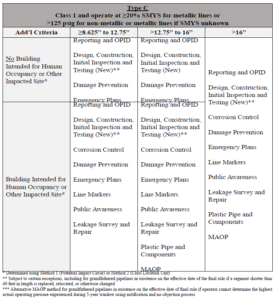
In addition to prescribing these new requirements, the final rule authorizes the use of composite materials in Type C lines if the operator provides PHMSA with a notification containing certain information at least 90 days prior to installation or replacement and receives a no objection letter or no response from PHMSA within 90 days.
Deadlines: The effective date of the final rule is May 16, 2022. Operators of Type R and Type C lines must comply with the applicable requirements in Part 191 starting on May 16, 2022, although the first annual report is not due until March 15, 2023. Operators must also comply with the requirement to document the methodology used in determining the beginning and end-points of onshore gas gathering by November 6, 2022, and operators of Type C lines must comply with the applicable requirements in Part 192 by May 16, 2023. Operators may request an alternative to these 6- and 12-month compliance dead-lines by providing PHMSA with a notification containing certain information at least 90 days in advance and receiving a no-objection letter or no response from PHMSA within 90 days.
Other Considerations: Along with the final rule, PHMSA published its final regulatory impact analysis, which estimated that the final rule will regulate approximately 426,000 miles of gas gathering lines, of which 91,000 miles will be subject to new safety requirements. PHMSA also estimated that the annualized cost to implement the final rule is approximately $13.7 million. PHMSA determined that these costs are outweighed by the benefits of the rule, which include avoided injuries, evacuations, commodity loss, improved reporting processes, and a reduction in the number of pipeline incidents. Notably, PHMSA did not address comments submitted by industry raising concerns regarding the costs of complying with the new regulations, but instead reiterated its findings from the preliminary regulatory impact analysis.
Administrative petitions for reconsideration must be filed with PHMSA within 30 days of the final rule’s publication in the Federal Register. Petitions for judicial review must be filed within 89 days of the final rule’s publication in the Federal Register or, if an administrative petition for reconsideration is filed, within 89 days of PHMSA’s decision on the petition.
Click here to view the article online in the January issue of GO-WV News.
Babst Calland recently named Mary H. Binker, Michael E. Fink, Jennifer L. Malik and Cary M. Snyder shareholders in the Firm.
Mary Binker is a member of the Corporate and Commercial, Energy and Natural Resources, and Real Estate groups. Her practice focuses primarily on corporate and transactional matters, including negotiation of commercial contracts and real estate transactions. Ms. Binker advises businesses of various sizes and complexity, in a broad range of industries including chemical, energy and real estate development, in their corporate contracting needs. She counsels clients on their day-to-day contracting needs such as procurement and service agreements. Ms. Binker also has experience assisting real estate clients in acquisitions, leasing, and management agreements. She is a 2010 graduate of the University of Pittsburgh School of Law.
Michael Fink is a member of the Corporate and Commercial and Emerging Technologies groups. Mr. Fink focuses his practice on assisting high-tech start-up ventures with both fundraising and general corporate or governance matters. He also counsels clients with technology transactions and licensing, and he works on both the buy-side and the sell-side in mergers and acquisitions in the technology, real estate, energy, and healthcare sectors. Entity selection and formation, preparation and programming of capitalization tables and distribution models, and corporate governance counseling are additional services Mr. Fink routinely provides clients. He is a 2011 graduate of the University of Pittsburgh School of Law.
Jenn Malik is a member of the Public Sector and Energy and Natural Resources groups. Ms. Malik’s practice focuses primarily on municipal and land use law, with an emphasis on zoning, subdivision and land development, and municipal ordinance construction and enforcement. She represents the Firm’s municipal clients on a wide array of local government issues, including developing and implementing zoning and land development ordinances, reviewing and overseeing the processing of Pennsylvania Municipalities Planning Code applications, such as applications for conditional uses and special exceptions, analyzing and responding to Pennsylvania Right-to-Know Law record requests, navigating public bidding procedures, assisting to identify and enforce property maintenance and zoning violations, and counseling clients to ensure compliance with both the Pennsylvania Sunshine Act and the Pennsylvania Public Official and Employee Ethics Act. Additionally, Ms. Malik represents corporations, and businesses before local governing bodies, zoning hearing boards, planning commissions and private landowners. In doing so, Ms. Malik assists private-sector clients in analyzing municipal zoning ordinances, obtaining land development approvals, filing Right-to-Know Law requests, defending against Notices of Violation, challenging the procedural and substantive validity of municipal zoning ordinances, and appealing the issuance or denial of local permits. She is a 2011 graduate of the University of Houston Law Center.
Cary Snyder is a member of the Litigation group. He primarily works in the areas of complex commercial litigation and appellate practice. Mr. Snyder has experience in all stages of litigation, from drafting complaints through dispositive motions, discovery, settlement, and trial. He also represents clients in matters before federal and state appellate courts. He is a 2011 graduate of the University of Minnesota Law School.
Babst Calland today announced the lateral move of Harley Stone, who recently joined the Firm’s Pittsburgh office.
A shareholder in Babst Calland’s Public Sector and Energy and Natural Resources groups, Attorney Stone provides senior-level counsel in municipal, land use, environmental and energy law. He represents municipal governments, authorities and private developers in municipal permitting, planning, land use, and zoning. A seasoned trial lawyer, he also has many years of experience as a litigator in the areas of municipal law, employment law, and tax assessment appeals.
Commenting about Harlan’s lateral move to the Firm, Babst Calland Managing Shareholder Donald C. Bluedorn II said, “We are very pleased to welcome Harlan to our Firm. He is a natural fit for us as he shares our values, experience and philosophy in serving clients. Harlan is a highly-regarded attorney and supports our strategy to expand Babst Calland’s legal counseling team and capabilities to serve the needs of existing and new clients in the region.”
With significant experience in municipal, land use and zoning law, Mr. Stone will be joining forces with Babst Calland’s well-established and respected Public Sector team.
“Much deliberation went into my decision to join Babst Calland after practicing with various law firms over my 40+ year career,” said Mr. Stone. “Ultimately, I became convinced that Babst Calland represented the perfect fit for me and my practice.”
Mr. Stone is admitted to practice in Pennsylvania and before the Supreme Court of Pennsylvania, Supreme Court of the United States, United States Court of Appeals for the Third Circuit, and United States District Court for the Western District of Pennsylvania. He is a member of the Allegheny County Bar Association, Allegheny County & Western Pennsylvania Association of Township Commissioners (AC&WPTAC), Association of Municipal and School Solicitors, and the Local Government Academy. Mr. Stone is a past president of the Rodef Shalom Congregation, that oldest and largest reform Jewish congregation in southwest Pennsylvania. He has been rated by Martindale-Hubbell as AV Preeminent, Peer Rated for the Highest Level of Professional Excellence since 2009.