Client Alert
(By Jim Curry, Ashleigh H. Krick, Christopher T. Kuhman)
On November 15, 2021, President Biden signed the bipartisan $1.2 trillion Infrastructure Investment and Jobs Act (H.R. 3684). This Alert reviews the key provisions related to hydrogen and carbon capture, utilization, and storage (CCUS). Babst Calland has also issued a companion Alert on other renewable energy-related provisions in the Infrastructure Bill.
Hydrogen
- Regional Clean Hydrogen Hubs (Sec. 40314): In perhaps the most impactful provision, the Bill authorizes an $8 billion program to support the development of at least four regional clean hydrogen hubs to network hydrogen producers, storage, offtakers and transport infrastructure. DOE must solicit proposals for regional clean hydrogen hubs by May 15, 2022, and select the four hubs by May 15, 2023. DOE will solicit at least one hub proposal for each of the following hydrogen production technologies: fossil fuels, renewables or nuclear. And, DOE will solicit at least one hub to provide hydrogen to each of the following sectors: power generation, industrial, residential and commercial heating, and transportation.
- Clean Hydrogen Definition and Production Qualifications (Secs. 40312 & 40315): Defines “clean hydrogen” and “hydrogen” in a technology neutral way, and requires DOE and EPA to develop an initial carbon standard for projects to qualify as clean hydrogen production, eligible for the variety of incentives throughout the Bill. Clean hydrogen means “hydrogen produced with a carbon intensity equal to or less than 2 kilograms of carbon dioxide (CO2)-equivalent produced at the site of production per kilogram of hydrogen produced.” The standard must consider technological and economic feasibility and allow production from fossil fuels with CCUS, hydrogen carrier fuels, renewables, nuclear and other methods that DOE determines are appropriate.
- Research and Development Program and National Clean Hydrogen Strategy and Roadmap (Secs. 40313 and 40314): Requires DOE to establish an R&D program with the private sector to commercialize clean hydrogen production in a variety of applications by May 15, 2022. This provision includes $500 million in grant funding for clean hydrogen manufacturing and recycling.
- Clean Hydrogen Electrolysis Program (Sec. 40314): Requires DOE to establish a program to improve the efficiency, increase the durability, and reduce the cost of producing clean hydrogen using electrolyzers (commonly called “green hydrogen”) and authorizes $1 billion for grants and demonstration projects. The goal is to reduce the cost of green hydrogen to less than $2 per kilogram by 2026.
- Appalachian Regional Energy Hub (Sec. 14511): Provides the Appalachian Region Commission with $5 million to establish an Appalachian Region hub for natural gas, natural gas liquids, and hydrogen produced through steam methane reforming.
- Grants for Hydrogen Fueling Infrastructure (Sec. 11401): Authorizes the Federal Highway Administration to award $2.5 billion in grants for the acquisition or installation of publicly accessible electric vehicle charging, or hydrogen, propane, or natural gas fueling infrastructure along an alternative fuel corridor.
Carbon Capture, Utilization, and Storage
- Carbon Utilization (Sec. 40302): Requires DOE, through its Carbon Utilization Program, to develop standards to facilitate the commercialization of carbon-based technologies. The Bill also requires DOE to establish a grant program for states and governmental entities to procure and use products that are derived from carbon and reduce greenhouse gas emissions. The Bill authorizes $310 million for this program.
- Carbon Capture Technology (Sec. 40303): Authorizes $100 million for DOE grants under its Carbon Capture Technology Program, including an engineering and design program for CO2 transportation.
- CO2 Transportation Infrastructure Finance and Innovation (Sec. 40304): Creates a CO2 transportation infrastructure finance and innovation (CIFIA) program in DOE and provides $2.7 billion in funding. CIFIA is a federal credit instrument that will provide funding for certain CO2 transportation projects anticipated to cost $100 million or more. In selecting projects, DOE will give priority to large-capacity common carrier pipeline projects, projects with clear demand, and projects sited adjacent to existing pipelines. Grants are also available for upsizing infrastructure to meet increase in future demand. All iron, steel, and manufactured goods used in a project must be produced in the U.S., with some exceptions.
- Carbon Storage Validation and Testing (Sec. 40305): Authorizes $2.5 billion for DOE to provide funding for large-scale carbon sequestration projects and associated transportation infrastructure.
- Secure Geologic Storage Permitting (Sec. 40306): Authorizes $25 million for EPA’s Class VI UIC well permit program for the geologic sequestration of CO2, and $50 million for grants to states seeking Class VI primacy.
- Geologic Carbon Sequestration on the Outer Continental Shelf (Sec. 40307): Allows DOI to grant a lease, easement, or right-of-way on the outer continental shelf for the injection of CO2 into sub-seabed geologic formation, for the purpose of long-term carbon sequestration. The Bill requires DOI to issue regulations by November 15, 2022.
- Carbon Removal (Sec. 40308): Authorizes $3.5 billion for a DOE program to develop four regional air capture hubs. The hubs will facilitate the deployment of direct air capture projects; have the capacity to capture, sequester, or utilize at least one million metric tons of CO2 annually; demonstrate the capture, processing, delivery, and sequestration of captured carbon; and have potential for developing a regional or inter-regional network to facilitate CCUS.
- Carbon Capture Large-Scale Pilot Projects (Sec. 41004(a)): Authorizes $937 million for DOE to carry out a large-scale CCUS technology program.
- Carbon Capture Demonstration Projects Program (Sec. 41004(b)): Authorizes $2 billion for DOE to carry out CCUS demonstration projects.
- Carbon Removal (Sec. 41005). Authorizes $15 million for DOE to award a competitive technology prize for the precommercial capture of CO2 from dilute media and $100 million for commercial applications of direct air capture technologies.
If you have any questions about these developments, please contact Jim Curry at 202.853.3461 or jcurry@babstcalland.com, Ashleigh Krick at 202.853.3466 or akrick@babstcalland.com, or Chris Kuhman at 202.853.3467 or ckuhman@babstcalland.com.
Click here for PDF.
Client Alert
(by Ben Clapp, Anna Jewart and Josh Snyder)
On Monday, November 15, 2021, President Biden signed the Infrastructure Investment and Jobs Act (Infrastructure Bill) into law. The historic $1.2 trillion package contains a number of provisions aimed at promoting the growth of the renewable energy sector and places significant emphasis on large-scale improvements to, and expansion of, the electric transmission grid. Key provisions of the Infrastructure Bill aimed at benefitting the renewables sector are discussed below. Babst Calland is issuing a companion Alert on the Carbon Capture, Utilization, and Storage and Hydrogen Technologies provisions in the Infrastructure Bill.
Transmission Infrastructure Resiliency and Expansion
It is well understood that grid capacity constraints and access to adequate transmission infrastructure are often roadblocks to siting renewable energy projects. The Infrastructure Bill’s investment in transmission infrastructure and resiliency and in building out the grid is designed, in part, to ease these impediments with the aim of making more sites viable for renewable energy development across the country. The Infrastructure Bill allocates about $28 billion to transmission infrastructure generally, including approximately $15 billion in grants and other financial assistance to prevent outages and enhance grid resiliency, develop new or innovative approaches to transmission, storage, and distribution infrastructure, and facilitate siting or upgrading transmission and distribution lines in rural areas.
$2.5 billion is allocated to the “Transmission Facilitation Program,” a fund that allows the Department of Energy (DOE) to enter into a capacity contract for the right to use up to 50 percent of the planned capacity of certain new, expanded or upgraded transmission lines. The program is intended to leverage the DOE investment to demonstrate the project’s viability and thereby encourage other entities to enter into capacity contracts with these transmission projects. The Infrastructure Bill also took steps to reduce certain regulatory barriers which had stalled transmission line development, giving the DOE the authority to designate national transmission corridors to facilitate the deployment of transmission infrastructure in areas with transmission capacity constraints. The provision is designed to enhance the ability of electricity generators, including intermittent producers such as wind and solar projects, to connect to the grid.
Renewable Energy Technology Investments
In addition to investing in the modernization and expansion of the transmission grid, the Infrastructure Bill allocates significant funding towards the development of renewable energy and energy storage technologies.
Solar and Wind
The Infrastructure Bill promotes the development of solar projects on current or former mine land, requiring the DOE to create a report of the viability of siting solar energy on those lands, including the necessary interconnection, transmission siting, and impacts on local job creation. $500 million is authorized for the creation of a DOE program to demonstrate the technical and economic viability of carrying out clean energy projects on current and former mine land. Up to five qualifying projects will be selected to receive financial assistance based on a project’s capacity to create jobs and reduce or avoid greenhouse gas emissions.
In addition to the mine land-specific provisions, $80 million is allocated to the DOE for programs established under the Energy Act of 2020 to provide grants and other financial assistance to promote the development and commercialization of solar energy technologies. $100 million is allocated to the DOE for similar wind programs.
Investment in Energy Storage Development
The Infrastructure Bill appropriates $505 million to the DOE to carry out energy storage initiatives previously authorized under the Energy Act of 2020. $355 million is allocated to a competitive grant program to advance energy storage technologies. $150 million is allocated to the DOE for its long-duration energy storage technologies program. A Battery Material Processing Grant Program is created to expand the capabilities of the United States in advanced battery manufacturing. The DOE will award grants for (i) demonstration projects for the processing of battery materials; (ii) construction of commercial-scale battery material processing facilities; and (iii) projects to retool, retrofit, or expand existing battery material processing facilities.
Supply Chains for Renewable Technology
The Infrastructure Bill includes several provisions that aim to help alleviate supply chain issues that affect the renewable energy sector. Rare-earth elements are key raw materials for components of solar and wind power equipment. The United States is currently dependent on other countries to supply these important resources. $320 million is allocated to the Earth Mapping Resources Initiative (Earth MRI). The Earth MRI maps mineral deposits (including rare-earth elements) within the United States. Another $307 million is provided to fund research related to the extraction, reclamation, and refining of rare-earth elements, and to demonstrate the commercial feasibility of a full-scale, integrated rare-earth extraction and separation facility and refinery.
Conclusion
The Infrastructure Bill is a sweeping piece of legislation in which provisions related to the promotion of renewables development are a relatively small component. Nonetheless, renewable energy proponents are hopeful that the provisions discussed in this Alert will help the sector continue the explosive rate of growth that it has enjoyed in recent years by unclogging the transmission bottleneck and incentivizing investment in new technologies.
The Infrastructure Bill provides the agencies tasked with implementing it a large amount of discretion in developing and managing its programs. Babst Calland will be monitoring the ensuing regulations and guidance issued by those agencies closely as they work to bring the Infrastructure Bill’s goals to fruition. If you have any questions about the developments described in this Alert, please contact Ben Clapp at 202.853.3488 or bclapp@babstcalland.com; Joshua Snyder at 412.394.6556 or jsnyder@bcalland.com; or Anna Jewart at 412.253.8806 or ajewart@babstcalland.com.
Click here for PDF.
Pittsburgh Business Times
(By Sean M. McGovern)
Babst Calland Shareholder Sean McGovern takes a closer look at Pennsylvania Governor Tom Wolf’s executive order to develop a stronger environmental justice policy and what local business and industry can expect.
Pennsylvania businesses can expect 2022 to become the year of environmental justice, thanks largely to Executive Order 2021-7 issued by Pennsylvania Governor Tom Wolf on October 28.
So said Sean McGovern, a shareholder with Pittsburgh law firm Babst Calland’s environmental practice, who suggested the executive order will, indeed, change Pennsylvania’s approach to environmental justice significantly ahead.
“Certainly, this is a very current development,” McGovern said. “There’s no statute or explicit regulation here in the state. We already have an environmental justice policy, but this new environmental justice order, as well as the Executive Order 14008 from President Biden earlier this year, will further establish the rights and duties under the Environmental Rights Amendment to protect all people in Pennsylvania.”
McGovern shared his insights on environmental justice in Pennsylvania recently with the Pittsburgh Business Times as part of the law firm’s ongoing Business Insights series. Babst Calland is one of the Pittsburgh region’s largest law firms. McGovern is considered one of Babst Calland’s environmental counselors on issues surrounding environmental justice and other matters of environmental law.
Environmental justice defined
So, what is it? The U.S. Environmental Protection Agency defines environmental justice as “the fair treatment and meaningful involvement of all people regardless of race, color, national origin, or income, with respect to the development, implementation, and enforcement of environmental laws, regulations, and policies.”
While the issue has been around for decades, it took center stage earlier this year when President Biden signed an executive order prioritizing for the federal government “environmental justice on a fairly systemic federal level,” McGovern said.
“It set forth a policy that the agencies under the federal government’s purview will make achieving environmental justice as part of their missions,” he continued, “by developing programs, policies, activities to address disproportionately high human health, environmental and climate-related and other cumulative impacts on disadvantaged environmental justice communities.”
Federal and state guidance
A key reason for the order: “To spur economic opportunity for disadvantaged communities,” McGovern said. “We’re seeing quite a bit now in the press regarding [President Biden’s] Build Back Better plan.” Among its provisions: it gives all people the same degree of protection from environmental and health hazards, and it gives all people equal access to the decision-making process to have a healthy environment in which to live, learn, and work.
The Biden administration also has begun to establish the White House Environmental Justice Interagency Council which, McGovern said, not only includes traditional environmental agencies, but also the U.S. Departments of Commerce, Labor, Justice, Health and Human Services, Transportation, and other federal departments and agencies.
President Biden’s actions to prioritize environmental justice includes a directive to set aside 40 percent of federal funding “investments” for the benefit of disadvantaged communities, McGovern said.
Seeking improved environmental justice in Pennsylvania
This is important background information, McGovern said, because Pennsylvania’s governor largely followed the Biden administration in issuing his own executive order for the Commonwealth to foster greater equity for all Pennsylvania citizens when it comes particularly to environmental health and safety.
“A lot of language in the recitals of the executive order almost directly mirror the executive order from President Biden, so clearly, I would say, the support — inspiration — for the executive order was placed here,” he said.
McGovern said the Pennsylvania Department of Environmental Protection is working on a revised environmental justice policy that currently is being reviewed by an environmental justice advisory board, although the “guidance document … is not a statute, law, or regulation, but really a policy for the [Pennsylvania Department of Environmental Protection] to evaluate permit applications.”
He expects a final policy to be completed in 2022.
Expanding disadvantaged populations
Among the proposed policy’s key provisions, he said: an expansion of the definition of what should be considered an “environmental justice area.” That is, 30 percent or greater of a population that is considered minority, or 20 percent or greater of a population living below twice the poverty level as defined by the U.S. Census Bureau, as proposed in the department’s current working draft.
McGovern also said Wolf’s order will include populations where at least 10 percent of the households have limited English language proficiency.
“This is a broadening of the current definition of an environmental justice area,” McGovern said.
An impact on well permits
The executive order also includes what McGovern referred to as an unconventional well permit section that would “require the DEP’s Office of Oil and Gas to collaborate with the Office of Environmental Justice to conduct an annual assessment of anticipated or actual drilling operations.
“This is important,” he continued, “because it effectively moves the environmental justice policy into a retroactive document for permits that have already been issued historically.”
McGovern described the potential impact on the oil and gas industry as significant.
“The working draft is likely going to impact all of the DEP’s permitting operations as it spreads across industries,” McGovern said. “It’s going to require a significant amount of collaboration between the Office of Environmental Justice and these individual bureaus under the DEP, and it will consider, as part of permit applications, in some cases, past permit approvals — further analysis that companies may not have had to consider before.
“Also, there’s going to be a broadening of environmental justice guidelines here in Pennsylvania, to include a variety of new data, including potential health impacts,” he added.
Like its federal counterpart, Wolf’s executive order also creates an Environmental Justice Interagency Council, in addition to an advisory board, McGovern explained. The council will include the Pennsylvania Department of Conservation and Natural Resources, as well as the Commonwealth’s Departments of Education, Agriculture, Health, Transportation, Community and Economic Development, and several cabinet members “at the discretion of the governor to be part of a periodic meeting to discuss environmental justice across agencies.”
In addition to the executive order, McGovern said, other state legislators have proposed bills that would establish as law the Office of Environmental Justice and an Environmental Justice Advisory Board, as well as an Environmental Justice Task Force and regional committees.
“There’s quite a bit going on as of late here in Pennsylvania … that further establishes, along with the environmental justice policy, that there are critical aspects moving forward in Pennsylvania with permitting industrial activities and how those permit applications are going to proceed,” McGovern said.
An environmental counseling role
McGovern said Babst Calland “has a strong, vibrant environmental practice, and we do handle all aspects of permitting, compliance, enforcement litigation, and transactional work. But environmental justice considerations would probably fall in the counseling area, in that prior to applying for a permit for a development or new industrial activity, for example, an applicant should seek knowledgeable counsel regarding impacts of the environmental justice policy, especially if constructing or operating in an environmental justice area.”
Without question, McGovern said, the forthcoming new policy will require businesses to build in extra time to complete the permitting process and, even then, prepare for hurdles, depending on the location of environmental justice areas.
He added: “As the policy proceeds … it becomes more and more critical for businesses and industries in Pennsylvania to be cognizant of the updated policy during the application process.”
More aggressive enforcement anticipated
To support environmental justice policy and principles, local business and industry can expect more aggressive enforcement at both the federal and state levels, including Pennsylvania, where there’s going to be more enforcement that may likely result in more penalties.
Babst Calland will continue to track these developments and their potential impact across various industries. If you have any questions about the environmental justice, please contact Sean McGovern at smcgovern@babstcalland.com.
Business Insights is presented by Babst Calland and the Pittsburgh Business Times. To learn more about Babst Calland and its environmental practice, go to www.babstcalland.com.
PIOGA Press
(By Gary Steinbauer)
On November 2, the U.S. Environmental Protection Agency (EPA) released its highly anticipated proposal to expand existing and create new regulations related to greenhouse gas (in the form of methane) and volatile organic compound (VOC) emissions from the oil and gas sector. The proposed rule is entitled Standards of Performance for New, Reconstructed, and Modified Sources and Emissions Guidelines for Existing Sources: Oil and Natural Gas Sector Climate Review. The proposal, if finalized, will lead to more stringent Clean Air Act (CAA) emission limitations and other work practice requirements related to emissions of methane and VOCs from new and existing sources within the crude oil and natural gas production sector, including producers in Pennsylvania.
Brief overview of the methane proposal
The methane proposal is comprised of three distinct actions proposed under sections 111(b) and (d) of the CAA: (1) proposed amendments to the existing methane and VOC requirements in Subpart OOOOa of the New Source Performance Standards (NSPS) in 40 CFR Part 60; (2) a proposed new NSPS to be included in new Subpart OOOOb, regulating emissions of methane and VOCs from new, modified and reconstructed sources within the oil and gas sector; and (3) nationwide methane emission guidelines (EGs) for existing sources within the oil and gas sector in new Subpart OOOOc.
EPA’s proposed amendments to the current requirements in Subpart OOOOa are primarily in response to Congress’ June 2021 revocation of regulatory amendments made by the EPA during the Trump administration. The new proposed NSPS to be included in Subpart OOOOb would expand the existing requirements in Subpart OOOOa and regulate additional sources of methane and VOC emissions within the oil and gas sector, establishing the “best system of emission reduction” for affected sources that are new, modified, and recon-structed after the effective date. The proposed EGs in new Subpart OOOOc are a set of presumptive methane emission standards that would apply nationwide to various existing sources within the crude oil and natural gas sector. The proposed EGs in new Subpart OOOOc, if finalized, would not apply immediately to affected sources. Rather, the EGs are intended to guide states in the creation of their own plans to implement the EGs, which would be submitted to EPA for review and approval similar to the state implementation plan process created under section 110 of the CAA.
When it released the 577-page methane proposal, EPA did not provide proposed regulatory text for proposed new Subparts OOOOb and OOOOc. Rather, the methane proposal includes EPA’s summary of and justification for the proposed regulations in these new subparts. EPA states that it will issue a supplemental proposal seeking “additional public input” when it releases the proposed regulatory text for Subparts OOOOb and OOOOc.
Key changes in EPA’s methane proposal
The following five key changes in the methane proposal could significantly impact the majority of crude oil and natural gas producers in Pennsylvania.
- Shift from production to overall site-level baseline methane emissions for determining LDAR applicability and monitoring frequency at well sites. In a departure from the existing low-production well site exclusion from LDAR in Subpart OOOOa, 40 CFR § 60.5397a(1), EPA now proposes to abandon using pro-duction volume as a basis for excluding equipment at well sites from LDAR requirements. Instead, EPA proposes to require LDAR for equipment at well sites based on total site-level baseline methane emissions. Well sites with total site-level baseline methane emissions less than 3 tons per year (tpy) would be excluded from LDAR monitoring requirements, provided that these well sites demonstrate that methane emissions do not exceed 3 tpy through an on-site specific survey. Well sites with total site-level baseline methane emissions exceeding 3 tpy would be required to perform quarterly LDAR monitoring, although EPA is co-proposing a semiannual LDAR monitoring frequency for well sites with total site-level baseline methane emissions between 3 and 8 tpy and quarterly LDAR monitoring for well sites with total site-level methane emissions above 8 tpy.
- Significant expansion of storage vessel regulations. As part of the methane proposal, EPA proposes to expand its regulation of oil and gas-related storage vessels under both Subparts OOOOb and OOOOc. Currently, Subpart OOOOa storage vessel regulations are limited to VOC emissions and based on a VOC potential to emit (PTE) of 6 tpy for a single storage vessel. Under Subpart OOOOb, EPA is proposing to include the same 6 tpy PTE applicability threshold, expand it to include methane, and apply it to a single storage vessel or the aggregate potential emissions from a “tank battery,” i.e., a group of storage vessels that are adjacent and receive fluids from the same operation or are manifolded together. As for storage vessels at existing facilities, EPA is proposing to regulate existing tank batteries with potential methane emissions of 20 tpy or more. Combined with EPA’s proposal to narrowly redefine instances where legally and practically enforceable limitations are in place to limit the PTE for a single or group of storage vessels below the 6 tpy applicability threshold, EPA’s proposal is likely to increase the number of regulated storage vessels and require that methane and VOC emissions from newly regulated storage vessels be reduced by 95 percent using a vapor recovery device or combustor.
- First-time requirements for new and existing oil wells with associated gas. For the first time, EPA pro-poses to require that associated gas from oil wells be routed immediately to a sales line. Currently, there are no NSPS requirements that apply to emissions from venting associated gas from oil wells. In situations where gas-producing oil wells do not have access to a sales line, associated gas would need to be used on-site as a fuel source, used for another purpose that a purchased fuel or raw material would service, or be routed to a flare or other control device achieving 95 percent reduction of methane and VOC emissions. Under the methane proposal, any new or existing oil well producing associated gas would be regulated, regardless of production volumes.
- Zeroing out emissions from new and existing pneumatic controllers. Currently, under Subpart OOOOa, affected pneumatic controllers located anywhere except for onshore natural gas processing plants are allowed to have a bleed rate of 6 standard cubic feet per hour. 40 CFR § 60.5390a(c). Furthermore, intermittent vent natural gas-driven pneumatic controllers are not regulated under Subpart OOOOa, regardless of their location. Under Subpart OOOOb, EPA proposes to regulate single natural gas-driven continuous and intermittent bleed pneumatic controllers regardless of location. All these affected pneumatic controllers would be required to meet a new zero emission rate for VOCs and methane. Lastly, EPA proposes to remove an exemption in Subpart OOOOa that applies to affected pneumatic controllers with a bleed rate greater than the applicable standard based on functional needs, including response time, safety and positive actuation, so long as such pneumatic controllers are tagged with the month and year of installation. § 60.5390a(a).
- Zeroing out or controlling emissions from liquids unloading. Described as an “episodic high-emitting source,” EPA proposes to regulate methane and VOC emissions from liquids unloading. More specifically, each liquids unloading event at an existing affected well site would be considered a modification triggering the requirements in proposed Subpart OOOOb, eliminating the need to regulate liquids unloading at existing well sites under proposed Subpart OOOOc. EPA is proposing to require liquids unloading operations be performed with zero methane or VOC emissions. Where it is not safe to perform liquids unloading operations with zero emissions, EPA proposes to require best management practices to minimize methane and VOC emissions.
The methane proposal is expected to be published in the Federal Register on November 15, starting a 60-day public comment period. In addition to the five key changes noted above, EPA is specifically requesting comments on whether to add requirements related to: (1) abandoned and plugged wells, tank trunk loading operations and pipeline “pigging” operations; and (2) improving performance and minimizing malfunctions at flares.
Babst Calland is tracking the methane proposal closely, particularly as it affects Pennsylvania oil and natural gas producers. If you have any questions or would like addi-tional information, please contact Gary Steinbauer at 412-394-6590 or gsteinbauer@babstcalland.com, Gina Falaschi at 202-853-3483 or gfalaschi@babstcalland.com, or Christina Puhnaty at 412-394-6514 or cpuhnaty@babst-calland.com.
For the full article, click here.
Reprinted with permission from the November 2021 issue of The PIOGA Press. All rights reserved.
The Legal Intelligencer
(By Stephen Antonelli)
On September 9, 2021, President Biden announced his administration’s Path out of the Pandemic action plan, a six-pronged national strategy aimed to combat COVID-19 while keeping schools and workplaces open and safe. One prong of the plan involves vaccinating those who are not yet vaccinated. To achieve this goal, the president took actions that have since been on the minds of most employers and human resources professionals: he issued an Executive Order requiring contractors who do business with the federal government to mandate vaccinations for their employees; he directed the Occupational Safety and Health Administration (OSHA) to develop a rule requiring employers with 100 or more employees to ensure that their employees are either fully vaccinated or tested weekly; and he ordered the Centers for Medicare & Medicaid Services (CMS) to require vaccinations for most healthcare workers.
As of this writing in early November, the Safer Federal Workforce Task Force has released detailed guidance related to the federal contractor order, but OSHA has not yet released an Emergency Temporary Standard (ETS) to implement the mandate for large employers, and CMS has not yet issued an interim final rule related to healthcare workers. As a result, employers across the country are waiting for important guidance and details about how vaccine mandates will impact their employees. Complicating matters further, at least 12 states have commenced litigation against the Biden administration in at least three different federal district courts (Arizona, Missouri, and Florida) over the federal contractor rule, and several states (Texas, Florida, Arizona, and Alabama) have issued executive orders of their own opposing vaccine mandates.
In short, employers could use some clarity on the topic of implementing vaccine mandates.
One agency that has continually provided timely and detailed guidance throughout the pandemic is the Equal Employment Opportunity Commission (EEOC). On October 25, 2021, it provided the most recent of many updates to its Technical Assistance document, a practical question-and-answer format resource that is organized by category. The most recent update primarily addressed the topic of employees’ religious objections to vaccine mandates, by guiding employers through hypothetical situations that many employers have actually faced since the announcement of mandatory vaccination programs. A summary of the latest guidance is below.
- Although employees must tell their employer if they are requesting an exception to a COVID-19 vaccination requirement because of a sincerely held religious belief, practice, or observance, they are not required to use any “magic words,” such as “religious accommodation.” Instead, they must only notify their employer that the requirement conflicts with their religious beliefs, practices, or observances.
- While employers have the right to seek additional information concerning a request for an exception based on an employee’s religious beliefs, employers should generally assume that the request is based on sincerely held religious beliefs, absent an objective basis to question either the religious nature or the sincerity of the stated or professed belief.
- Title VII of the Civil Right Act uses an expansive definition of the term “religion” that protects nontraditional religious beliefs that may be unfamiliar to employers. Employers should therefore not assume that an employee’s request is insincere or invalid because it is based on unfamiliar religious beliefs.
- On the other hand, Title VII does not protect social, political, or economic views, or personal preferences. Such objections to vaccine mandates do not qualify as “religious beliefs” under Title VII.
- Courts are likely to resolve disputes over the sincerity of an employee’s stated religious belief in favor of the employee, because these disputes are largely matters of “individual credibility” that are not easily undermined unless the employee has acted in a manner inconsistent with the stated belief, or the timing of the request is suspicious because, for instance, it follows an unsuccessful request for an exception for a secular reason, or the employer has objective evidence demonstrating that the accommodation is not religious in nature.
- Employers should not assume that a stated belief is insincere because it does not align with commonly followed or known tenets of the employee’s religion, or because the employee’s belief, practice, or observance is relatively new. An employee’s religious beliefs do not have to be shared by an organized religion to be sincerely held.
- While employers should consider all potential reasonable accommodations, including telework and reassignment, in some circumstances, it not may be possible to accommodate those seeking reasonable accommodations for their religious beliefs, practices, or observances without imposing an undue hardship on the employer.
- Employers that demonstrate that a requested accommodation will be an “undue hardship” are not required to accommodate an employee’s request for a religious accommodation.
- Courts have held that requiring an employer to bear more than a “de minimis” cost to accommodate an employee’s religious belief can constitute an undue hardship. Employers should consider monetary costs as well as the burden on conducting business, including the risk of spreading COVID-19 to other employees or to the public.
- When assessing whether a request for an accommodation will cause an undue hardship, employers should consider the unique facts of each situation and determine the cost or level of disruption of each potential accommodation.
- If an employer grants a religious accommodation to some employees, it does not automatically have to grant religious accommodations to all employees who request one. Employers should assess the specific factual context of each individual request.
- When assessing whether an accommodation would impair workplace safety, an employer may consider a number of factors including the type of workplace, the nature of the employee’s duties, the number of employees who are fully vaccinated, the number of people who physically enter the workplace, and the number of employees who will in fact need a particular accommodation.
- Employers are not required to provide employees with the religious accommodation of the employee’s choosing. If there is more than one reasonable accommodation that is available, the employer is not obligated to provide the reasonable accommodation preferred by the employee.
- After granting a religious accommodation, an employer may reconsider it as circumstances change. An employer may therefore discontinue a previously granted accommodation if it begins to pose an undue hardship on the employer’s operations. Before discontinuing the accommodation unilaterally, employers should discuss the proposed change or revocation with the impacted employee. The employer should also consider whether there are any other accommodations that would not impose an undue hardship.
At a time when employers and human resources professionals have just as many questions as they have answers, the EEOC’s updated Technical Assistance document has provided much needed clarity, most recently on the topic of religious objections to vaccine mandates.
For the full article, click here.
Reprinted with permission from the November 11, 2021 edition of The Legal Intelligencer© 2021 ALM Media Properties, LLC. All rights reserved.
Charleston Gazette-Mail
(By Moore Capito)
Small-business owners have many roles to fill–from managing payrolls and marketing to customer service. But one area many small-business owners fail to plan for is their company’s cybersecurity.
According to a recent Small Business Administration survey, 88% of small-business owners feel their business was vulnerable to a cyberattack. Experts warn that small businesses, including those in West Virginia, are under constant attack by cybercriminals, be it from local, national or global actors.
We don’t have to dig deep for a local example of this threat. In 2017 Princeton Community Hospital, in Mercer County, was a victim of the Petya attack, costing the health system $27 million.
Yet, many businesses can’t afford professional IT solutions, have limited time to devote to cybersecurity or simply don’t know where to begin.
As a delegate, I am focused on supporting West Virginia small businesses through state and federal grants and providing critical resources and training to entrepreneurs across the state. Small businesses are the backbone of our economy and provide the greatest opportunity for job growth in our state. We need to do everything we can to encourage and support them. West Virginians are hard-working, dedicated people–they just need the right tools to succeed.
This is where programs like the one hosted by the National Cybersecurity Center come in. The National Cybersecurity Center is a nonprofit organization established to promote cyber innovation and awareness, and offers training for the public and private sector alike. I have the privilege of taking part in a key public education effort, Cybersecurity for State Leaders, which is training leaders in all 50 states on best practices in cybersecurity.
Best practices for maintaining good cyber hygiene apply equally to the government and to business across West Virginia. Individuals must stay on top of their own cybersecurity hygiene, personally and professionally, and continuously stay ahead of emerging threats by completing simple tasks, such as updating your software.
The NCC initiative has taken bold steps to integrate, in their outreach and curriculum, with guests from the private sector, including Robert Herjavec, representative from Google, IBM, Microsoft’s Defending Democracy Program and Meredith Griffanti from FTI Consulting.
From the public sector, participants have included Georgia Gov. Brian Kemp, Mississippi Gov. Tate Reeves, Oregon Gov. Kate Brown, among countless more senators and members of Congress who have supported this initiative.
For West Virginia small businesses, the good news is that this training is now available to the public at no charge.
For more information on Cybersecurity for State Leaders and to find training in your home state, visit https://cyberforstateleaders.org.
Click here to view the full article online in the Charleston Gazette-Mail.
Environmental Alert
(By Sean M. McGovern and Evan M. Baylor)
On October 28, 2021, Governor Tom Wolf issued an Executive Order (Order) addressing environmental justice in the Commonwealth (Executive Order 2021-07). In support of the Order, Pennsylvania legislators announced environmental justice actions that would reflect the directives of the Order.
Executive Order
Gov. Wolf’s Order largely focuses on the establishment of bodies within the Department of Environmental Protection (DEP) and an interagency council within the Executive Branch to better address environmental justice, which is addressed in further detail below. The Order also asserts:
- The Commonwealth’s duty to “ensure the rights and duties of Article I, Section 27 protect all the people of Pennsylvania” and the significance of environmental justice in President Biden’s Executive Order 14008 and his administration’s mission;
- That low-income communities and communities of color residents bear a disproportionate share of adverse climate and environmental impacts with accompanying adverse health impacts; and
- That all Pennsylvanians are entitled to meaningful involvement in decision-making that impacts their lives, environments, and health and that such involvement is critical to reduce adverse impacts.
Environmental Justice Advisory Board
The Order formally established the existing Environmental Justice Advisory Board (EJAB). The EJAB makes recommendations to the DEP Secretary concerning environmental justice policies, practices, and actions. The EJAB shall meet at least semi-annually.
Office of Environmental Justice
The Order formally establishes the existing Office of Environment Justice (OEJ) within the DEP. In 2002, the DEP established the Office of Environmental Advocate. In 2015, the DEP renamed the Office of the Environmental Advocate as the Office of Environmental Justice. The OEJ acts as a point of contact for residents in low-income areas and areas with a higher number of minorities. The primary goal of the OEJ is to increase communities’ environmental awareness and involvement in the DEP permitting process. While the office is not newly established, the Order includes some notable new roles and responsibilities for the OEJ.
The Order directs the OEJ to develop and publish an environmental justice strategic plan (EJ Plan) every five (5) years. The EJ Plan should include recommendations for advancing environmental justice, focusing attention on the environmental and public health issues and challenges confronting the Commonwealth’s minority and low-income populations. The plan should also make recommendations on the integration of Environmental Justice considerations into existing DEP programs.
The Order further directs the OEJ to revise the Enhanced Public Participation Policy (EJ Policy). The Order suggests a revised EJ Policy should include the definitions of “Environmental Justice Area,” “cumulative environmental impacts,” and “disproportionate environmental impacts.” The Policy should include established criteria for Environmental Justice Areas. Importantly, the EJ Policy should include standardized mitigation and/or restoration practices for consideration by applicants and permit application reviewers in the permitting or cleanup context. This requirement may result in the development of standards or best management practices, where none previously existed, for mitigation and restoration practices. The DEP is currently working to update the EJ Policy and earlier this year released a working draft of the revised EJ Policy. It is anticipated that a revised EJ Policy will be released for public comment in the coming months. Following the DEP’s response to those comments and subsequent changes to the EJ Policy as a result of that input, the DEP has signaled that it intends to finalize the revised EJ Policy as early as the spring of 2022. The Order does not dictate a timeline for DEP to finalize a revised policy.
Environmental Justice Interagency Council (EJIC)
The Order establishes the Environmental Justice Interagency Council (EJIC). This new body will require coordination between executive agencies to comprehensively address environmental justice. This new body shall consist of the Secretaries (or their designees) of Conservation and Natural Resources, Education, Agriculture, Health, Transportation, Community and Economic Development, as well as cabinet members or agency heads as determined by the governor. The EJIC will advise the governor’s office and executive agencies, review the environmental justice strategic plan, ensure Commonwealth consistency with federal environmental justice programs, and recommend an environmental justice training plan for all executive agencies. Further, each executive agency included in the EJIC shall develop a strategic plan every five years to promote Environmental Justice, in accordance with each agency’s authority, mission, and programs. The EJIC will meet within 90 days of October 28, 2021, and at least semi-annually going forward.
Pending Legislative Action
In concert with Gov. Wolf’s Order, two proposals are now moving through the legislature. On October 26, 2021, Representative Donna Bullock (D-Philadelphia) proposed a resolution recognizing the 30th anniversary of the adoption of the 17 principles of Environmental Justice that were presented to delegates at the First National People of Color Environmental Leadership Summit (Resolution 151). And earlier this year, Senator Vincent Hughes (D-Philadelphia) proposed a bill echoing Gov. Wolf’s Order (Senate Bill 189). The bill proposes to permanently establish the OEJ and the EJAB. Additionally, the bill proposes to establish an Environmental Justice Task Force and Regional Environmental Justice Committees.
According to the bill, the OEJ would be charged with the creation of an EJ Task Force (Task Force). The Task Force would plan a strategy and develop guidelines for the operation of new Regional Environmental Justice Committees (Regional EJ Committees), which would provide an avenue for residents to raise environment justice concerns. Municipalities or residents would be able to file a petition directly with a Regional Environmental Justice Committee regarding adverse exposure to environmental health risks or to disproportionate adverse effects resulting from the implementation of a state law, regulation, guideline or policy affecting public health or the environment. A petition would trigger an initial review by the Regional EJ Committee and a public meeting with the relevant municipality to discuss the petition. Within 120 days of the public meeting, the Task Force would be required to issue an action plan to address the petition.
What’s Next?
As the DEP continues to work on revisions to the current EJ Policy, they will certainly look to include revisions as directed by the Order into their working draft. In their May 2021 meeting the EJAB discussed updates to the proposed EJ Policy and the EJ Policy will be discussed again at their next meeting on November 16, 2021 (Agenda). Further, the EJAB will also discuss the Order and meet with a representative of the Office of the Attorney General to discuss environmental justice at their next meeting.
Babst Calland will be tracking the revisions to the EJ Policy and subsequent actions taken in response to Gov. Wolf’s Order. If you have any questions about the environmental justice developments described in this Alert, please contact Sean McGovern at 412-394-5439 or smcgovern@babstcalland.com or Evan Baylor at 202-868-0538 or ebaylor@babstcalland.com.
Click here for the PDF.
Energy Alert
(by Timothy Miller, Jennifer Hicks and Katrina Bowers)
The West Virginia Supreme Court of Appeals has accepted four questions certified to it by The United States District Court for the Northern District of West Virginia in Charles Kellam, et al. v. SWN Production Company, LLC, et al., No. 5:20-CV-85. The Court will hear oral argument during the January 2022 term. The Court will address four questions: (1) Is Estate of Tawney v. Columbia Natural Resources, LLC, 219 W.Va. 266, 633 S.E.2d 22 (2006) (Tawney) still good law in West Virginia; (2) What is meant by the “method of calculating” the amount of post-production costs to be deducted; (3) Is a simple listing of the types of costs which may be deducted sufficient to satisfy Tawney; and (4) If post-production costs are to be deducted, are they limited to direct costs or may indirect costs be deducted as well?
At the time of the District Court’s certification in Kellam, defendants’ Motion for Judgment on the Pleadings asserting that the Kellams’ lease complied with Tawney and that the District Court was bound by the decision in Young v. Equinor USA Onshore Properties, Inc., 982 F.3d 201 (4th Cir. 2020) was pending. In Young, the 4th Circuit Court of Appeals reversed Judge Bailey and held the lease clearly and unambiguously allowed the deduction of post-production expenses and noted that “Tawney doesn’t demand that an oil and gas lease set out an Einsteinian proof for calculating post-production costs. By its plain language, the case merely requires that an oil and gas lease that expressly allocates some post-production costs to the lessor identify which costs and how much of those costs will be deducted from the lessor’s royalties.” Young, 982 F.3d at 208. Moreover, the 4th Circuit noted recent criticism of Tawney by the West Virginia Supreme Court of Appeals. See Leggett v. EQT Prod. Co., 239 W. Va. 264, 800 S.E.2d 850 (2017).
For more information about the case, contact Tim Miller at 681.265.1361 or tmiller@babstcalland.com, Jennifer Hicks at 681.265.1370 or jhicks@babstcalland.com, or Katrina Bowers at 681.205.8955 or kbowers@babstcalland.com, who are serving as counsel for the defendants in Kellam.
Click here for PDF.
The Legal Intelligencer
By Joe Yeager
On Aug. 10, the U.S. Senate passed President Joe Biden’s Infrastructure Investment and Jobs Act (HR 3684 or Infrastructure Bill) by a vote of 69-30. The $1 trillion Infrastructure Bill received bipartisan support with a proposed $550 billion in new infrastructure spending over the next five years that would be offset by a combination of tax and nontax provisions.
Among other proposals, the Senate bill includes a provision to resurrect a modified version of the long-expired Hazardous Substance Superfund Trust Fund (Superfund) excise tax on chemical manufacturing and imports (Superfund excise taxes). The bill reinstates certain excise taxes to replenish the Superfund, which provides the federal government with resources to respond to environmental threats related to managing hazardous substances.
Congress allowed the excise taxes to expire at the end of 1995, and this absence of funds has forced the Superfund to support cleanup efforts through general disbursements of other tax revenues. Although there have been multiple attempts to reinstate the Superfund excise tax over the course of the last 25 years, none garnered as much bipartisan support.
The new version of the Superfund tax would apply to the production of certain chemicals through Dec. 31, 2031, effective for periods after June 30, 2022. In addition, the Superfund tax will increase the rate of tax per ton on a list of taxable chemicals. Its proponents assert that over the course of 10 years, the new tax is estimated to raise approximately $14.4 billion (or $1.2 billion annually). In support of the Infrastructure Bill, the funds would be specifically aimed at shoring up the Superfund, addressing the overall goals of cleanup and protection of human health and the environment from historical contamination, and bolstering EPA efforts to conduct additional investigations and collect more data on newer sites.
As anticipated, there is opposition by industry (led by the American Chemistry Council) with claims that the reintroduction of the Superfund tax would result in shrinking profit margins and place the United States at a disadvantage in the global chemical industry. The American Chemistry Council condemns the new version of the infrastructure tax because they believe it uniquely focuses on chemical manufacturers and importers (the new Superfund tax differs from the original in that it does not impose tax on oil and petroleum). Historically, the Superfund was funded by three excise taxes applied to oil and petroleum products, chemicals and hazardous substances. The prior funding was intended to seek compensation from those entities deemed responsible for contamination. The proposed Superfund excise taxes are not directed at any particular responsible party, rather the tax will be imposed entirely on those companies that import or produce chemicals, chemical compounds or chemical byproducts. Thus, this new tax could unfairly impact a small subset of the industrial sectors that may have contributed to pollution. According to the opposition, the result of this tax will be the forced closure of more than 40 chemical plants and the loss of thousands of industry-related jobs. In addition, the new Superfund tax would likely increase the cost of a variety of consumer goods, including many of the materials needed for infrastructure and climate improvement.
Assuming the bill passes the House and is signed into law by Biden, a logical next question is how this money be used. The intent of the new tax is to provide monies to EPA in order to boost funding of its Superfund program. It is expected that the monies collected would be applied to contaminated sites without viable responsible parties, known as orphan sites. However, the EPA has also intimated it would like to use some of the new revenue to conduct new investigations about newer sites.
The Senate-passed Infrastructure Bill is currently held up in Congress as talks continue on the passage of the overall act, but there is a strong belief that it will pass because it is viewed as an old tax brought back to life. The Superfund tax is promoted by the Biden administration as a way to advance an increased interest in the environment and as a reliable revenue source to help clean up a backlog of legacy orphan sites. Further, there is bipartisan support to fund the bill due to its potential to offset expenses of the overall Infrastructure Bill without raising new broad-based taxes.
The Senate bill has moved to the House of Representatives for approval and is still pending. It will not become law until it has been approved by the House and signed by Biden.
Although developments continue to unfold, including opposition in Congress, resurrection of the Superfund tax could take some months for the House and Senate to pass a final reconciliation tax bill.
Babst Calland Clements & Zomnir environmental attorneys will continue to track Superfund developments and their implications to the industry in the coming months.
Click here to view the article online in the November issue of the Legal Intelligencer.
Reprinted with permission from the November 4, 2021 edition of The Legal Intelligencer© 2021 ALM Media Properties, LLC. All rights reserved.
Pipeline Safety Alert
(by Keith Coyle, Jim Curry and Brianne Kurdock)
On November 2, 2021, the Pipeline and Hazardous Materials Safety Administration (PHMSA) released a pre-publication version of its final rule for onshore gas gathering lines. The final rule, which represents the culmination of a decade-long rulemaking process, amends 49 C.F.R. Parts 191 and 192 by establishing new safety standards and reporting requirements for previously unregulated onshore gas gathering lines. Building on PHMSA’s existing two-tiered, risk-based regime for regulated onshore gas gathering lines (Type A and Type B), the final rule creates:
- A new category of onshore gas gathering lines that are only subject to incident and annual reporting requirements (Type R); and
- Another new category of regulated onshore gas gathering lines in rural, Class 1 locations that are subject to certain Part 191 reporting and registration requirements and Part 192 safety standards (Type C).
The final rule largely retains PHMSA’s existing definitions for onshore gas gathering lines but imposes a 10-mile limitation on the use of the incidental gathering provision. The final rule also creates a process for authorizing the use of composite materials in Type C lines and prescribes compliance deadlines for Type R and Type C lines. Additional information about these requirements is provided below.
Type R Lines
The final rule creates a new category of reporting-only regulated gathering lines. These gathering lines, known as Type R lines, include any onshore gas gathering lines in Class 1 or Class 2 locations that do not meet the definition of a Type A, Type B, or Type C line. Operators of Type R lines must comply with the certain incident and annual reporting requirements in Part 191. No other requirements in Part 191 apply to Type R lines.
Type C Lines
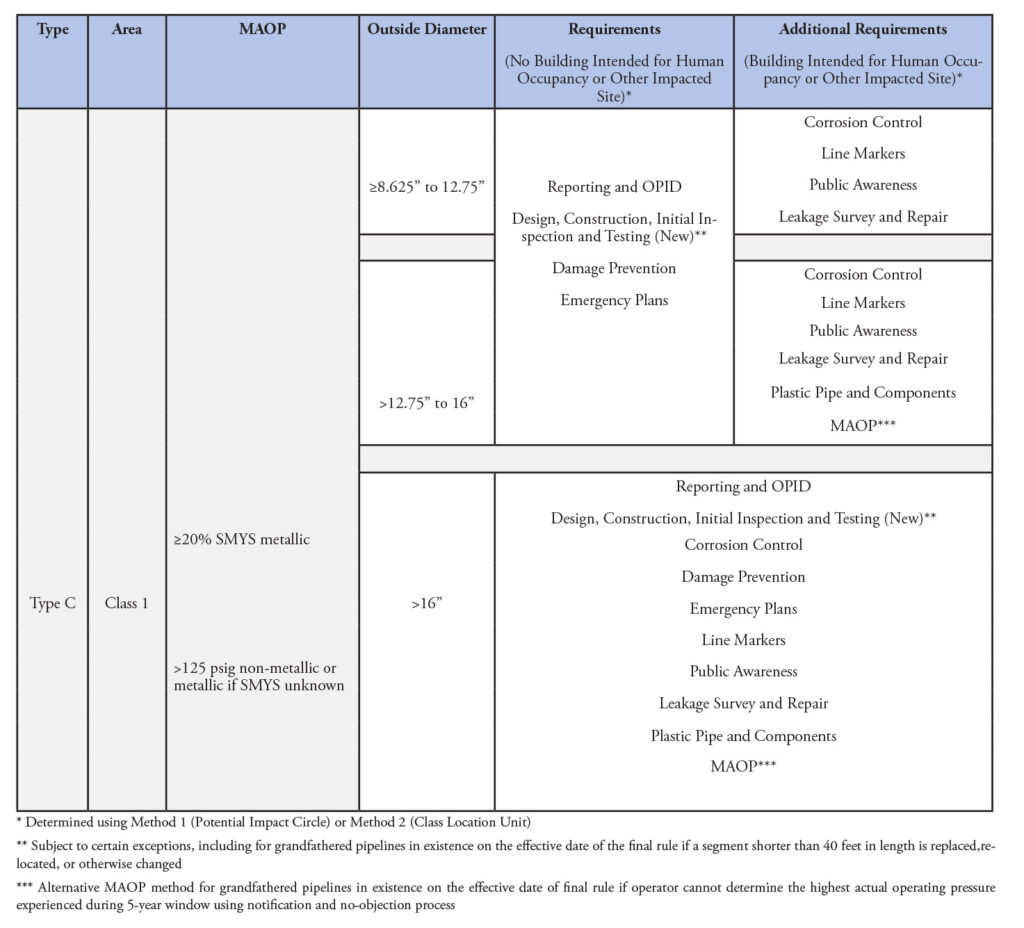
The final rule creates a new category of regulated onshore gas gathering lines. These gathering lines, known as Type C lines, include onshore gas gathering lines in rural, Class 1 locations with an outside diameter greater than or equal to 8.625 inches and a maximum allowable operating pressure (MAOP) that produces a hoop stress of 20 percent or more of specified minimum yield strength (SMYS) for metallic lines, or more than 125 psig for non-metallic lines or metallic lines if the stress level is unknown.
Operators of Type C lines are subject to the same Part 191 requirements as Type A and Type B lines and must comply with certain Part 192 requirements for gas transmission lines, subject to the non-retroactivity provision for design, construction, initial inspection, and testing, as well as other exceptions and limitations that vary based on the outside diameter of the pipeline and whether there are any buildings intended for human occupancy or other impacted sites within the potential impact circle or class location unit for a segment. The final rule also provides additional exceptions from certain requirements, including for grandfathered pipelines if a segment 40 feet or shorter in length is replaced, relocated, or otherwise changed. A chart illustrating the applicable requirements is provided below.
In addition to prescribing these new requirements, the final rule authorizes the use of composite materials in Type C lines if the operator provides PHMSA with a notification containing certain information at least 90 days prior to installation or replacement and receives a no-objection letter or no response from PHMSA within 90 days.
Deadlines
The effective date of the final rule is 6 months after the date of publication in the Federal Register. Operators of Type R and Type C lines must comply with the applicable requirements in Part 191 starting as of the effective date, although the first annual report is not due until March 15, 2023. Operators must also comply with the requirement to document the methodology used in determining the beginning and endpoints of onshore gas gathering within 6 months of the effective date, and operators of Type C lines must comply with the applicable requirements in Part 192 within 12 months of the effective date. Operators may request an alternative to these 6- and 12-month compliance deadlines by providing PHMSA with a notification containing certain information at least 90 days in advance and receiving a no-objection letter or no response from PHMSA within 90 days.
Other Considerations
In accordance with 49 C.F.R. § 190.335, administrative petitions for reconsideration must be filed with PHMSA within 30 days of the final rule’s publication in the Federal Register. Petitions for judicial review must be filed within 89 days of the final rule’s publication in the Federal Register or, if an administrative petition for reconsideration is filed, within 89 days of PHMSA’s decision on the petition.
For a more detailed assessment or to discuss the implications of the Final Rule, please contact Keith Coyle at 202.853.3460 or
KCoyle@babstcalland.com, Jim Curry at 202.853.3461 or JCurry@babstcalland.com, or Brianne Kurdock at 202.853.3462 or
BKurdock@babstcalland.com.
Click here for PDF.
Babst Calland has been ranked in the 2022 U.S. News & World Report-Best Lawyers® “Best Law Firms” list nationally in eight practice areas and regionally in 32 practice areas:
- National Tier 2
- Environmental Law
- Land Use & Zoning Law
- Litigation – Environmental
- Oil & Gas Law
- National Tier 3
-
- Bankruptcy and Creditor Debtor Rights / Insolvency and Reorganization Law
- Litigation – Construction
- Mining Law
- Natural Resources Law
- Metropolitan Tier 1
- Pittsburgh
- Bankruptcy and Creditor Debtor Rights / Insolvency and Reorganization Law
- Bet-the-Company Litigation
- Commercial Litigation
- Construction Law
- Corporate Law
- Energy Law
- Environmental Law
- Information Technology Law
- Land Use & Zoning Law
- Litigation – Bankruptcy
- Litigation – Construction
- Litigation – Environmental
- Litigation – Land Use & Zoning
- Municipal Law
- Natural Resources Law
- Water Law
- Charleston-WV
- Commercial Litigation
- Energy Law
- Environmental Law
- Litigation – Environmental
- Oil & Gas Law
- Metropolitan Tier 2
- Pittsburgh, PA
- Charleston-WV
- Mining Law
- Natural Resources Law
- Washington, D.C.
- Metropolitan Tier 3
- Pittsburgh, PA
- Mediation
- Mergers & Acquisitions Law
- Charleston-WV
- Bet-the-Company Litigation
- Litigation – ERISA
- Real Estate Law
- Washington, D.C.
- Environmental Law
- Litigation – Environmental
Firms included in the 2022 “Best Law Firms” list are recognized for professional excellence with persistently impressive ratings from clients and peers. Achieving a tiered ranking signals a unique combination of quality law practice and breadth of legal expertise.
Ranked firms, presented in tiers, are listed on a national and/or metropolitan scale. Receiving a tier designation reflects the high level of respect a firm has earned among other leading lawyers and clients in the same communities and the same practice areas for their abilities, their professionalism and their integrity.
The 2022 Edition of “Best Law Firms” includes rankings in 75 national practice areas and 127 metropolitan-based practice areas. One “Law Firm of the Year” is named in each of the nationally ranked practice areas.
Click here to view the full ranking on U.S. News U.S. News & World Report-Best Lawyers® “Best Law Firms” list.
GO-WV News
By Christopher (Kip) Power
The West Virginia Department of Environmental Protection (WVDEP) is continuing work on rules for permitting of geologic storage of captured CO2 — a necessary (but not sufficient) element in developing a CCS industry.
As discussed in the August GO-WV News, the WVDEP released proposed amendments to its Underground Injection Control (UIC) permitting and related regulations (47 CSR 13) on June 23, 2021 and held a public hearing on the proposed rules on July 23, 2021. Although they include substantial changes to the rules for Class 1 permits (governing hazardous waste injection wells) and Class 2 permits (for enhanced recovery of oil and gas, and disposal of produced water), the rule changes primarily consist of an entirely new section establishing a permitting program for Class 6 wells (those used for injecting carbon dioxide for the purpose of permanent geologic sequestration). Those proposed new Class 6 rules are largely modeled on EPA’s detailed “Class VI” regulations promulgated under the federal Safe Drinking Water Act (40 CFR 146).
Ten organizations (including GO-WV and several environmental/citizen groups) filed comments on the draft amendments, and a few of their representatives spoke at the hearing. By letter dated July 23, 2021, the WVDEP released copies of the written comments it received, along with its responses. There was a total of 10 comments that the WVDEP considered to be meritorious enough to alter the proposed rule language in minor ways, almost all of which consisted of typographical errors (along with the elimination of the use of Roman numerals for identifying the “classes” of permits). The final agency-approved rule proposal was filed with the Legislative Rule-Making Review Committee on July 30, 2021 (incorporating most, but not all, of the edits mentioned in the WVDEP’s July 23 letter).
As expected, most of the comments centered on the proposed Class 6 UIC permit provisions. In this regard, the WVDEP acknowledged that it is seeking to incorporate the Class 6 provisions (new section 13) so that the approved regulations may be included as a part of an “Application for Substantial Program Update” to be filed with the EPA, requesting that WVDEP be granted primacy over the Class 6 UIC well permit program. However, for the most part the WVDEP found that concerns raised by commenters pertaining to this aspect of the regulations either addressed matters within the agency’s discretion under the rules as drafted or exceeded the scope of the UIC program. Those topics deemed to be beyond the scope of the regulations include pore space ownership (or “subsurface trespass”) concerns, enhanced set-back requirements for Class 6 projects located near sensitive areas, “liability for accidents,” and the potential transfer of liability to the State for a completed CO2 sequestration site.
The WVDEP did address two Class 6-focused comments. First, it noted that the Division of Water and Waste Management has tentatively agreed to the terms of a Memorandum of Understanding (MOU) with the West Virginia Geological and Economic Survey (WVGES) to review each application for a Class 6 well permit related to geologic matters, including seismicity. Although the WVDEP believes “the likelihood of induced seismicity is low,” its application for primacy over the Class 6 program will specify that no Class 6 permit application will be considered for approval until after such a WVGES review has been completed. Second, the WVDEP stated that it will await approval of primacy over the Class 6 well permit program, and some actual experience with processing Class 6 well permit applications, before it considers whether to seek a supplemental source of funding for the additional administrative burdens imposed by that program.
In short, the WVDEP’s proposal to amend its UIC regulations to incorporate the Class 6 UIC permit program, which is an important undertaking and will be a key part of application for primacy over that program, is moving along in the rule-making process. However, vesting authority in the WVDEP to issue such permits in West Virginia will almost certainly not be sufficient in and of itself to incentivize the development of carbon dioxide injection and sequestration projects of any significant size.
As other states have done (e.g., North Dakota, Texas), it is reasonable to expect that the West Virginia Legislature will need to enact statutes establishing some fundamental property and liability principles that will govern this new industry before any organization will seek a Class 6 permit to construct a sequestration facility here. Given the number of recent federal legislative proposals that promote the use of some form of carbon capture and sequestration as an important part of the country’s evolving energy policy, and the substantial additional funding that will presumably be available to support such projects, it would appear there is no time to waste in developing those complementary laws.
Click here to view the article online in the November issue of GOWV News.
Smart Business
(by Sue Ostrowski featuring Moore Capito)
For years, the banking industry has functioned in the same ways it always has. But FinTech — financial technology — is revolutionizing the way things are done and increasing access to financial tools for those who may not have previously had it.
“At its core, FinTech is when you have the convergence of an emerging technology and a financial service,” says Moore Capito, shareholder at Babst Calland. “It’s using innovation to compete with traditional methods of delivering financial services.”
Smart Business spoke with Capito about how FinTech is revolutionizing the financial industry, the opportunities it presents and challenges it poses.
How is Fintech Changing the Financial Industry?
There are a lot of unbanked, or underbanked, people that have difficulty accessing the traditional banking industry. FinTech products, sometimes in collaboration with a traditional bank, can provide better financial services to these individuals, especially in rural areas where there is less access to bricks-and-mortar banks.
There are potentially endless applications, from insurance to mobile banking, cryptocurrency, investment apps, and financial products including mortgages — the most well-known being PayPal. The onset of COVID accelerated the necessity and the willingness to adapt with FinTech, doing more transactions remotely from phones and bringing finance directly to individuals, instead of individuals going to a physical banking location.
On the economic development side, entrepreneurs are coding programs that create the functionality behind the apps. And states such as West Virginia have created regulatory sandboxes for FinTech entrepreneurs. These let participants apply to come in and test their products in the marketplace without going the traditional regulatory route, allowing them to become viable and ready for commercialization before becoming regulated by state agencies. It gives them two years to be able to exist with greater leniency and more flexibility, to be leaner and nimbler to develop their products.
What are the Challenges of Fintech?
Traditional finance wants to protect itself against changes to how it operates, which can be a challenge. In a lot of states, the banking industry is slow to move. It’s a conservative industry, and it is hesitant to accept change. It has resisted for a long time because emerging technology can be disruptive.
However, we need to be engaging with startup businesses that are innovating. We are living in a changing market, and we need to lean into these changes that are not only moving the industry forward but that are creating jobs. Disruption can be scary for big, entrenched industries. But while it can be intimidating, rising tides lift all ships and everyone becomes better as a result.
The second challenge is to ensure the consumer is protected. By their very nature, some startups fail, and we need to ensure no consumers are hurt in cases where a business doesn’t get off the ground.
What Does the Future of Fintech Look Like?
It’s unbelievable how quickly it’s continuing to grow. Even with a recent downturn in the economy, we’ve seen increased investment; the venture capital community is investing billions of dollars in a year where there has been quite a bit of handwringing. While technology and disruption can be scary, these products, once tested and trusted, create conveniences that are making people’s financial lives happier and healthier.
The entrepreneurial community in the FinTech space is very vibrant, and they are attracted to places that want them. We have created a very welcoming and forward-thinking space for entrepreneurs that only not serves the state and the wider region, but that also has a global impact.
For full article, click here.
For the PDF, click here.
Environmental Alert
(by Matt Wood and Mackenize Moyer)
On October 18, 2021, the U.S. Environmental Protection Agency (EPA) released its comprehensive strategy for addressing per- and polyfluoroalkyl substances (PFAS), “PFAS Strategic Roadmap: EPA’s Commitments to Action 2021–2024” (Roadmap). PFAS are a large group of manmade chemicals that have been widely used in various consumer, commercial, and industrial applications since the around 1940s and more recently have been discovered in environmental media (e.g., groundwater), as well as in plants, animals, and humans. PFAS do not tend to break down naturally, and evidence suggests that exposure to PFAS can lead to adverse health effects. As such, the EPA Council on PFAS, established by EPA Administrator Michael S. Regan in April 2021, developed the Roadmap to “pursue a rigorous scientific agenda to better characterize toxicities, understand exposure pathways, and identify new methods to avert and remediate PFAS pollution.”[1]
The Roadmap highlights EPA’s “whole-of-agency” approach, that includes proposed actions across program offices, as well as the PFAS “lifecycle” (i.e., activities that occur prior to PFAS entering the environment, such as manufacturing). EPA’s “Key Actions” illustrate this approach and are informed by one or more of the Roadmap’s three central directives: (1) Research; (2) Restrict; and (3) Remediate. A selection of the Roadmap’s Key Actions is summarized below.
Office of Water
- Establish a National Primary Drinking Water Regulation (NPDWR) for PFOA and PFOS – In March 2021, EPA published the Fourth Regulatory Determinations, which included a final determination to regulate PFOA and PFOS in drinking water. EPA expects to issue a proposed NPDWR for PFOA and PFOS in fall 2022. A final regulation is anticipated in fall 2023.
- Reduce PFAS Discharges through NPDES Permitting – EPA is seeking to use existing NPDES authorities to reduce PFAS discharges at the source. Proposals include monitoring requirements at facilities where PFAS are expected or suspected to be present in wastewater and stormwater discharges and issuing new state permitting guidance. These proposals are expected winter 2022.
- Restrict PFAS Discharges from Industrial Sources through a Multi-Faceted Effluent Limitations Guidelines (ELG) Program – By 2024, EPA plans to make significant progress in its ELG regulatory work by addressing PFAS from specific industrial sources. As examples, EPA intends to: (1) Develop rules to restrict PFAS discharges from industrial categories, where existing data support it (e.g., plastics and synthetic fibers); (2) Study facilities where EPA has preliminary data on PFAS discharges (e.g., electronic components); and (3) Complete data reviews for industrial categories for which there is little known information on PFAS discharges (e.g., plastics molding and forming).
- Finalize Risk Assessment for PFOA and PFOS in Biosolids – By winter 2024, EPA intends to complete a risk assessment to determine whether to regulate PFOA and PFOS in biosolids.
Office of Air and Radiation
- Build Technical Foundation to Address PFAS Air Emissions – No PFAS compounds are currently listed as hazardous air pollutants (HAPs), but EPA is building the technical foundation to inform future decisions, e.g., identifying sources of PFAS air emissions; developing and finalizing monitoring approaches for measuring stack emissions and ambient concentrations of PFAS; and developing information on cost-effective mitigation technologies. EPA expects to evaluate mitigation options, including listing certain PFAS as HAPs and/or pursuing other regulatory and non-regulatory approaches, by fall 2022.
Office of Land Emergency and Management
- Designate PFOA and PFOS as CERCLA Hazardous Substances – EPA intends to publish a proposed rule to designate PFOA and PFOS as CERCLA hazardous substances in spring 2022 (with a final rule expected summer 2023). These designations would require facilities to report PFOA and PFOS releases above applicable reportable quantities and allow EPA to use additional enforcement and cost recovery authority, including potentially “reopening” previously remediated Superfund sites.
- Issue Advance Notice of Proposed Rulemaking (ANPR) for Various PFAS under CERCLA – EPA expects to issue an ANPR in spring 2022 to propose designating other PFAS as hazardous substances under CERCLA and to seek input on designating precursors, additional PFAS, and groups or subgroups of PFAS.
Office of Chemical Safety and Pollution Prevention
- Develop National PFAS Testing Strategy – EPA is developing a national PFAS testing strategy to address data gaps regarding PFAS toxicity and better understand potential hazards from categories of PFAS (most PFAS have little or no toxicity data). EPA intends to use its TSCA authority to require PFAS manufacturers to fund and conduct additional studies, with the first round of test orders on selected PFAS expected to be issued by the end of 2021.
Cross-Program Actions, Public Engagement, and Other Developments
In addition to individual programmatic actions, EPA’s “whole-of-agency” approach includes collaboration between EPA offices, utilizing enforcement tools from multiple environmental authorities (e.g., RCRA, CERCLA, the Clean Water Act, and TSCA), to identify and address past and ongoing PFAS releases from various sources. These tools include, among other things, conducting inspections, collecting data, and issuing information requests, as well as addressing or limiting future releases, and likely will expand in the coming years. At the recommendation of the National Environmental Justice Advisory Council, EPA will also directly engage with communities in all EPA Regions to understand the impacts of PFAS contamination on their lives – experiences EPA will rely on to inform the actions summarized in the Roadmap. Similarly, EPA has identified developing meaningful educational materials as an important tool to assist the broader public in understanding PFAS and their potential risks. To keep stakeholders informed, EPA will report annually on its progress implementing the Roadmap’s actions.
Recent developments indicate that EPA aims to move swiftly to accomplish its goals. One week after releasing the Roadmap, EPA announced that it had finalized a human health toxicity assessment for GenX chemicals (a subset of PFAS), which the agency identified in the Roadmap as a fall 2021 goal. The finalized assessment represents a preliminary step toward developing health advisory levels (HALs) for GenX under the Safe Drinking Water Act, an action that EPA expects to complete in spring 2022. Although HALs are informational in nature (i.e., they are non-regulatory and non-enforceable), their development could be an interim step toward EPA establishing NPDWRs for GenX chemicals.
On October 26, 2021, in response to a petition from New Mexico Governor Michelle Lujan Grisham, EPA Administrator Regan announced that EPA plans to initiate two rulemakings to address PFAS. Under the first rulemaking, EPA will propose adding four PFAS as RCRA Hazardous Constituents, PFOA, PFOS, PFBS, and GenX, making them subject to corrective action requirements (such a designation would also inform future efforts to regulate PFAS as a listed hazardous waste). The second proposed rulemaking, related to the first, will clarify in applicable regulations that emerging contaminants such as PFAS (that meet the statutory definition of hazardous waste) can be cleaned up via the RCRA corrective action process. EPA Administrator Regan specifically highlighted these proposed rulemakings as part of EPA’s broader strategy to address PFAS contamination.
Conclusion
The Roadmap represents EPA’s broadest strategy to address PFAS since the agency released its 2019 PFAS Action Plan. That is, it sets specific timeframes to accomplish a range of identified actions that span multiple EPA offices, various statutory and regulatory programs, and the “lifecycle” of PFAS. Moreover, as many of EPA’s actions represent preliminary or interim steps in their respective regulatory processes, and as EPA continues to gather data on PFAS, stakeholders likely can expect the Roadmap to evolve over time as EPA accomplishes its goals (e.g., EPA may add new, future actions).
Despite the speed at which EPA and the Biden administration appear to be moving to address PFAS, many states have developed (or are currently developing) their own applicable regulations. For example, in recent years, New Jersey set maximum contaminant levels (MCLs) in drinking water for PFOA, PFOS, and PFNA, and designated all three compounds as hazardous substances under state law. In Pennsylvania, the Department of Environmental Protection is in the process of proposing MCLs in drinking water for PFOA and PFOS. In short, while EPA implements its strategy over the coming months and years, relevant parties in many states have been (or will be) operating under applicable state regulations. The Roadmap and related materials are available on EPA’s website here.
Babst Calland will continue to track EPA’s proposed actions (and other developments, e.g., at the state level) and are available to assist you with PFAS-related matters. For more information for this or other remediation matters, please contact Matthew C. Wood at (412) 394-6583 or mwood@babstcalland.com, Mackenzie Moyer at (412) 394-6578 or mmoyer@babstcalland.com, or any of our other environmental attorneys.
_____________
[1] PFAS Strategic Roadmap: EPA’s Commitments to Action 2021–2024, 6.
Click here for PDF.
Renewables Law Blog
(By Bruce Rudoy)
 NextEra Energy Inc.’s CEO, Jim Robo, has pushed Congress to extend clean energy tax credits as the company announced record renewables contracts and a major hydrogen project yesterday. Robo said odds are “reasonably high” of an extension if a consensus can be reached on what would be in the reconciliation bill. There is wider support in Congress to expand clean energy tax credits compared to the proposed $150 billion Clean Electricity Performance Program or carbon pricing. Other proposals have included a broad clean energy tax overhaul that some large energy companies say they support. “If something happens there, we feel good about the fact that there will be a long-term extension of the credits,” Robo said, adding that he foresees tax policy support for hydrogen and energy storage investments. “It would be very constructive for us.” As one of the world’s largest renewable energy developers, NextEra has a lot to gain if the Biden administration is successful in financially encouraging wind, solar and other technologies to cut U.S. power sector emissions in half by 2030. President Biden has set the goal of decarbonizing the grid by 2035. “We are increasingly thinking about ourselves as the company that’s going to lead not only the clean energy transformation of the electric grid but really the clean energy transformation of the U.S. economy and the decarbonization of the U.S. economy,” he said. The way Robo sees it, a low-emissions grid is critical to decarbonizing the transportation and industrial sectors. The falling costs of renewable resources combined with utility, corporate and state goals aimed at cutting emissions are driving large-scale projects nationwide. NextEra’s renewable energy unit signed a record 2,160 megawatts of solar, wind and storage projects during the third quarter, the company said during a conference call with Wall Street analysts. This includes 1,240 MW of new wind projects, the largest amount signed during a three-month period in the company’s history, said Rebecca Kujawa, NextEra’s chief financial officer. Even with the future of tax credits in play, NextEra now has more than 18 gigawatts of signed contracts in its development queue, including more than 7,600 MW worth of projects post-2022.
Electric companies nationwide are targeting hydrogen as a new option for emission-free electricity. Kujawa yesterday said NextEra has inked a deal to build a 500 MW wind project designed to power a green hydrogen fuel cell company. “Green” hydrogen is made from water and renewable electricity. That company wants to build a hydrogen electrolyzer nearby and use the wind power to meet up to 100 percent of its load requirements, Kujawa said. The hydrogen produced would be sold to commercial and industrial end-users to replace their current electricity that comes from other forms of hydrogen and fossil fuels, she said. The goal is to further accelerate the decarbonization of the industrial and transportation sectors, she said. Electric companies are eying expanded used of hydrogen during the later part of the 2020s and the next decade, Kujawa said, because it’s likely that long-duration storage will be developed by then. The transportation sector may be able to take advantage of green hydrogen earlier, however, she said. “The big question mark would be whether or not there’s a hydrogen production tax credit ultimately, in the final reconciliation bill,” she said. She said the $3-a-kilogram PTC “really closes the gap” between natural gas-based hydrogen and green hydrogen. That would create more opportunities to replace gas-based hydrogen with green hydrogen and expand renewable energy options. “We’ll know a lot more in January once we see the final package, if there is one,” she said.
E&E News | Article | NextEra announces record renewables, major ‘green’ hydrogen project (politicopro.com)
Tags: decarbonizing, electricity, emission free electricity, Hydrogen, renewable energy